Category Archives: Guest Bloggers For TSC Awareness Month

Why We’re Thankful for TSC

Day 17 of Guest Blogging for TSC Awareness Month

By Guest blogger Catrina Jones  (Monroe, Louisiana)

Note from Mixed Up Mommy: This was originally a Facebook post in the TS Alliance forum. I asked if I could share it here because I think it’s such a great story.
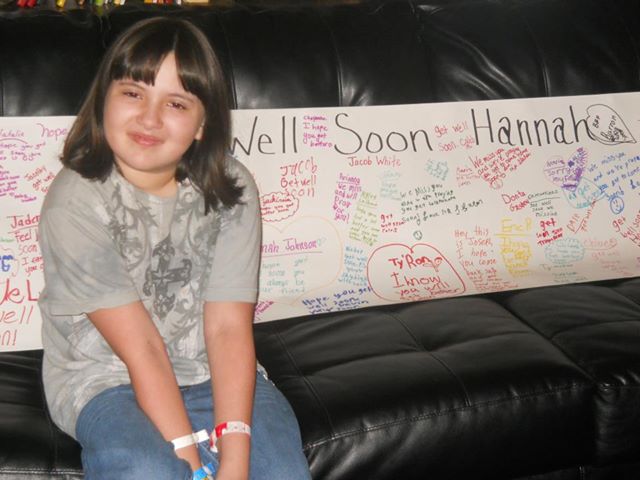
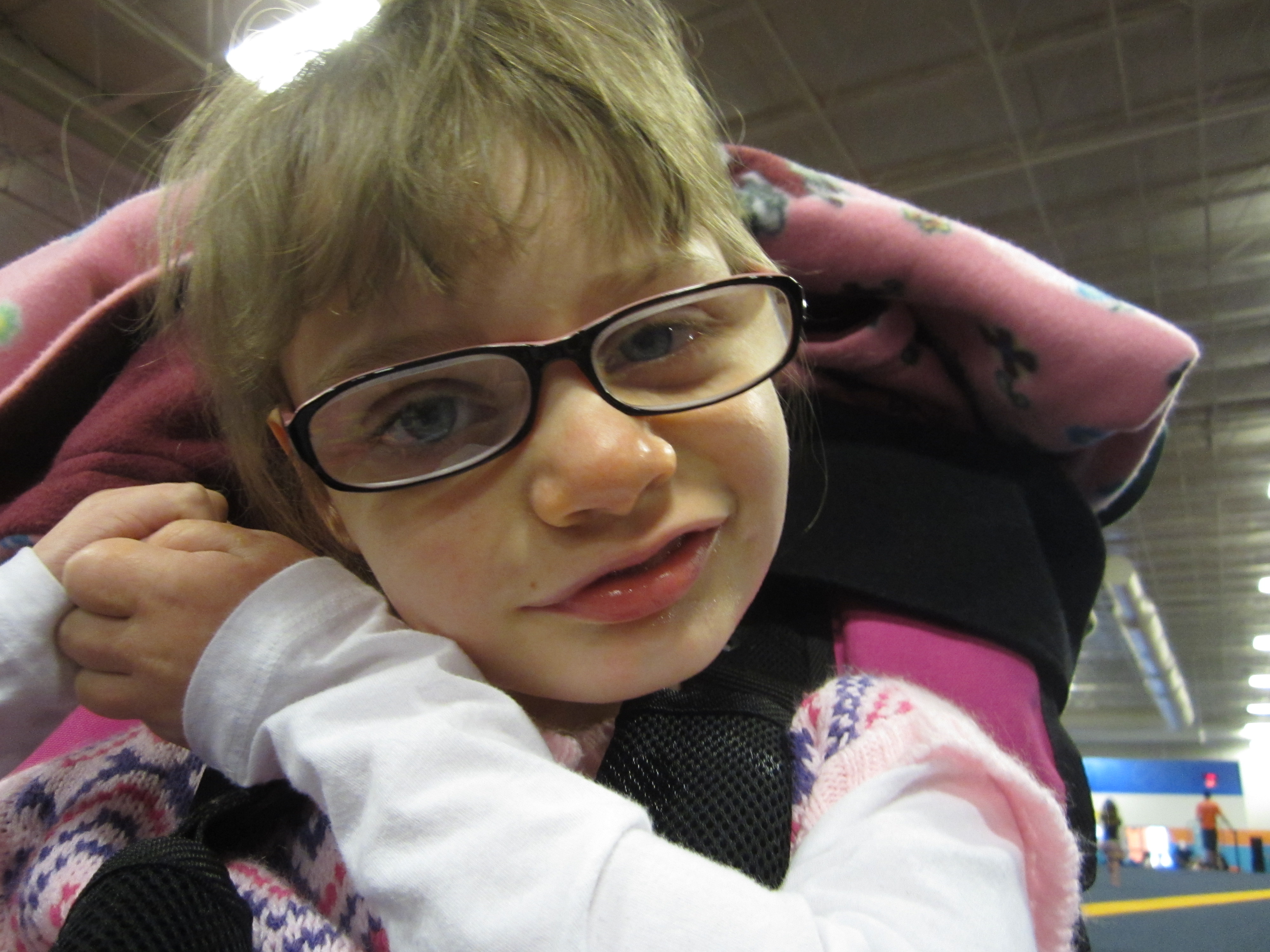
Hannah in August 2012.

My daughter Hannah Grace, now 11 years old, started having infantile spasms at 8 months old. After an EEG was performed, it was determined that she had idiopathic benign occipital epilepsy. We were then referred to a local neurologist a month or so later, who ordered MRI/Brain prior to our appointment. I will never forget the day I received the call with the MRI results from the neurologist’s office where the nurse told me over the phone (while I was at work) that it was suspected our daughter had tuberous sclerosis. She said I needed to pick up the film and report to bring with us to Hannah’s appointment, and the doctor would discuss this further. When I asked her what tuberous sclerosis was, she could not tell me and informed me that the doctor would have to give me that information. I was in such shock and dismay that I dropped the phone at work crying, and a co-worker had to finish the call with the nurse. This co-worker immediately went to the internet and pulled up a fact sheet about TS and began reading it to me. After I composed myself, I called my husband and the rest of our family with this news of our daughter having something we had never EVER heard of. I remember having this huge fear of the unknown. When we took Hannah Grace (who was 11 months old at this time) in to the appointment, the neurologist said that he wasn’t sure 100% she had TSC because of lack of other symptoms, but when he started naming off things associated with TSC, the white patches were present on Hannah Grace. He took the woods lamp and inspected Hannah Grace, and to our surprise, she had a LOT of them on her body. He then said he had to concur that she did have tuberous sclerosis. As for her infantile spasms, he ordered her phenobarbital. Later on, her IS started developing into partial seizures so Tegretol & Topamax was added to control those.

So, with the new diagnosis of TSC, began a life of yearly testing and doctors visits. Since Hannah Grace was so young when she was diagnosed, we were unsure of the severity of her TSC. Did she have a mild case or was hers more severe? She was meeting milestones at her regular pediatric checkups, so we were hoping that by controlling the IS, just maybe she would live normal life. She does have some mild developemental/learning/cognitive delays, but at 11 years old, she is pretty much living a normal life that TSC says she should not be living. She has been seizure free for eight years now, and we could not be happier with her progress and accomplishments . She has overcome so much in her life. But our story doesn’t stop there.

Where most of you hate/despise TSC, our family is THANKFUL for it. You see, it was because of Hannah Grace having TSC that we went to her yearly checkup with the neurologist this past July. Actually, it was a six-month checkup, because we had been weaning her off of Topamax, since she has been seizure free for so long. The neurologist always runs labs to check her medicine levels. Those labs that day came back to show Hannah Grace had extremely low white blood counts, and it was thought she was developing a virus. We were told to take her to her pediatrician for a followup to let them check her for mono or other viruses. We went into the office the next day, and they re-ran her labs to find that her counts had dropped even more. They tested for numerous viruses and all came back negative. We were sent home in hopes that she had some type of virus that she would rid itself over the next week, and were told to come back later for repeat labs. The following week, her counts were even lower than the week before. The pediatrician was baffled because Hannah Grace showed no signs of being sick, yet her counts continued to decline. We were sent home under strict isolation and told if she developed a fever to get her to the ER. That night brought the fever and an ER visit. She was admitted to the hospital where our new journey was just beginning.

For two weeks in the hospital, Hannah Grace fought extremely high fevers, developed a rash, and her chemistry levels began to fall. She eventually ended up in PICU, where the
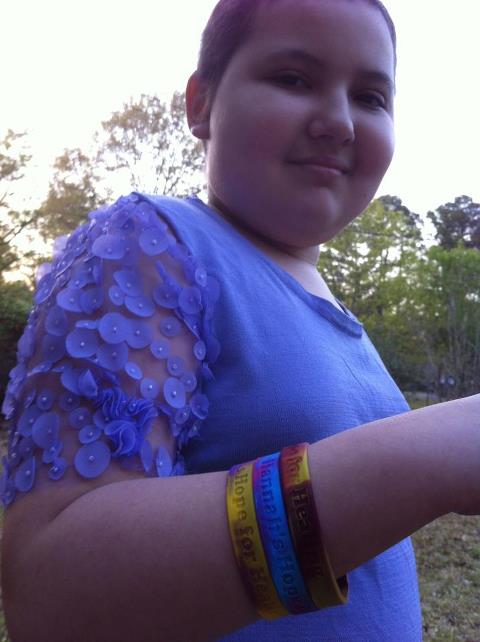
A recent photo of Hannah Grace.

MD told me she was critical and needed to go under a pediatric hematologist because her counts had bottomed out. It was determined that we would be transferred to a Baton Rouge Children’s Hospital under the care of a hematologist. When we got there, they believed she had an infectious disease, so tests were run for every infectious disease/fungus there was, and everything came back negative. After a week of this, a bone marrow aspirate was done August 7, 2012, and we were told on August 8, 2012 that Hannah Grace had acute lymphoblastic leukemia. OMG, for a second time in our lives, we were hit with devastating news. Our little girl has cancer. The last ten months of our lives have been spent at St. Jude Children’s Research Hospital & Affiliate fighting leukemia. I would give anything in the world if I could go back in time to the days of her having to deal with just TSC. TSC we were managing and doing well. Hannah Grace is in remission, but she will have to be in treatment for the next 2 1/2 yrs to make sure she is completely cured of leukemia. This road has had many difficulties, but we are most THANKFUL that St. Jude has decided to help treat her TSC along with the leukemia. This week, we came back St. Jude because they started Hannah Grace on Rapamune (Sirolimus) to try to shrink the SEGA and other tumors she has throughout her body (mostly on her brain & kidneys). We are so THANKFUL to have this opportunity, where we probably wouldn’t have had it back home in our small town. God works in mysterious ways!

We invite you all to checkout our pages at:

https://www.facebook.com/LouisianaTuberousSclerosisPage

and https://www.facebook.com/HannahsHopeForHealing.

Humor Gets Us Through the TSC Battlefield

Day 16 of Guest Blogging for TSC Awareness

By guest blogger Renee Seiling  (Westbury, New York)

tsc walkMy husband and I married in 2007 after dating for over six years. We always planned to try and start a family in September 2008, and we did get pregnant that month. But we never planned for our daughter to be born with an incurable disease.

May 15, 2009 we heard devastating news; they found rhabdomyomas on our unborn daughter when we were 35 weeks pregnant. That is when we first heard the words tuberous sclerosis. I remember crying at home that night and my husband said to me “She can feel everything from you. You are stronger than this and she is going to get her strength from you, so no tears, so she’s as tough as you are.” He was right, so I started doing research, met with genetics doctors, cardiologists and had sonograms every 3 days to check on her. They induced our pregnancy three weeks early and admitted her to the NICU.

It was so hard to not have your baby in the room with you and having to go down to the NICU for feedings and for the doctor’s rounds. But the hardest was watching the days when babies were not well and they would be crashing right before your eyes. I did not know any of the moms there, but we all felt for each other. Seeing babies that have lived there for four months made you realize that you did not have it so bad.

When she was 4 days old a brain MRI confirmed TSC. Zoey was born with countless tubers on her brain and a subependymal giant astrocytoma (SEGA) as well. We were told by her neurosurgeon that it is the second largest SEGA he has ever seen, lucky us.  Fortunately we were also told that if it ever grew it is operable. Zoey had blood work to find the strand of TSC she might have and at 8 weeks old it was confirmed she has TSC-2.

We had Zoey start early intervention when she was 4 months old, one of the greatest decisions we ever made. She was granted physical therapy, and we met Sonny. Sonny was Zoey’s first best friend. He came to our home 3 times a week, and Zoey just loved him. He helped us through all of the hard times. He was there for her no matter what. When we intubatedmoved from Queens, NY to Long Island, he even followed us. He made sure he found a company that also worked with Long Island early intervention so he could stay with her. He was with us for 3 years, and I cried on his last day. He will always be remembered.

Zoey also had speech therapy and occupational therapy at home three times a week. We met Hadiah, a no nonsense OT who always made Zoey work harder and still have fun, and Kelly, her speech therapist ,with whom Zoey fell in love with immediately. Her bubbly personality helped Zoey sit through her 45 minute sessions.

Zoey is developmentally delayed; she has been going to school since she was 2. Zoey has a team of therapists and teachers that have helped tremendously. Zoey can wave hello and goodbye, blow me a kiss, give high fives, climb stairs, run, jump and loves spinning to get herself dizzy. These are simple gestures that I thought she was never going to be able to accomplish. While she is non-verbal, we always have hope that one day she might find her voice.

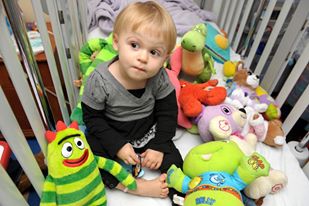
Zoey has been through more in her four years of existence than most go through in a lifetime. When she was 6 ½ months old she started having infantile spasms, I remember calling the on-call pediatrician because it was a Sunday, and she told me, oh she’s probably just teething. Zoey would cry, and when she stopped, her arms would go above her head and her thanksgiving at columbia presbyterianeyes would roll to the back of her head while her legs crunched up. I knew it was not teething, so I called her everytime she had a spasm and had an EEG appointment made in two days.

Zoey spent her first Christmas Eve in the hospital and started a steroid, ACTH. I had to give her an injection every morning in her thigh. I remember the first time I had to do it at home. My dad came over to help me and hold her leg because I was so scared she was going to move. Lets face it, this steroid was a nightmare. All she wanted to do was eat, sleep and poop. But thankfully, because of the TS alliance, I was able to make contact with a fellow TSC mom, Cindy. She helped me get an appointment with a new neurologist, Dr. Orrin Devinsky, at NYU. He wanted her to start Sabril immediately. I am not even sure if Cindy remembers helping us, or if I ever thanked her enough because with Sabril, Zoey’s spasms stopped after the first dose and she still has to take this medication twice a day.

Zoey’s development had worsened after the spasms. She had a difficult time trying to crawl because she had gained five pounds in three weeks from the steroid, but Sonny, our superhero helped her. She was crawling at 9 months and started walking at 15 months old.

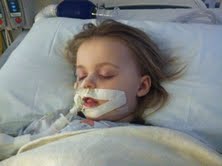
Then when she was 17 months old, Zoey vomited and turned blue. She was rushed to the hospital, where countless medications were given to her, and even a defibrillator was used on her. I thought we were going to lose our little girl. Once they put a central line in her thigh, the medication finally stabilized her after two hours, the longest two hours of our lives. They diagnosed her with Wolf Parkinson’s White, an extra electric charge in your heart causing dysrhthmia.  Zoey spent eight days in the hospital trying to find the right dose and right kind of medication to help keep her heart beat at a normal rate. She takes flecainide and amiodarone still, just to maintain her rhythm.  We spent Thanksgiving in Columbian Presbyterian Hospital that year, and you know you’re supported when your sisters and brother-in-law show up with Thanksgiving dinner, crockpots and all. We ate a very thankful meal that year for having our Zoey with us.

Well wouldn’t you know it, two days after she was released, Zoey was unresponsive again; we assume it’s her heart and call 911. She gets to the hospital, and it’s now seizures… hospitalized again, and prescribed Keppra. Well that month of December 2010 proved to be a crazy one. I stayed with my parents because they live so close to the hospital. That was a good decision because she had a seizure every 2 weeks that she could not get out of; she was hospitalized a total of eight days in December, including New Year’s Eve.

Some years are good, and some are bad. Last year, 2012, Zoey had some rough seizures. Zoey never gets out of her seizures. She always needs diastat, an emergency seizure medication, to stop the seizure. But then she has shallow breathing so she needs to be intubated…that happened six times last year. Most of Zoey’s seizures have been febrile as her immune system is slightly weakened, since she is on a newly FDA approved drug called Afinitior, a chemotherapeutic drug. Afinitor is prescribed to try and shrink a TSC person’s SEGA. Zoey’s SEGA has shrunk and is now stable. Her doctor said that she still might need brain surgery one day because of how large her SEGA is, but for now, thanks to the medication, she does not need to have any surgeries. We also had her start a vitamin, probiotic, and that seems to help her fight off any illnesses she might receive.

While my husband and I never planned to have a special needs child, we do. Now we just try to keep our sense of humor about everything, and realize she is the strongest person familywe both know. I mean when you get a needle stuck in your arm to take blood for the umpteenth time, and you just look at it, and then just start playing with your iPad like the needle is not there, that’s pretty amazing for any child.

Zoey is also one of the happiest kids you would ever meet. She is always smiling, laughing and hugging everyone. Everything she goes through has not changed her demeanor. She refuses to let TSC run her life and chooses to just be happy. Her outlook on life has helped us keep our sense of humor and live everyday to the fullest.

I like to find the humor in the fact that you never thought you would be writing her teachers asking if she had any bowel movements because of how constipated she gets from her medications. Or your mom texting you that her poop was “hard like little nuggets, I gave her some prunes.”  But it’s humorous and gets me through the hard days.

We try to find the humor in everything we do, even the hospital visits, especially when you are dealing with doctors who sometimes forget how to talk to parents. Zoey had been intubated and was being moved to PICU when her tube came out and she started crashing in the hall. They had to rush her back to the ER to fix it. Everything was fine in a few minutes, but the ER doctor turns to me and goes, “Well that was scary, huh?” Really doc, is that appropriate to say to the worried mom? And then he high fives your husband and says ,“Until next time.”  Your husband just replies back “Well, I hope not.”

Nurses have also told us that we are the calmest parents they have ever met. We have learned in Zoey’s 26 hospitals stays to just kind of stay out of the way, let them do their job and when she is stable you can hold her hand and lay with her. We remember a nurse saying, “You guys are amazing. I mean you are sitting here watching and just waiting patiently, when we have moms here who have a kid that stubbed a toe and they are freaking out.”  See, humor gets me through these times.

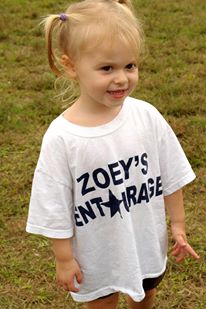
Our family refuses to receive a “pity party”. Instead of people feeling sorry for us, we decided to try and raise awareness for an unknown disease. We have attended the TSC walk in Wantagh Park, NY every year it has existed; this will be the fourth year. Our team is Zoey’s Entourage. All of our family and friends come and support TSC and our team has raised over $15,000.00 for the TS alliance. This year the walk is on September 21, 2013. You can find our team page below, with pictures of Zoey and her story:

http://my.e2rm.com/personalPage.aspx?SID=3720000&LangPref=en-CA

We’ve also met an amazing family, the Spears, whose daughter, Ally, also has TSC and they are the chair people for the Wantagh walk. Their family has a fundraiser every year for TSC before the walk to raise donations. We finally got to attend last year and donate some baskets for the raffles. It was a great time. I met fellow TSC families, watched people empty their pockets for an unknown disease, and win a couple of baskets as well! If you are in the NY area and want to get out and have a good time, and raise donations to help find a cure, join us or if you know a company or yourself would like to donate items to for the raffles, contact me and I can give you some information:

August 12, 2013 from 6PM-11PM.

The Nutty Irishman

323 Main Street

Farmingdale, NY 11735

 Just $10.00 entry fee, for a fun time, with live music, raffles, Chinese auctions, food and a cash bar.


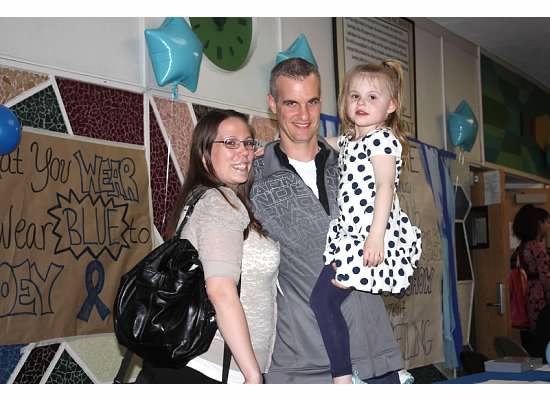
This year our local High School’s Key Club had a fashion show honoring Zoey. They were raising donations for our family’s medical expenses and helped raise awareness for TSC. The halls were covered in blue TSC ribbons and the crowd there was their largest yet. Even the elementary school wanted to get involved and had a “Zippers for Zoey” day. They all wore zippers and if they did not have one, the teachers put zippers on pins and the kids wore them all day. The Key Club made a video raising awareness for TSC and sharing Zoey’s story. I might be a little biased, but it’s the best video ever made, it should win an academy award. The link is below if you would like to learn a little more about TSC:

http://www.youtube.com/watch?v=PEK9N4NgwEY

Our family will always raise awareness and give everything but up in trying to find a cure. Zoey has had seven MRI’s (so far), been intubated six times, has had 14 EEG’s, and too many blood tests to count, but she gets up from all of her procedures with a smile on her face. So we just take it one day at a time. Some days are harder than others, but Zoey does not let that bring her down.  She gives the greatest hugs in the world and is our warrior. I can listen to her laugh all day long. So no pity party please; we are way too busy laughing, hugging and smiling the day away.


Renee

Email: Rseiling3@gmail.com

An Eleven-Year-Old Takes on Capitol Hill

Day 15 of Guest Blogging for TSC Awareness Month

By guest blogger Jennifer Silva  (Prince George, Virginia)

TS walk and KD 016Most people never forget the day something tragic happens to their child.  Little did we know September 19, 2002 would put us on a never ending journey.  What started out as a normal morning that day, ended in exhausting weeks and months of the unknown.  My first child Jared was born five weeks premature, after complications of preeclampsia.  Even though he made his debut into the world much earlier than anticipated, he was the image of health.   He weighed 5 lbs and 15 ounces, with healthy lungs and heart.  He incurred a small bout with jaundice, but other than that everything was seemingly great.

On September 19, 2002, Jared was approaching 9 months old.  He played that morning, with no warning signs of what was about to happen.  Shortly after he laid down for his nap, I heard a very odd sound coming from his room.   After a few moments, I went to see what the sound was. I was in total shock at the sight in front of me.  Jared was in a full seizure, jerking about in his crib, and foaming from his mouth.   His dad was home at the time and called 911.   It seemed like an eternity, before the ambulance arrived.   That seizure lasted more than ten minutes.   Once at the hospital, doctors weren’t sure what had caused his seizure.   His cat scan revealed what was thought to be blood.  He was transferred to a larger hospital, into a PICU unit.

 An MRI was done and we were told he had bleeding on his brain.   After several days in the PICU, hospital social workers started questioning us as to what had happened to Jared.   Jared moved down to a step down unit, and things started to get weird.  We were being treated very oddly.   Jared had been at the hospital for a week, when the local sherriffs’ department showed up and said that someone at the hospital had reported a possible shaken baby case on us.  We were in total shock. Within days we were in court being asked by a judge if this had occurred.  Of course it hadn’t.  They put the poor child through a whole body x-ray to see if any broken bones had healed over from past injuries.  The case was considered unfounded, and we left the hospital with Jared after close to two weeks has passed.  The watchful eye of social services followed.

Months went by and Jared did well on his anti-seizure meds.  An MRI follow up was done, and to our surprise, the blood was still there after months.  That’s when they knew there had been a terrible mistake.  Jared had a tuber, not blood.  A little more time went on, and at Jared’s next visit, it was discovered that Jared had odd white spots on his back under a wood’s light.  That’s when the words tuberous sclerosis came up.   Of course, back then there really wasn’t that much info out on the web, and most of it was very traumatic information.

Jared went on about his childhood under the watch of his neurologist.   He did very well, with few seizures and few tubers.  As he got older things did change some.  The skin abnormalities have come out (angiofibromas, café au lait, depigmentation, some forehead plaques), and some learning problems have been noticed.   Jared did so well on the seizure side of things; he went for years without an MRI.  Everything changed on December 26, 2011.  Jared started having seizures and was rushed by ambulance to the hospital because he wasn’t breathing.    It was determined that he had strep throat and had outgrown his seizure med levels.  An MRI was done, and they found a SEGA.  The SEGA didn’t cause the seizure, but it most likely wouldn’t have been known about, if not for the seizure, until it caused problems.

Initially he was just watched, but then we saw a pediatric oncologist who ordered a new MRI.  It had been eight months since the seizure sets, and Jared had three SEGA’s by then.  He started afinitor, and as of March 2013, his SEGAs have drastically shrunk.  In June he will have a new MRI and go from there.   Jared accompanied me to the March on The Hill in 2013.  He saw how government works, and was amazed at all of it.  We have had several publications about our story recently and I am glad to see TSC getting attention.   When I took on Chair of the TS Alliance of Virginia, I knew then that I would have an uphill battle. But with a little effort change can happen.   Jared is a typical 11-year-old child now; he has some issues, but we are grateful for all the new advancements in TS world.   His father and I divorced years ago and have given Jared a large extended family.    Jared is a special child, with lots of family supporting him.

I know one day he will help out others. He helped me stuff and mail out envelopes for our Virginia Educational Meeting in June.  He said, “Wouldn’t it be great if all these people showed up to support TS?”  The world needs more caring, compassionate 11-year-olds like Jared.

Fighting for My Child

Day 14 of Guest Blogging for TSC Awareness Month 

By guest blogger Jessica Sharon  (Virginia Beach, Virginia)

I will never forget that day in November three years ago when my son Joey was diagnosed with tuberous sclerosis at the age of 7. At times it seems like it was only yesterday, and at other times it seems like it was forever go.

I went to wake him up for school like any ordinary day only to find he wasn’t responding to my voice, which was often typical being that he was NOT a morning person; only to roll him over and discover his eyes were rolled back in his head and he began convulsing. My initial thought at first was that he was playing a joke on me as children often do and being silly, but I very quickly realized that was not the case. It was the longest 30 seconds of my life and it seemed to go on forever. When he tried to get out of bed and walk, he immediately fell to the floor and had no feeling in his arms or legs. He began to cry in fear that he couldn’t walk and had to crawl to get around. I called 911 because I had no idea what to do or what was wrong with him. After all, he was a normal healthy child and had never had any health concerns before.

After admission to CHKD (Children’s Hospital of the Kings Daughters) in Norfolk, Virginia and numerous neurological tests, it was determined that he had TSC with lesions on his brain and heart. Thankfully, over time, the spots on his heart just went away, but spots had formed on his kidneys. I had never heard of this disorder before and had so many questions and concerns.

Fast forward three years to May of 2013. He is still averaging 3-4 absence seizures a week while on five epilepsy medications. We have tried just about every epilepsy medication out there to no avail. I always thought the seizures would be the worst of it all, but honestly, it’s the learning disabilities, mood changes, and just the overall change in his personality that has affected him and our family the most. He doesn’t want to be involved in any sports or activities that put him in a position to be surrounded by people with the possibility of a seizure occurring. It was such a struggle and an upward battle to get him an IEP within his school. As parents you truly must fight for them and be their biggest advocate because no one else will. He needed one desperately because his confidence was very low. He never felt smart, and he just struggled every day within the classroom; he is so bright and intelligent, but all the medications just seem to suppress much of that. He will be undergoing resection surgery in June at VCU medical center in Richmond to remove the cyst they confidently believe is causing the seizure activity. There is no guarantee that this will be the end of seizures for him, but as his mother, all I can do is give him the best chance at normalcy and a life free of seizures. After all, isn’t that what all of us want for our children, for them to be happy and healthy?

PIC 3-1

It Could Be Something, But It Could Also Be Nothing…

Day 13 of Guest Blogging for TSC Awareness Month

By guest blogger Alison Walsh  (Buckinghamshire, England)

a few hours oldI was about 16 weeks pregnant and had just been to see my cardiologist about my heart murmur, when he mentioned having the baby’s heart scanned just in case he had a valve defect like mine. I replied that it would be really cool to see a baby’s heart scan as I had never seen one before, and I was never offered a scan with any of my other children. As I wanted to see a baby’s echocardiogram, I mentioned the heart scan to my baby consultant and she said that it sounded like a good idea for just in case, so she sent off for an appointment for me.

I received a phone call from Oxford University Hospital a week later to confirm an appointment. I got a bit nervous for a few days because I thought the heart scan would be at my local hospital. My partner gave me a lot of reassurance that my other children were fine so this baby should be too. At 18 weeks pregnant we were driving to Oxford at 7 am. I was nervous but excited all the way there.

The prenatal heart doctor took her time to scan me, being quite quiet throughout the scan. She just explained and showed us the heart chambers on the screen. After the scan she told us that she may have seen something that she wanted to keep an eye on, but for us to try not to worry as it could be something, but it could also be nothing. She asked us to return in four weeks just so she could be sure.

At the next scan in Oxford, the prenatal doctor brought in a colleague to help her have a look. It was then that she told us that our unborn son had rhabdomyomas (heart tumours) Theo's new hatand she was worried about three of the tumours as they were quite large. Also, one of the tumours was positioned next to his heart valve. The doctor also told us that my baby had a very high chance of having TSC, and the worst case scenario was that he would die before being born.

I went home and cried for a few days, when I suddenly thought that my other children could have TS, and if they did, they were all fine. So my baby would be, too. This thought reassured me until we returned back to the hospital two weeks later and the two doctors were waiting in the scan room for us. They scanned the baby’s heart, then told us that one of the tumours they were worried about was moving in and out of the valve with the blood flow. If the tumour got any fatter, it would get stuck in the valve and stop the flow of blood, resulting in the baby’s death. She made us another appointment and said, “Hopefully, if everything is okay with the baby, I will see you in two weeks.” She gave us a sad smile goodbye.

Well, my heart just broke. I started grieving for my baby as I waited for him to die inside me. I couldn’t sleep or eat for a week. All I did was cry, and when I stopped crying, and he stopped kicking, I cried even more thinking that was the last kick that I would feel him give me. It was the worst two weeks of my life.

Baby Theo was oblivious to my suffering, and he was growing well. Two weeks later, we went back to the hospital where the doctor said she was so glad to see us back, and she had been worrying about us. The tumour was growing longer instead of fatter, and they were still worried about it interfering with Theo’s blood flow as the tumour was causing a lot of pressure in his heart.

I was told that Oxford University Hospital head cardiologists and Southampton head cardiologists had been having a meeting about Baby Theo, and if he survived until I was 30 weeks pregnant, they would give me a c-section and operate straight away.

DSC_0042A few hospital appointments later the cardiologists had another meeting. They decided that as the pressure in his heart was high but stable, and as he was really too small to operate on, they would only do it as a last resort for him. We were told that if he survived until I was 34 weeks pregnant they would take him out then. But I had to have fetal echo appointments every week from 30 weeks pregnant. I was also told to prepare and starve myself before each appointment as I might need an emergency c-section if the pressure in his heart got any worse or if the tumour grew fatter.

The pressure in Theo’s heart grew slowly and steadily but didn’t seem to affect his growth in any way. Theo shocked the doctors again by surviving and thriving. We were told his heart would not take the pressure of birth, so he would be delivered by c-section at 37 weeks all being well. He would have to be in a special care baby unit for three weeks at least as his heart wouldn’t work properly after birth due to all the tumours, but they also explained that the tumours would regress after birth.

After Theo’s delivery he only had to stay in SCBU for three days because his heart was working normally and he was feeding well.

Theo was talked about by so many heart specialists that they all came to visit him in SCBU just to see for themselves how well he was doing. They couldn’t believe it, and one of the doctors even wrote a presentation on him, as they said his heart should not have really coped with all the tumours and their postitioning.

Theo was allowed home on the condition that if he looked strange or blue that we would phone an ambulance straight away, and that he was to go back for appointments every week.

Theo continued to thrive at home. We received confirmation that Theo did have TSC2 when he was three weeks old as they had taken blood from his cord at delivery.

I was ecstatic that Theo was still with me. He was a fighter and had survived against all the odds.DSC_0079

Theo did worry us for a while as he didn’t smile until he was ten weeks old and didn’t give a full on belly laugh until he was eight months old. I am very pleased to say that Theo is growing well, and though he gets a bit behind on his development, he then seems to catch up really quickly.

Theo has ash leaf spots on his legs and belly and sometimes stares off into space, which could be absence seizures. I try to catch them on camera to show the doctors, which is just hilarious as they only last 30 seconds, and by the time I get my camera, he has snapped out of it. He has had an MRI and we know he has multiple tumours in his brain and still some in his heart, but he is the happiest baby around. He’s always smiling. He is 10 months old now and he loves to cruise around the furniture, dribbling on everything as he goes. I think he would walk all day if I let him.

He loves his sleep and has slept through the night since he was a month old. He loves Mickey Mouse and he waves his arms and legs every time he sees Mickey on the television.

We live in hope that TS has affected Theo enough now and won’t affect him anymore.

Love you lots my gorgeous little boy! x x

Our Roller Coaster Journey with Tuberous Sclerosis

Day 12 of Guest Blogging for TSC Awareness Month

By guest blogger Pamela Wolthuis  (Portland, Michigan)

NicolasMy husband Chuck and I were married on May 23, 1997.  I brought one beautiful 4-year-old daughter, Melanee, into our marriage. Little did we know on that day almost 16 years ago, that soon we would be on a journey we never expected, and that Melanee would be the only “healthy” child we would have. (Chuck loved her as his own, from the day we met on a blind date that she went on with us. He would eventually adopt her, as soon as he legally could).   Less than one year later, on May 17, 1998, we welcomed our son Nicolas into the world. He was the cutest little boy I’d ever seen, and the joy of all of our lives.  When he was about four months old, he had surgery for a hydrocele repair.  He seemed to be fine, and then all of a sudden he was bringing his legs up to his chest, almost like he was doubling over in pain.  He would cry, do this jerking with his legs, and it would go on for hours.  Several times we took him to the ER, but by the time they got around to seeing him, he would stop, and they would send us home saying he was fine.  We knew something was wrong, but no one seemed to believe us. I called the surgeon, but he was rude and arrogant, telling me, “He is fine.  What do you want me to do, cut him open again?”

We took him to the family doctor, who agreed with me that if we thought something was wrong, there very well was a problem that we needed to get to the bottom of.  His exact words I can remember to this day:  “Pam, you can have a room full of the best doctors in the world, and you as a mom, know more than them about your child.  If you say there is something wrong, I believe you.”  He sent us on for testing at the hospital.  Nicolas was set to have a ph probe, but while there, a resident looked at our baby, said he would like to do an EEG, and would that be ok?  We said yes, but thought it was a waste of time.  That resident was the one who cracked the case.  I can still remember the neurologist coming into the hospital room and telling us our perfect, beautiful baby boy had a terrible disease called tuberous sclerosis.  He told us Nicolas was having seizures.  He had epilepsy. I vividly remember telling him, “Well, if you know what is wrong, fix it.”  He said he couldn’t, that there is no cure for this disease, and that there really isn’t much even known about it.  He left the room, and I remember just crying, telling Chuck to “tell him he’s wrong.  There’s nothing wrong with our baby’s brain.”  Soon another doctor came in, telling us, “All you can do is take him home and just love him for the three to four years you will have him.”  Yes, he told us our baby would die by the time he was four.  I was inconsolable, and Chuck was feeling like it was his entire fault because he was told he passed the TS gene on to Nicolas.  They could tell, just by looking at him and the angios on his face, that he had tuberous sclerosis.  The angios that he never had a name for up until that point, that he had always worried his baby would have, but that doctors had assured him were no big deal.

When the neuro came back, he told us the other doctor was wrong, and that Nicolas wasn’t going to die.  It took many doctors to convince us that he wouldn’t die, but finally we believed them.  The first doctor who had told us didn’t know and had told us the worst case scenario. Nicolas was started on a seizure med that didn’t help.  The neuro put him on ACTH, a steroid injection given for seizures.  It had terrible side effects and didn’t help our baby.  At the next trip to the family doctor, he told us about Dr. Chugani in Detroit, who was a world renowned expert in TS.  We were so lucky to be so close to him and were able to get in fairly quick.  Nicolas was started on vigabatrin, a drug we couldn’t get here in the US, but had to go to Canada for.  Insurance wouldn’t cover it, and it was expensive, so we went into serious credit card debt to obtain it.  (More than a decade later, we were still paying for it, and finally had to settle it with the credit card companies, ruining our credit, so that we could afford to live.  But we do what we have to in order to help save our children!) It helped, but he still had seizures and was beginning to regress.  He was slipping into his own little world where he wasn’t interacting with us anymore. Dr. Chugani recommended brain surgery.

In June 2000, Nicolas had his first brain surgery.  It didn’t help his seizures, so we were angry and regretted doing it.  Then, all of a sudden, he was interacting again, and our happy boy was back!  The surgery was successful, because even though it didn’t stop his seizures, it helped him developmentally.  In 2003, we were advocating along with Dr. Chugani for more surgery.  The surgical board recommended him, and he had his second resection.  This time his seizures decreased.  He still had some seizures and was still on meds, but he was progressing.

Fast forward another year…..We finally decided to have another baby, with the thinking that God wouldn’t give us two disabled children.  On December 26, 2005, our beautiful MalarieMalarie was born six weeks early.  Within an hour of her birth, she had her first seizure and was diagnosed with TS.  Our hearts broke again, grieving for the “perfect” baby we prayed so hard for.  That is what people who have never been on this journey can never fully understand.  Although, yes, our babies are alive, we still have to go through a grieving process after a diagnosis.  No, our child hasn’t died, but our hopes and dreams for what was supposed to be have died.  We are forced into a place we never intended to go.  But just like the beautiful essay “Welcome to Holland” teaches us, we learn that we are not in a terrible place, just a different place.  So we learn to accept it, and see the beauty and good in it.  It’s not a place we willingly chose, but it’s not a horrible place either.

Over the years our kids have seen more medical professionals than most adults ever do.  Our list includes a neurologist, ophthalmologist, nephrologist, cardiologist, geneticist, gastroenterologist, dietician, neurosurgeon, dermatologist, physiacist, psychologist, psychiatrist, countless occupational, physical, speech, and feeding therapists, and pharmacists. We also have the whole special education team at school. The kids have had home based therapies, school based therapies, outpatient therapies, and soon, possibly inpatient therapy for our son.  We have been fortunate to meet some outstanding professionals, and some have even become our friends.

Nic right before brain surgery.

Today our children are 20, 14, and 7.  Melanee is a happy, intelligent college student who has more compassion than most young adults because of the experiences she has had with her “special” siblings.  We know without a doubt that she will become a remarkable adult, wherever her path in life takes her.  We worry, because when we are gone, she will become the guardian of her siblings, and is this really fair to her?  She will be tethered to them, and they will always be a major part of her life.  She has never once complained, and has reassured us that she WANTS to care for them when we are gone.  We thank God every single day for blessing us with such an amazing daughter!  Nicolas is now almost 15, but functions at a 3-4 year level.  He is autistic, has behavior issues that can occur unexpectedly at any time, is not potty trained, and may never be.  He takes eight different meds for seizures (which are still not completely controlled), behavior, and a nerve problem he just started with after his most recent brain surgery one and a half months ago. He is also the funniest, sweetest boy (when not in meltdown mode) we’ve even known.  His laugh is infectious and comes all the way from his toes!  Malarie is seven, but functions like an infant.  She depends on us for everything.  She is on six seizure meds and still has seizures several times per day.  Like her brother, she cannot be weaned off any of them, because then she starts seizing constantly. She cannot walk or talk.  She can, however, scoot on her butt across a room at an incredibly fast speed, and communicate with smiles and cries.  Her smile can light up a room in no time at all.

This is our crazy, roller coaster journey of tuberous sclerosis.  We go day to day, sometimes minute to minute.  It isn’t always easy, but it isn’t always bad.  Our days are filled with laughter, and sometimes tears.    We have lost friends, and even family, along the way, who can’t understand or cope with the way we live.  Our children will always come first, with no exceptions. We have learned the hard way who we can count on, and who our true friends are.  For that, we are grateful.  We know the miracle of something as small as a smile, or the quiet babbling of a child.  It isn’t a life we anticipated, but it is a life we enjoy, filled with love and acceptance.  In the end, isn’t that what everyone is searching for?

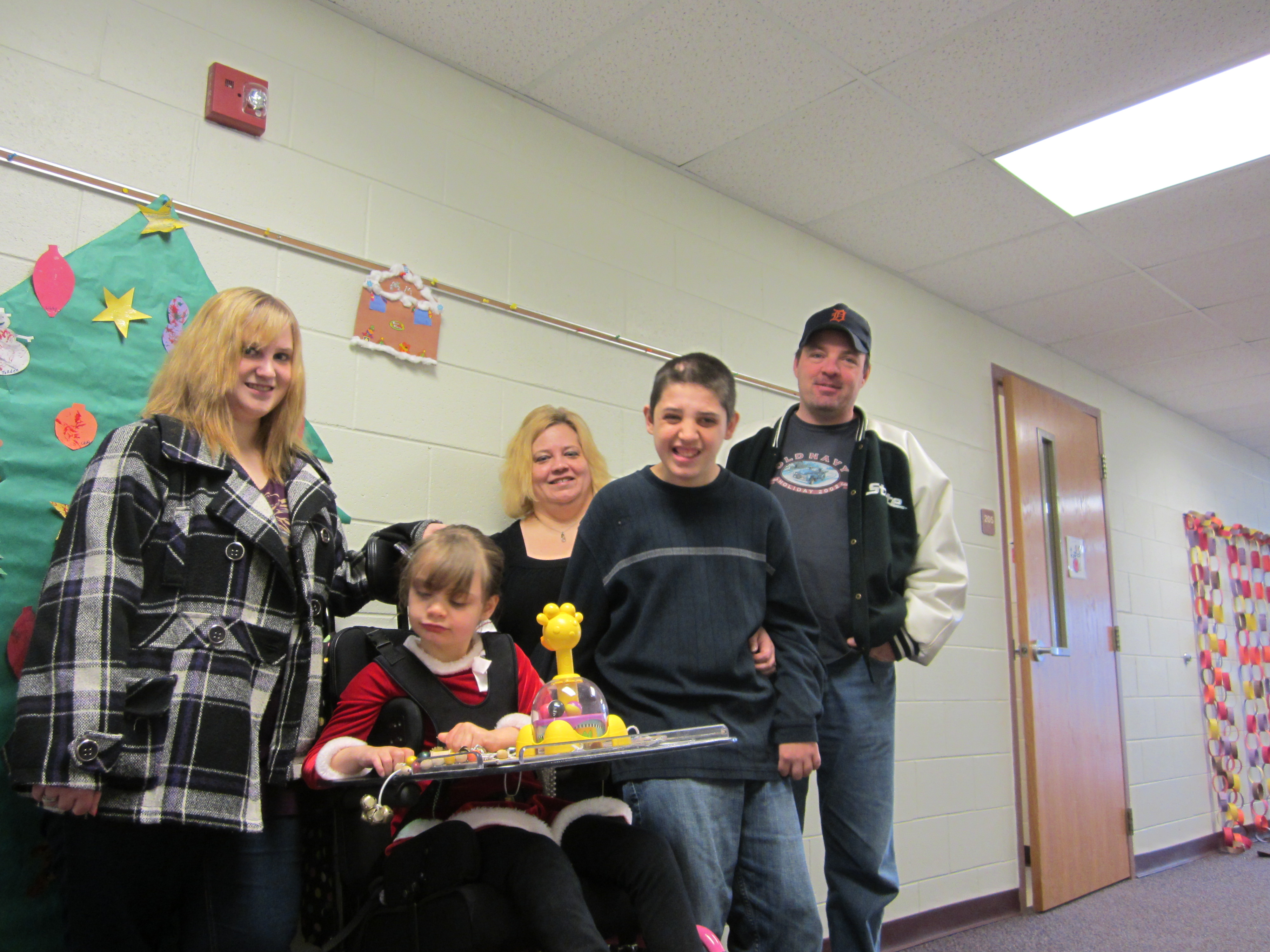
The family at a school Christmas party.

Life With Ricka

Andrea and Ricka ice skating.

Day 11 of Blogging for TSC Awareness Month

By guest blogger Andrea Hubert  (Willis, Michigan)

Everyone has their own story to tell when dealing with TS.  I was too young when Ricka was born to remember how things all went.  I only know them as related by our mom.  Ricka’s TS seems to be a random genetic mutation.  However, that didn’t mean anything when our younger brother began having seizures at the age of 24.  It took many months and several neurologists before they could figure out what was wrong.  Finally someone ordered genetic testing, and he doesn’t have TS.  He has an unrelated seizure disorder caused by something in his brain that was triggered by the long term use of Ultram (tramadol) for serious back pain.  No one tells you that a potential side effect of the medication is seizures, do they?

So, back to Ricka.  She is very severely affected by TS, with autistic tendencies, a mental age of about 15 months, and lots of different kinds of seizures everyday.  Both of her hips and her nose have been broken.  She’s had more stitches, staples, sprains, bruises and bumps than anyone else I know.  She used to be able to walk, but is now too scared.  At school they called her “the escape artist.”  She learned how to open doors, and she was so quiet they eventually had to put bells on all the doors in her building.  I think at one point, she wore bells so they could always find her.  Thankfully, she has never disappeared when I was in charge of her.

For me, life with Ricka is just my normal life.  It’s what I’ve always known.  With only 18 months between us, I was too young when she was born to have learned much about life without her.  The things that I’ve learned when dealing with TS have kept me on my toes as I go through my own health problems, back surgery, and further treatments.  I know when to fight and when to stop.  I know to always be ready for anything.  As a child, I always kept a bag packed with enough materials to keep me, Ricka, and our brother entertained for up to several days.  We never knew when we’d be headed to the hospital, and there wasn’t time to waste gathering stuff to do.  We also didn’t know when someone could come pick up my brother and me, so we had to be ready to stay at the hospital too.  Advances in technology have made it so much easier.  My laptop, Kindle, an iPad with movies on it for Ricka, snacks, and a charger for everything is enough for us now.

When we were young, before my brother was born, Ricka was in the hospital so much that I was allowed to walk around the hospital alone pretty often.  Nurses and other staff members recognized me.  My mom is still proud of the fact that I never got lost and could direct other people around.  Maybe that’s one of the things that helped shape my good sense of direction now. Who knows?

I grew up pretty fast thanks to Ricka’s TS.  I have always been her caretaker, and at nineteen, I became one of her guardians.  It’s a scary thing to be in charge of someone else, but even more so when that person is your sibling, close in age, and so medically needy.  Today, almost nothing freaks me out because I’ve probably seen it in my journey with Ricka or the other folks that I’ve been lucky enough to work with doing care for families.  There are positives and negatives to growing up fast and seeing so many things.  Some days, positives outweigh the negatives, and some days it’s the other way around.

I don’t know what the future holds for Ricka.  I do know that she will always be loved and cared for at home by people who love her.  I know that if something happens to our mom, I will be solely responsible for her.  My brother lives nearly 2000 miles away and doesn’t want to be involved anyway.  I know the importance of planning ahead now.

A Few White Spots

Day 10 of Guest Blogging for TSC Awareness Month

By guest blogger Annaka Vimahi  (Utah)

I have wanted to be a mother as long as I can remember. You can imagine the heartache my husband and I experienced when we didn’t have our first child for almost 9 ½ years. I Baby Viliami 092felt so much joy when our son finally arrived, but I also felt a twinge of fear. I couldn’t explain it. I just didn’t feel that everything was all right. After Nami’s birth I was told both apgar scores were 9, and I tried to have that great news reassure me that we had a healthy boy. It didn’t. I just couldn’t shake the feeling inside me that something was wrong. I tried to convince myself that it was just because I wasn’t used to receiving good news, considering many challenges I’d had up to that point in my life. I tried to tell myself that I was being a pessimistic person and that I should enjoy my dream to be a mother finally coming true.

A couple of significant things happened in the hospital after Nami was born that didn’t seem quite so significant at the time. First, he basically came out arching his back. My mom questioned my dad (Nami’s pediatrician) about it. I could see my dad trying to keep an open mind and discussing many possibilities of why this was. One was that sometimes babies with neurological issues do that. Second, a CNA noticed a weird heart beat and notified the other staff. An EKG was ordered and the results came back as normal. We left the hospital being told we had a healthy baby boy.

I kind of succeeded in being able to relax for the first three weeks of Nami’s life, enjoying lots of cuddle time. When Nami was three weeks old, I took him to my parents’ for my DSC00515 (2)sister to take some pictures of him. Near the end of the photo shoot, I noticed two white spots on the back of Nami’s leg. I am embarrassed of my reaction now, but at the time I started freaking out. I started to cry and ask, “How could my beautiful child have to have such ugly spots on his leg? Are they birthmarks? Is it vitiligo? This is so unfair!”

I remember badgering my dad with questions about the marks. He remained calm like he always does when I’m frantic about something. I told him that I had had a dream about my son having vitiligo and I just knew that’s what it was. He told me not to get ahead of myself, but that he would call the dermatologist and see what he thought. I left that night feeling angry that my son’s physical appearance wasn’t perfect. I thought, “How could this happen to us after we endured so much before he arrived?”

Over the next couple of days I noticed more white spots appearing. (I now know that Nami was born with the white spots, but as his jaundice went down and the pigment of his skin appeared, the white spots started to appear.) We finally heard from the dermatologist who suggested using a cream to see if it was eczema and we could clear it up. I was a bit suspicious that my dad wasn’t telling me everything so I pressed him about what else these spots could mean. He said that sometimes spots like this could be ashleaf spots and are a sign of a very rare neurological disorder, but that he didn’t want me to have to worry about that until we ruled out eczema. I let the issue go, but I felt that my dad was trying to protect me from something he knew was a possibility…something that was really bad.

For the next couple weeks I put the cream on Nami religiously. I checked his spots multiple times a day and even convinced myself at one point that they were getting better. Then I checked the next day and they were still there, as clear as ever. We made an appointment to see the dermatologist. I continued to feel like my dad knew more details than he was telling me. I feel now that he was hoping that he was wrong in thinking that it was TSC and he wanted to get the dermatologist’s opinion before verifying the horrible news.

??????????????

While at the appointment, I could quickly see that we were not going to receive good news. The dermatologist tried to mask his sadness for us as he confirmed that the white spots were ashleaf spots and that he felt our son likely had Tuberous Sclerosis Complex (TSC). He printed off a couple of pages from one of his medical books to read over. I felt my body instantly go numb. I couldn’t believe this was really happening. That night I cried and cried and cried. I hugged Nami tight as my tears drenched his head. The dermatologist and my dad tried to keep reassuring me that there was so much variation within this disease and not to think of the worst. But, there that feeling was again. I knew something was horribly wrong. I felt my child would have it all.

It’s amazing to me how little I knew about TSC at the time considering the knowledge I’ve gained with my new obsession over the last four years. I recorded my thoughts in an email to my family the next day:

“So, what do I know?  This is most likely a genetic mutation that can cause many problems. The problems range from neurological problems such as Parkinson’s and seizures to a 50% chance of mental retardation. ADHD, autism and tumors on various organs such as the brain, heart and kidneys are all possibilities. Major skin problems, eye problems and teeth problems are also possibilities. It’s difficult for us to know what Nami will have to endure until he gets some testing and experiences things as he grows. Dad is a lot more familiar with correct side-effects than I am. My mind is not too sharp right now, so I don’t want to say something wrong. I know the biggest thing we need to do is some genetic testing. It seems that dad also told us of about 5 specialists we’d need to see right away. We’ll need to get an EKG and brain wave test, an MRI and eye testing as well as some other tests that I can’t remember. He will have to get an MRI and eye test yearly. Whew…this is overwhelming!

This summer will be very different than what I expected and it’s only the beginning. I kinda feel like I deserved more of a break than I received with struggles, but I guess that’s selfish. Salesi and I have been through so much and grown through it all. During our most difficult times I felt that we were being prepared for something else. Those thoughts SCARED me but I guess I was right. It seemed quite a pessimistic view on life, but I’ve learned to be very tentative with good news. I’ve learned to try not to get so excited because it seems like disappointment is always around the corner. Throughout Nami’s birth, I took all good news in stride but had a dull gnawing sense that I didn’t know everything. My thinking throughout his short life and in the past has been that our child would be autistic. I am wishing that was it. I am wishing that what was first a disappointing discovery of what I thought were birthmarks were just that. My perspective on life has changed in an instant. Now I can see that ALL the difficulties I’ve experienced in my life have prepared me to be ready to take care of this special child. I am not shocked at this news although I can’t express the heartbreak I feel. I think I was prepared to receive this news so that I would be able to stay sane and make the choices I need to that are in Nami’s best interest.”

0501011136So far it has been a really tough road for us. Nami didn’t get the easier road with TSC (I say that knowing that “easy” and “TSC” do NOT belong in the same sentence). We have been told he has hundreds of brain tumors (no one is able to count exactly how many because there are too many), both cortical tubers and numerous SENs. He has an eye tumor, dozens of heart tumors (including one on his mitral valve which makes his blood kind of backwash), kidney tumors and cysts, and he already has 3 skin manifestations of the disease. He started having infantile spasms when he was 4 months old and has endured seizures most days of his life. He is currently having anywhere between 100-300 seizures daily despite being on 4 anti-epileptic medicines. We have made numerous trips to the ER due to seizures we cannot stop. Most of the time he is admitted. Our son has stopped breathing twice and had to be intubated and life-flighted both times. Nami is autistic. He can only say a few words and most of the time he only says them with prompting. He has major behavioral issues and at times he lashes out and can be destructive. He does not have good sleeping patterns. I feel like Nami would be much worse off were it not for my dad, though, the best pediatrician in the world (no I am not biased =).

I think back on the day I first saw Nami’s white spots. Oh how I wish now that the marks had just been birthmarks. It’s Boys photos 2012 250amazing how perspectives change so quickly. In a few short weeks I went from being extremely vain to wishing for all my son to have is some simple marks on his skin. Despite all of Nami’s challenges, I would not change him for anything. He is the light of our lives. He endures so much yet he smiles and laughs a lot. He loves his little brother. He sees the world in a unique way and teaches us to take time to see things his way too. He brings light to everyone who comes in contact with him. He hugs people. He makes us want to be better people. Every accomplishment he makes is a HUGE celebration. He is a FIGHTER! We are so blessed to have him as our son.

Please check out Annaka’s blog at www.afteritsoaksin.com

Not Alone

Guest Blogging for TSC Awareness Day 9

 By guest blogger Jennifer Simmans  (Dallas-Fort Worth, Texas)

Profile PicOn a lovely day in the spring of 2009, my husband and I walked through the doors of the Tuberous Sclerosis Clinic at Cincinnati Children’s Hospital.  I was, on two previous occasions, accompanied by my mom, but this was the first time for my husband to come with me since our wedding in 2008.  After checking in, we went to the waiting area where I saw the usual scene: a handful of patients, mostly children, accompanied by their parents.  Some were in wheelchairs, some were sprawled out on the floor playing with toys, and the moms looked on with such evident love and care.  We found some empty chairs in a corner of the room, and as we were sitting down, I noticed a woman sitting alone.  She wore a red shirt, black shorts, and had the familiar signs of someone with TSC.  I have two noticeable patches of angiofibromas on my face; this woman’s face was covered.  I struggled to peel my eyes away from her, not because of the angiofibromas, but because of the sadness that pierced my heart upon seeing her.  This adult woman was all alone at the clinic.  No loved ones accompanying her, no child in attendance, no spouse there to hold her hand.  Mixed with the sadness was an overwhelming sense of gratitude as the thought struck me – I’m not alone in this. While I so often dwell on the negative aspects of life with tuberous sclerosis, I take heart knowing that with each step, with each turn of the page in this story, I’m not alone.

~~~

My mom describes the spot on my face as a red, vein-like mark when I was born that developed into a strawberry-shaped patch by the time I was in grade school.  The area on my neckline developed over time until I was in junior high, and the shagreen patch on my back started appearing and spreading over the course of those same years.  My childhood involved occasional treks from doctor to doctor trying to get at least some idea of what these things were on my skin.  Anytime we would visit yet another doctor, the response was either a blank stare or the man awkwardly fumbling through his ancient medical tome.  Each visit ended the same, with my mom sighing and us returning to the parking lot with questions still unanswered.

Fast forward a few years to my early twenties.  I graduated from college in 2004, and spent the next year deciding on what the next phase of life would entail.  After weighing different possibilities, I opted to pursue a masters degree in counseling. My then-boyfriend-now-husband and I individually decided to apply to the Southern Baptist Theological Seminary in Louisville, KY, where he would receive a Master of Divinity in pastoral studies and I would work towards my Master of Arts in counseling.  Just prior to our move in the summer of 2005, my mom informed me of a new dermatologist she was seeing and suggested that I make one last attempt to see if he might shed some light on my skin abnormalities.  She accompanied me to the doctor’s office, and the difference from previous doctor visits was remarkable.  Within ten minutes of him looking at my skin and fingernails (a couple of my nails have visible tubers underneath), he looked me straight in the eye and said, “I’m pretty sure you have tuberous sclerosis, more commonly referred to as TSC or TS.”  He then ordered a biopsy of the shagreen patch on my back.  Just like that, days later, I had an official diagnosis.  The dermatologist didn’t want to overload me with information, but gave me a few pointers and places to begin my personal research.  He also recommended lining up a variety of doctors after moving to Louisville to begin the process of having additional tests run.  A few months after the move, once I was a settled and had medical insurance in place, I researched dermatologists in the area and was able to get an appointment fairly quickly.  The dermatologist I met with confirmed the TSC diagnosis, and ordered scans for my heart and kidneys, as well as an MRI for my brain.  Up until this point, all had assured me that these tests are protocol.  I was given the assurance that medical concerns were pretty minimal as I was in the small percentage of individuals whose manifestations of tuberous sclerosis are limited to the skin abnormalities.  The scans of my kidneys, heart, and lungs came back clear, so the doctor assured me that I could wait several years until being tested again since there weren’t any concerns.

The same dermatologist called me one evening after two weeks of waiting for the results of the MRI.  I was scheduled to be in a night class on campus, but all plans for the evening came to a halt when the phone rang.  I could hear the hesitation in her voice. The radiologist found a tuber on my brain roughly 5mm in size.  While the spot was not of extremely considerable size in and of itself, the location was of concern.  There was also the question of whether or not it would continue to grow since this was my first MRI at 23 years of age.  The dermatologist then strongly advised that I get in touch with a neurologist, and also instructed me to have an MRI performed every six months to a year for the next three years so that we could detect whether or not the tuber would continue to grow.  The weight and uncertainty of such news was paralyzing.  What if something goes undetected?  What if I develop additional tubers elsewhere?  The questions came to mind like rapid fire as I sat in shock on the couch in my living room.  I will never forget the quiet that came over my apartment after hanging up the phone.  It was as if the air in the room had escaped and I couldn’t move.  My boyfriend came over and spent the reminder of the evening at my side.  I don’t recall having ever wept as much as I did that night.  However, once the tears finally ceased, I again recall the stillness.  Only this time the stillness was accompanied with a sense of peace.  Not only did I have the comfort of my boyfriend’s presence there with me, but I knew in that moment that I was in God’s care.  All I had ever known and been taught came into focus as I was reminded that God knew this day before it happened, that I was His child, and that I could rest in His care.  That assurance—as frail as it seemed in the moment—was the only thing that prevented me from falling over the cliff into despair.

Over the course of the next year, I was lined up with a neurologist in Louisville who referred me to Dr. Franz at the Tuberous Sclerosis Clinic.  In 2006 and 2007, my mom and I took the short day trip to Cincinnati and met with the clinic staff.  The more I met with the team of doctors there, the more helpful information and encouragement I received.  While there were still very real concerns with my diagnosis, I had a bit of assurance knowing that my case was so minor.  More and more research showed that many patients have far worse ordeals to face in contrast to my own struggles.  The additional MRIs indicated that the tuber in my brain had not grown, therefore, doctors felt it safe to wait several years until ordering the next scan.

Two short months after marrying my husband in 2008, I had a malignant tumor removed from a salivary gland in my mouth.  While the link to TSC wasn’t certain, the nurse at the Tuberous Sclerosis Clinic said there was still the likelihood that it was related.  My husband and I were deeply relieved when we learned that the tumor was fully encapsulated, and further tests or treatment weren’t necessary.

I made the decision in 2011 to have a CO2 laser procedure performed to try and remove some of the angiofibromas from my face.  After having the procedure once in 2011 and again in 2012, I can’t say that much has changed.  The dermatologist who performed the laser procedure informed of the possibility that there wouldn’t be long-term results, and she was right to warn me in advance.  Skin tends to have a mind of its own, and the tissue is going to respond to a laser as it will.  While I was quite disappointed with the lack of results, I can at least say that I tried.  There is also always the possibility of trying a different doctor or researching whether or not a different procedure would be a possibility.

We moved back to Texas this past January, and with that will likely come finding new doctors and perhaps scheduling the next round of scans in the near future.  I am amazed that over seven years have passed since this journey first began!

~~~

The greatest blessing through this journey has been my husband.  I recall sitting with him shortly after receiving the news of those first MRI results, and him feeling utterly powerless to fix me.  He wanted me whole, free from sickness and complications, and he was powerless to change the situation.  And yet, he stayed.  When I told him soon after that he was free of this burden, under no obligation stay with me long-term, he chose to stay.  We entered into marriage knowing the difficulties we would face.  He chose to marry me knowing that our “normal” would look very different from everyone else we knew.  We had to have conversations early on that many couples we know never have to face.  We aren’t asking the question “Can we have kids?” but instead “Should we have kids?”  My husband is adopted, and the relationship he has with his parents encourages my heart.  They chose to take him in as a newborn orphan, giving him a home and name, which displays so beautifully the love that God bestows on His children.  Even before my diagnosis, we knew adoption would be on the table if we ever got married.  While we long for children, and while I have days when I long for that experience of carrying a child, we know that God has the plans for our family in His hands.  Any child we welcome into our home will be a gift, and at this point in our life together, we do feel compelled to pursue adoption.

God has blessed me in ways that often move me to a humble gratitude.  Nothing I have been given have I deserved.  I am surrounded by family and friends who support and encourage, most of whom respect our decisions pertaining to how we will eventually grow our family.  And I quite honestly don’t deserve my husband.  He loves me despite my imperfections, despite the ongoing, open-ended questions related to TSC.  He knew our family would likely look different than that of others, and he married me in spite of all of that.  My husband is a daily reminder that I am never alone.  I cannot be driven to despair over TSC because of the Hope that supersedes all pain and sickness that come with this life.

“But we have this treasure in jars of clay, to show that the surpassing power belongs to God and not to us. We are afflicted in every way, but not crushed; perplexed, but not driven to despair; persecuted, but not forsaken; struck down, but not destroyed; always carrying in the body the death of Jesus, so that the life of Jesus may also be manifested in our bodies. . . .Though our outer nature is wasting away, our inner nature is being renewed day by day. For this slight momentary affliction is preparing for us an eternal weight of glory beyond all comparison, as we look not to the things that are seen but to the things that are unseen. For the things that are seen are transient, but the things that are unseen are eternal.” ~2 Corinthians 4:7-18

For those of you reading this who have the support of loved ones around you—Praise God for that, and praise Him that you have such tangible evidence of His care and comfort.

For those of you who—like the woman in the waiting room at the TS Clinic—are alone in this, I pray for you.  I pray that you will come to know the hope and comfort from the God who will never leave you alone~

Finding Family Through TSC

Day 8 of Guest Blogging for TSC Awareness Month

By guest blogger Karren Nelson  (Brunswick, Ohio)

feb3_2011My son Joel was born on February 3, 2011. After struggling for a couple years with infertility, my husband and I felt extremely blessed when we were finally able to hold our precious miracle in our arms! Doctors did routine exams on Joel after he was born. They told us he was healthy, but they did notice a long white patch (almost looked like a blister) on his right arm. They had no idea what it was or what caused it, so we were sent to a dermatologist when he was around three months old. By the time we saw the dermatologist, the white patch on his arm had changed in appearance and texture. The dermatologist told us it was linear epidermal nevus–just a cosmetic thing and we had nothing to worry about. We went home that night feeling relieved.

Months later, when Joel was seven months old, he began doing a strange head nodding thing. He would slowly drop his head and then quickly jerk it back up. The first time he did it we weren’t sure what to think; we had never seen anything like it before. When it continued the following day we knew we needed to see a doctor. We quickly scheduled an appointment with his pediatrician, and we tried our best to video record the heading nodding episodes to show the doctor. The pediatrician watched the video but almost sent us home, telling us he didn’t think we had anything to worry about. I knew in my heart there was something wrong, so I spoke up and questioned whether it could be somehow related to the white patch on Joel’s right arm. He was honest and said he had no idea, but he would call the dermatologist to discuss it. The next april2013eegmorning the pediatrician called me and said we needed to see a neurologist because Joel needed to have an EEG as soon as possible.

An hour after Joel’s EEG we were able to see the neurologist to discuss the results. The neurologist walked in the room, sat down and said, “The EEG showed abnormal activity which we believe is seizures, mostly on the left side of his brain, so we would like to do further testing to rule out a condition known as tuberous sclerosis complex, which can cause tumors to grow on the brain.” We had no idea what she was talking about. We had never heard of TSC before that day. I honestly can’t even remember anything else that was discussed during that appointment… All I could hear was my baby might have tumors on his brain!

The next step was for Joel to have a sedated MRI. We were terrified. I couldn’t handle being in the room and seeing Joel be sedated so Jeremy stayed by his side. When he walked out with tears in his eyes, I lost it. He told me he never wanted me to see that. It was the hardest thing he ever had to do. The nurses told us to go have lunch while we waited. We walked to the cafeteria but we could barely eat anything. We kept looking at the clock, wishing time would speed up so we could see our baby again.

When we finally received the MRI results we were devastated. The MRI showed Joel has tubers on his brain. Further testing also revealed he has rhabdomyomas on his heart. The good news is we were able to control his seizures very quickly after trying only one medication.

teamjoel_seattlewalk2012The hardest part of this whole thing was that we were miles away from any sort of family support system. We were living in Washington state for my husband’s career with the Navy. Jeremy’s unit was supportive, but we still felt so alone. During our first Step Forward To Cure TSC walk we realized we were wrong–we did have a support system there. A group of military friends came out to walk with us so we wouldn’t have to walk alone. That meant more to us than any dollar we were able to raise! I still get emotional talking about it!!

These days Joel is doing well. We have to monitor his weight very closely though, because if he gains too much weight, he starts having staring spells and we have to increase his dosage of medication. We are also watching his developmental growth very closely because TS can cause delays. He is in a grey area, right on the border of having delays in certain areas, so I’m constantly fighting with early intervention services to get Joel the help he needs. It’s frustrates me that we have to wait until he is extremely delayed to get help. You would think it would make more sense to be proactive with speech and occupational therapies BEFORE he is too far behind!

We recently moved to Ohio to be near my husband’s family. Moving here has been great because we are able to see a TS specialist. It’s amazing to be able to talk to a doctor that actually understands the condition and everything that comes along with it!

In February I had the amazing opportunity to join the TS Alliance for March the Hill. A very special lady named Dee told me that every time the Alliance gets together it’s like a big family reunion… She couldn’t have been more right! Everyone was so welcoming and instantly supportive. I don’t know how to explain in words how it felt to be surrounded by people that understand what we’re dealing with. I’m counting the days until we can all get together again though–I can’t wait to see everyone at the next “family reunion!” 🙂

nov132012mri
2013
photo-16
Please check out Karren’s blog at http://www.nelsonfamily2008.blogspot.com