Tag Archives: autism

Spilled Milk, the “R” Word, and Trees

Day 19 of Guest Blogging for TSC Awareness

By guest blogger Josh Krischel  (Dwight, Illinois)
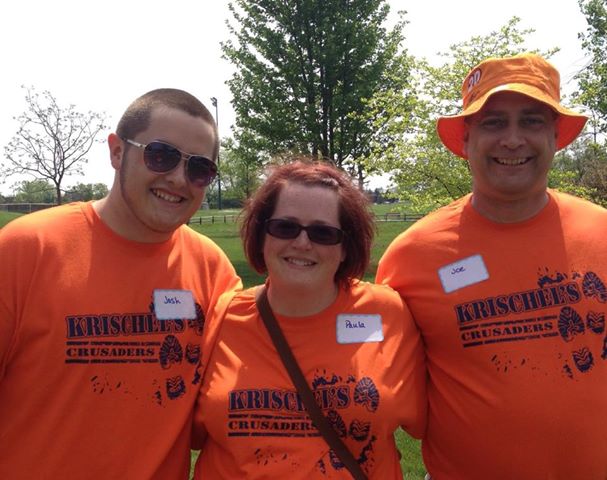
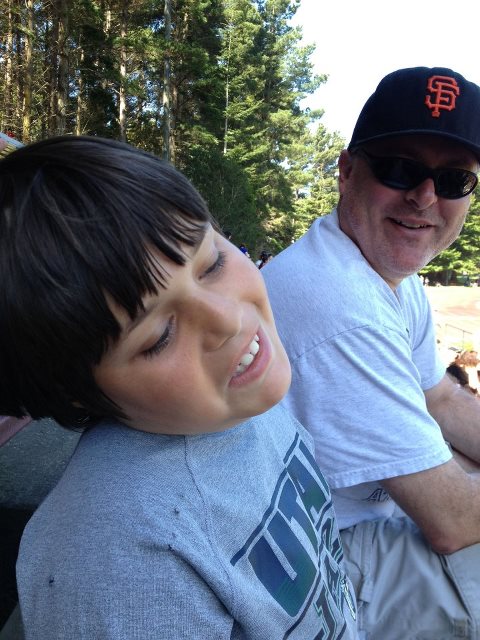
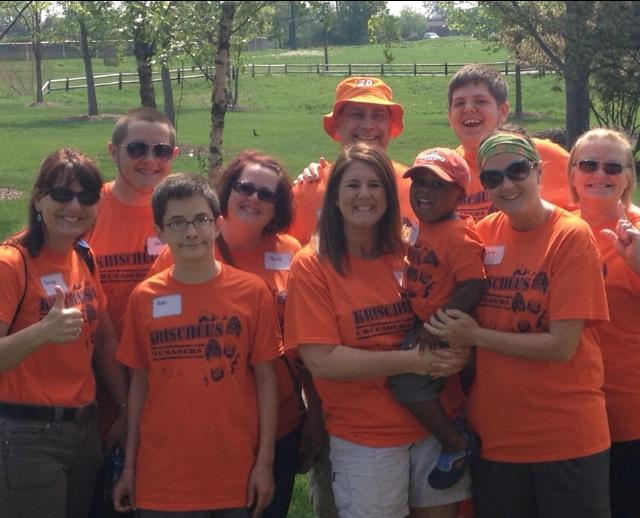
Josh and his parents.

Life is full of lessons, as well as people who teach us these lessons, instructors if you will. When reading that first sentence you might have thought of an elder who has given you some words of wisdom, or maybe a code of life your parents always told you to live by. However, when I think of the most important lessons in my life, I don’t think of my grandparents, or my dad teaching me how to mow the lawn. Nor do I think of a single thing I’ve ever learned in school. What I do think of is the much more important things I’ve learned and continue to learn from my two absolutely amazing brothers who have TSC, Adin (13) and Mason (17). Adin and Mason are continuously reminding me to be patient, tolerant, and above all things to just enjoy the many little gifts I receive from God each day. Every morning before school, when I begin freaking out because of my intense issues with being late to events, I just slow down and take a look at one of my brothers and it just calms me down and puts a big smile on my face. Every time a situation such as that arises it always reminds me that I would never, ever, under any circumstances wish for my brothers to be any different from the way they are.

I’ll start off with a quick intro into the life of Josh Krischel. I went to Dwight Grade School for 8 years, and am currently enrolled as a freshman at good old Dwight Township High School(DTHS).  I try to, and am fairly successful at, keeping a 4.0 GPA. I play football and am part of the scholastic bowl and mathletes teams, and I also throw shot and disc for the track team. As well as trying to balance my life between all these activities and school work, just like any other teenager, I also get a bit of chaos thrown into the mix. However a bit hectic at times, I suppose chaos is a bit of a strong word. Considering I don’t know what I would do with my life if it wasn’t how it is today.

Adin and Mason both have very distinct characteristics that make them both a joy to be around. Adin, who is the higher functioning of the two, loves nature, our puppy Keegan, the weather, and always carries around a watch that has little penguins on it that he constantly looks at about every five minutes just to give us the time. Then there’s Mason who is the most joyful person to be around and always seems to have a huge smile on his face.

Now, earlier I threw out a few things I have learned from my brothers and I’d like to talk about those and how they relate to our everyday life, the first of those being patience. I’ve 553615_3801382325047_2054365817_nlearned over these past 14 years that it really isn’t worth it to get mad over all the little aggravating things in life. Just like the old saying, “there’s no use in crying over spilled milk,” which in our house quite honestly happens more than it probably does in the average household. For the simple reason that Mason, who likes to fill his glass of milk to the very brim, doesn’t have the best reflexes, so he spills quite often. So, every time this happens he just goes to the drawer in our kitchen that we keep the rags in, grabs one, and just cleans up his mess without even a single peep. After watching this happen I often sit there and just think, if my autistic brother, who is very easily upset, can be patient like that then why can’t I? The answer to that question is because I can!! Often I mess something up and begin to get frustrated, and then I just think about Mason, and his ability to keep his eyes dry over spilled milk.
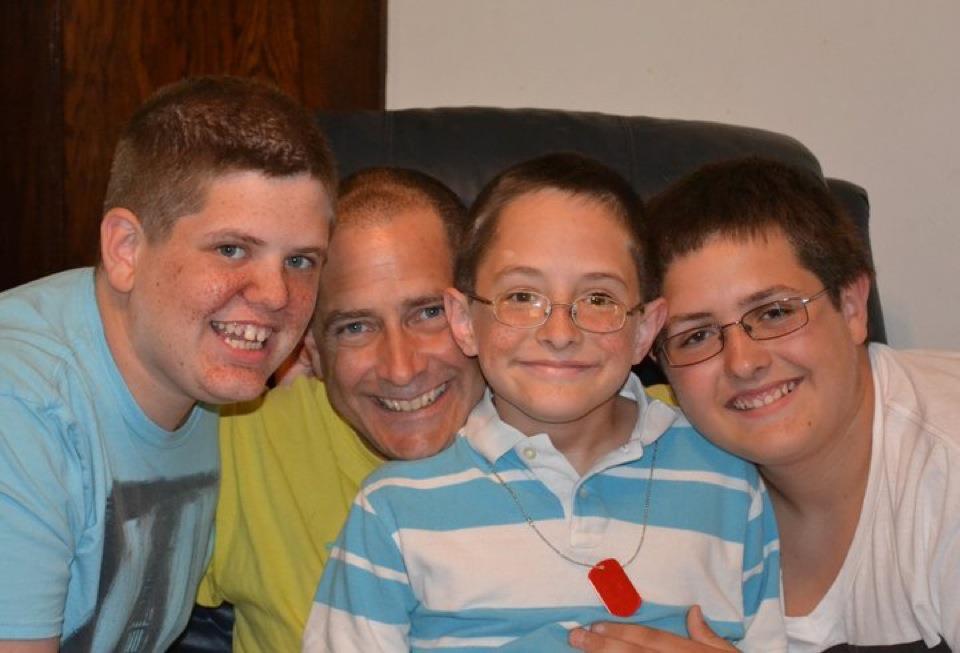
Then there is tolerance, which is something I’ve learned from both my brothers. Often when we go out to eat or just have to go to store shopping, my brothers somehow find some way to make me embarrassed or to cause a scene. Well at least that’s how I used to see it. Now, whenever we are out and about and one of the two begins to say some phrase they’ve heard from a movie or something over and over, I just often let them keep on doing it and continue whatever it is I’m doing. However, in the past year or so, I occasionally even find myself chuckling at them, or even joining in quoting Finding Nemo, Cars, or The Wiggles. As far as that topic goes, having the two of them in my life has allowed me to be very tolerant for all sorts of people, whether it is race, religion, or even just personality. I constantly, day after day, am hearing people in the hallways of DTHS, using the “R” word to call someone stupid. I understand when in the moment of using this word these people don’t realize how offensive it is to some people, that or they just don’t care, but regardless, 99% of the time I will stop whatever I’m doing to call the person out on it for the simple reason that it isn’t ok. Just like how it isn’t ok to call someone a “homo” or a “faggot,” it is just as offensive to anyone who cares for someone with special needs to hear the “R” word.
294883_10200707258115803_180476492_nLastly, the most important lesson my brothers have taught me is to enjoy the little things in life. In our dining room we have a big bay window overlooking a section of our backyard, and every morning Adin will just sit there and look out at the trees and the flowers. However, one morning he seemed very spacey looking out the window. At first I thought he might be having a seizure, so I went over and sat down and asked if he was ok. He responded with just a simple yes.  I then asked him what he was looking at and he said, “I’m just looking at that tree that God made.” Then without a single ounce of hesitation I smiled and looked out the window and sat there for a good five minutes just looking at a plain old tree. This, later in the day, made me realize that I take a lot of little things for granted, and that I need to just slow down sometimes and just take a big whiff of some roses.

If I haven’t made it clear enough already, I love both of my wonderful TSC brothers more than words can describe, and I wouldn’t trade them for anything in the whole entire world. However there is one extremely wonderful, amazing, caring, and loving woman I know that has TSC, and that would be my beautiful mother. She has also helped the cause by molding me into the, not to brag, wonderful young man that I am today (never said I was modest). She has taught me how to be a loving and compassionate person. She also easily undergoes more stress than the CEO of a multimillion dollar company, but somehow she manages to keep us boys in line, and babysit her two-year-old nephew. She is probably the strongest woman anyone could ever have the pleasure of meeting and is probably the biggest inspiration in my life.

So, if there is one positive to look for out of all the troubles of TSC, it would be that TSC carriers are by far the best teachers a person could possibly ever have.

See Josh’s mom’s post here.
It Affects Us All

Day 18 of Guest Blogging for TSC Awareness Month

By guest blogger Tina Carver   (Eureka, California)

Please check out Tina’s blog at http://captainjacktastic.wordpress.com

Jackson and Tina.
Jackson and Tina.

Prior to April 2009, all that I knew about Tuberous Sclerosis Complex would fit on the head of an angel dancing on the head of a pin.
In other words:
NOTHING.
Never heard of it. AT ALL.

Once I met Jack, all of that changed.
I became Jack’s stepmom in September of 2010, and shortly thereafter, his birth mother left the area, leaving us with sole custody.

Now, I have to be honest.  The hardest part of Jack’s TSC  had already happened.  The in vitro diagnosis.  The debilitating and never ending febrile seizures.  The rounds and rounds of various seizure meds.  The brain surgery.

That all happened BEFORE.

In the TSC community I feel a bit adrift — I get asked questions about the specifics of his disease — the types of tumors, etc– and I cannot answer them.

My life with TSC is all about moving forward and making Jack’s life the best it can be in the here and now.  It is also about dealing with how the disease affects US: myself, my husband, my daughter.

Our life revolves around “what if’s”.  Every plan that we have has a back up- “just in case”.  We have emergency seizure meds in each of our cars, Jack’s backpack, the home.  We plan and plot ANY trip to make sure we are near hospitals.  My husband and I get THREE WHOLE hours a week to be adults outside the house.  My daughter knows that any school function most likely means only ONE OF US will be there (respite is a harsh mistress). Tuberous Sclerosis may have had its way with Jack, but it also has the rest of us in its grip EVERY. SINGLE. DAY.

Jackson and Dad.
Jackson and Dad.

But there are days……lovely days like last Sunday when all of us were in the backyard.  My daughter running fully clothed through the sprinklers, much to the delight of Jack who had his favorite spot on what he calls the bouncepoline.  The sky was clear and sunny.  There was laughter from all.  And it’s for these moments that we continue on.  THAT is what makes it worth it all.  We forge ahead because these moments make life worthwhile.  These moments balance those tense moments in the ER, the sedation for MRIs, and the uncertainty of the future.

Now, to be honest, how Tuberous Sclerosis has had its way with Jack has NOT been kind-

Febrile seizures have left permanent damage.
There is a thick scar that crosses his scalp from brain surgery.
There are developmental delays.  There are physical issues.
There are over 30 tumors in his brain.

But over the past few years we have seen progress.
We have speech and communication.
We have staid the growth of the tumors.
We have found the right cocktail of meds to keep away the seizures.
And Jackson the boy is blossoming……

SO what else can I say about this disease that I have come to know and loathe?
That it took away one boy and left us another.
One that I love just the same.

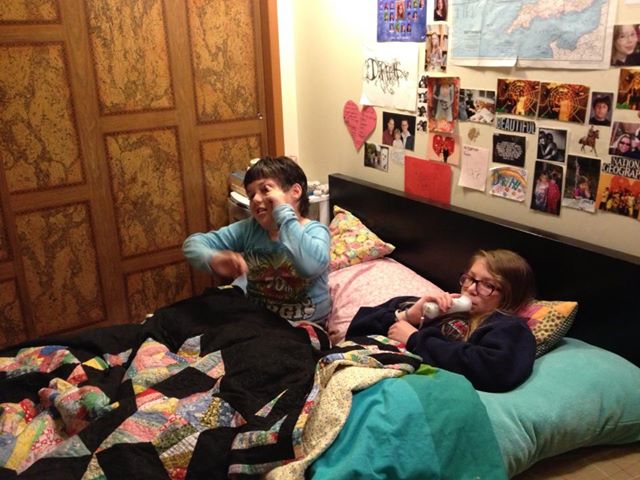
Jackson hanging out in Darrah's room.
Jackson hanging out in Darrah’s room.

JACKSON The Poem

In my dreams

I constantly see

You

Your smile so bright

and beautiful

A mischievous grin

to match the

glint in  those

bright blue

Eyes

You run

Untroubled

Carefree

with an easy

and natural

gait.

Laughter unfettered

Musical

And there are

no tumors

no damage

Or delays.

There is only a boy

who is

Not You.

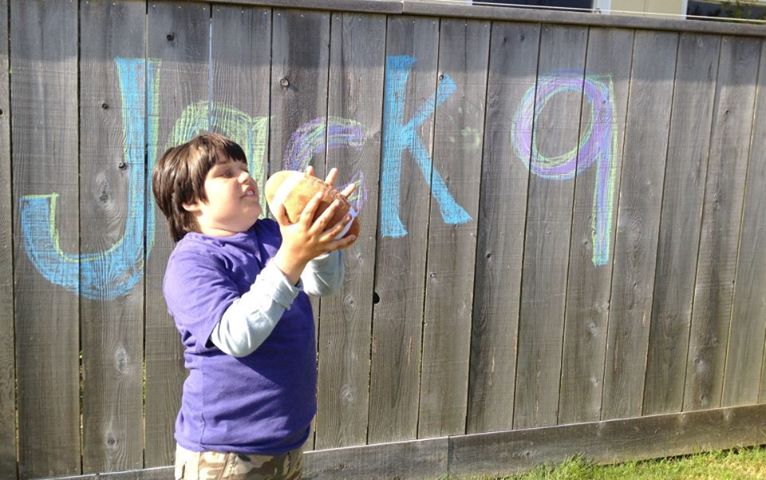
Jack loves the number 9.

Our Roller Coaster Journey with Tuberous Sclerosis

Day 12 of Guest Blogging for TSC Awareness Month

By guest blogger Pamela Wolthuis  (Portland, Michigan)

NicolasMy husband Chuck and I were married on May 23, 1997.  I brought one beautiful 4-year-old daughter, Melanee, into our marriage. Little did we know on that day almost 16 years ago, that soon we would be on a journey we never expected, and that Melanee would be the only “healthy” child we would have. (Chuck loved her as his own, from the day we met on a blind date that she went on with us. He would eventually adopt her, as soon as he legally could).   Less than one year later, on May 17, 1998, we welcomed our son Nicolas into the world. He was the cutest little boy I’d ever seen, and the joy of all of our lives.  When he was about four months old, he had surgery for a hydrocele repair.  He seemed to be fine, and then all of a sudden he was bringing his legs up to his chest, almost like he was doubling over in pain.  He would cry, do this jerking with his legs, and it would go on for hours.  Several times we took him to the ER, but by the time they got around to seeing him, he would stop, and they would send us home saying he was fine.  We knew something was wrong, but no one seemed to believe us. I called the surgeon, but he was rude and arrogant, telling me, “He is fine.  What do you want me to do, cut him open again?”

We took him to the family doctor, who agreed with me that if we thought something was wrong, there very well was a problem that we needed to get to the bottom of.  His exact words I can remember to this day:  “Pam, you can have a room full of the best doctors in the world, and you as a mom, know more than them about your child.  If you say there is something wrong, I believe you.”  He sent us on for testing at the hospital.  Nicolas was set to have a ph probe, but while there, a resident looked at our baby, said he would like to do an EEG, and would that be ok?  We said yes, but thought it was a waste of time.  That resident was the one who cracked the case.  I can still remember the neurologist coming into the hospital room and telling us our perfect, beautiful baby boy had a terrible disease called tuberous sclerosis.  He told us Nicolas was having seizures.  He had epilepsy. I vividly remember telling him, “Well, if you know what is wrong, fix it.”  He said he couldn’t, that there is no cure for this disease, and that there really isn’t much even known about it.  He left the room, and I remember just crying, telling Chuck to “tell him he’s wrong.  There’s nothing wrong with our baby’s brain.”  Soon another doctor came in, telling us, “All you can do is take him home and just love him for the three to four years you will have him.”  Yes, he told us our baby would die by the time he was four.  I was inconsolable, and Chuck was feeling like it was his entire fault because he was told he passed the TS gene on to Nicolas.  They could tell, just by looking at him and the angios on his face, that he had tuberous sclerosis.  The angios that he never had a name for up until that point, that he had always worried his baby would have, but that doctors had assured him were no big deal.

When the neuro came back, he told us the other doctor was wrong, and that Nicolas wasn’t going to die.  It took many doctors to convince us that he wouldn’t die, but finally we believed them.  The first doctor who had told us didn’t know and had told us the worst case scenario. Nicolas was started on a seizure med that didn’t help.  The neuro put him on ACTH, a steroid injection given for seizures.  It had terrible side effects and didn’t help our baby.  At the next trip to the family doctor, he told us about Dr. Chugani in Detroit, who was a world renowned expert in TS.  We were so lucky to be so close to him and were able to get in fairly quick.  Nicolas was started on vigabatrin, a drug we couldn’t get here in the US, but had to go to Canada for.  Insurance wouldn’t cover it, and it was expensive, so we went into serious credit card debt to obtain it.  (More than a decade later, we were still paying for it, and finally had to settle it with the credit card companies, ruining our credit, so that we could afford to live.  But we do what we have to in order to help save our children!) It helped, but he still had seizures and was beginning to regress.  He was slipping into his own little world where he wasn’t interacting with us anymore. Dr. Chugani recommended brain surgery.

In June 2000, Nicolas had his first brain surgery.  It didn’t help his seizures, so we were angry and regretted doing it.  Then, all of a sudden, he was interacting again, and our happy boy was back!  The surgery was successful, because even though it didn’t stop his seizures, it helped him developmentally.  In 2003, we were advocating along with Dr. Chugani for more surgery.  The surgical board recommended him, and he had his second resection.  This time his seizures decreased.  He still had some seizures and was still on meds, but he was progressing.

Fast forward another year…..We finally decided to have another baby, with the thinking that God wouldn’t give us two disabled children.  On December 26, 2005, our beautiful MalarieMalarie was born six weeks early.  Within an hour of her birth, she had her first seizure and was diagnosed with TS.  Our hearts broke again, grieving for the “perfect” baby we prayed so hard for.  That is what people who have never been on this journey can never fully understand.  Although, yes, our babies are alive, we still have to go through a grieving process after a diagnosis.  No, our child hasn’t died, but our hopes and dreams for what was supposed to be have died.  We are forced into a place we never intended to go.  But just like the beautiful essay “Welcome to Holland” teaches us, we learn that we are not in a terrible place, just a different place.  So we learn to accept it, and see the beauty and good in it.  It’s not a place we willingly chose, but it’s not a horrible place either.

Over the years our kids have seen more medical professionals than most adults ever do.  Our list includes a neurologist, ophthalmologist, nephrologist, cardiologist, geneticist, gastroenterologist, dietician, neurosurgeon, dermatologist, physiacist, psychologist, psychiatrist, countless occupational, physical, speech, and feeding therapists, and pharmacists. We also have the whole special education team at school. The kids have had home based therapies, school based therapies, outpatient therapies, and soon, possibly inpatient therapy for our son.  We have been fortunate to meet some outstanding professionals, and some have even become our friends.

Nic right before brain surgery.

Today our children are 20, 14, and 7.  Melanee is a happy, intelligent college student who has more compassion than most young adults because of the experiences she has had with her “special” siblings.  We know without a doubt that she will become a remarkable adult, wherever her path in life takes her.  We worry, because when we are gone, she will become the guardian of her siblings, and is this really fair to her?  She will be tethered to them, and they will always be a major part of her life.  She has never once complained, and has reassured us that she WANTS to care for them when we are gone.  We thank God every single day for blessing us with such an amazing daughter!  Nicolas is now almost 15, but functions at a 3-4 year level.  He is autistic, has behavior issues that can occur unexpectedly at any time, is not potty trained, and may never be.  He takes eight different meds for seizures (which are still not completely controlled), behavior, and a nerve problem he just started with after his most recent brain surgery one and a half months ago. He is also the funniest, sweetest boy (when not in meltdown mode) we’ve even known.  His laugh is infectious and comes all the way from his toes!  Malarie is seven, but functions like an infant.  She depends on us for everything.  She is on six seizure meds and still has seizures several times per day.  Like her brother, she cannot be weaned off any of them, because then she starts seizing constantly. She cannot walk or talk.  She can, however, scoot on her butt across a room at an incredibly fast speed, and communicate with smiles and cries.  Her smile can light up a room in no time at all.

This is our crazy, roller coaster journey of tuberous sclerosis.  We go day to day, sometimes minute to minute.  It isn’t always easy, but it isn’t always bad.  Our days are filled with laughter, and sometimes tears.    We have lost friends, and even family, along the way, who can’t understand or cope with the way we live.  Our children will always come first, with no exceptions. We have learned the hard way who we can count on, and who our true friends are.  For that, we are grateful.  We know the miracle of something as small as a smile, or the quiet babbling of a child.  It isn’t a life we anticipated, but it is a life we enjoy, filled with love and acceptance.  In the end, isn’t that what everyone is searching for?

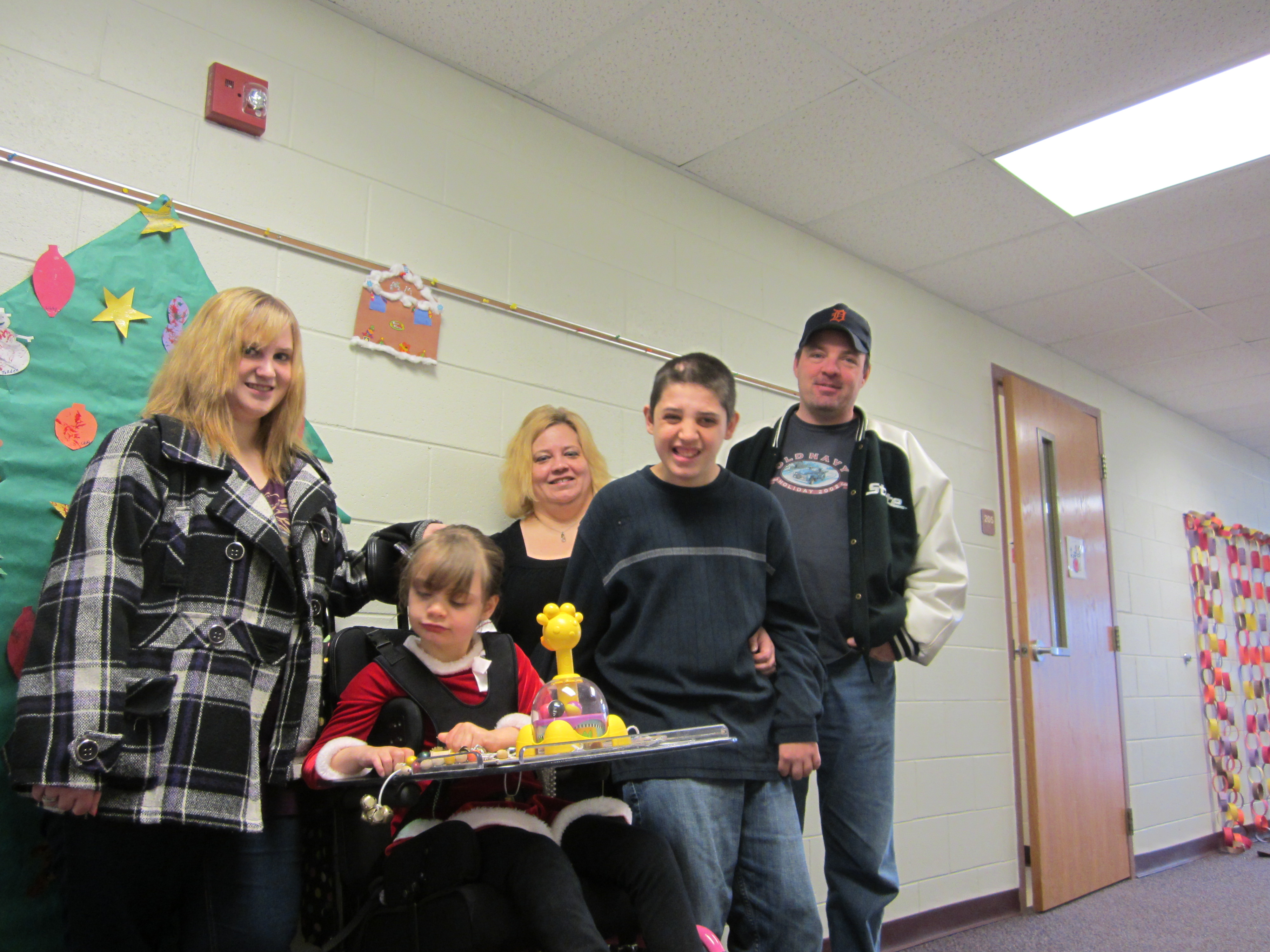
The family at a school Christmas party.

Life With Ricka

Andrea and Ricka ice skating.

Day 11 of Blogging for TSC Awareness Month

By guest blogger Andrea Hubert  (Willis, Michigan)

Everyone has their own story to tell when dealing with TS.  I was too young when Ricka was born to remember how things all went.  I only know them as related by our mom.  Ricka’s TS seems to be a random genetic mutation.  However, that didn’t mean anything when our younger brother began having seizures at the age of 24.  It took many months and several neurologists before they could figure out what was wrong.  Finally someone ordered genetic testing, and he doesn’t have TS.  He has an unrelated seizure disorder caused by something in his brain that was triggered by the long term use of Ultram (tramadol) for serious back pain.  No one tells you that a potential side effect of the medication is seizures, do they?

So, back to Ricka.  She is very severely affected by TS, with autistic tendencies, a mental age of about 15 months, and lots of different kinds of seizures everyday.  Both of her hips and her nose have been broken.  She’s had more stitches, staples, sprains, bruises and bumps than anyone else I know.  She used to be able to walk, but is now too scared.  At school they called her “the escape artist.”  She learned how to open doors, and she was so quiet they eventually had to put bells on all the doors in her building.  I think at one point, she wore bells so they could always find her.  Thankfully, she has never disappeared when I was in charge of her.

For me, life with Ricka is just my normal life.  It’s what I’ve always known.  With only 18 months between us, I was too young when she was born to have learned much about life without her.  The things that I’ve learned when dealing with TS have kept me on my toes as I go through my own health problems, back surgery, and further treatments.  I know when to fight and when to stop.  I know to always be ready for anything.  As a child, I always kept a bag packed with enough materials to keep me, Ricka, and our brother entertained for up to several days.  We never knew when we’d be headed to the hospital, and there wasn’t time to waste gathering stuff to do.  We also didn’t know when someone could come pick up my brother and me, so we had to be ready to stay at the hospital too.  Advances in technology have made it so much easier.  My laptop, Kindle, an iPad with movies on it for Ricka, snacks, and a charger for everything is enough for us now.

When we were young, before my brother was born, Ricka was in the hospital so much that I was allowed to walk around the hospital alone pretty often.  Nurses and other staff members recognized me.  My mom is still proud of the fact that I never got lost and could direct other people around.  Maybe that’s one of the things that helped shape my good sense of direction now. Who knows?

I grew up pretty fast thanks to Ricka’s TS.  I have always been her caretaker, and at nineteen, I became one of her guardians.  It’s a scary thing to be in charge of someone else, but even more so when that person is your sibling, close in age, and so medically needy.  Today, almost nothing freaks me out because I’ve probably seen it in my journey with Ricka or the other folks that I’ve been lucky enough to work with doing care for families.  There are positives and negatives to growing up fast and seeing so many things.  Some days, positives outweigh the negatives, and some days it’s the other way around.

I don’t know what the future holds for Ricka.  I do know that she will always be loved and cared for at home by people who love her.  I know that if something happens to our mom, I will be solely responsible for her.  My brother lives nearly 2000 miles away and doesn’t want to be involved anyway.  I know the importance of planning ahead now.

Cole’s TSC Diagnosis

Day 4 of Guest Blogging for TSC Awareness Month

By guest blogger Lana DenHarder  (Grand Rapids, Michigan)

Brian and I had been married for four years. Like most first-time parents we were excited to be expecting a baby and equally excited to have an ultrasound to learn the gender. We had spent weeks talking about names and imagining how the child would look, wondering what personality traits they would have, if they would get my clumsiness gene or Brian’s athletic abilities.

My first ultrasound was around nine weeks to verify dates, and I had another ultrasound around 16 weeks to learn the gender. We were pleased to learn we were having a boy. Brian’s visions of teaching the baby to play ball and coaching little league were starting to become a reality. Shortly after we learned we were having a boy we decided on the name, Cole Ryan.

My prenatal visits went along as planned. I jokingly told my doctor (whom I absolutely love) that I was disappointed that we didn’t get any good pictures of Cole at the first Coleultrasound and maybe I needed to have another. We both laughed! As my pregnancy moved along, around 30 weeks my doctor said that Cole was measuring small and maybe it was time for another ultrasound just to make sure we had the correct dates and that there was nothing wrong. I was thrilled because that meant I would have more pictures for his baby book. The ultrasound was scheduled a week or two later at our local hospital and I met Brian there…with a full bladder, as instructed. The tech took us back to the room and we were geeked to see Cole on the monitor. We asked goofy questions and the tech quietly answered them and then told us to wait and she would be right back. That should have been our first indication something was wrong. Ten minutes, twenty minutes, she didn’t return. Brian went out to try and find someone because my bladder was still full! The tech said we needed to wait in the room. Ten more minutes had passed and the tech returned with a doctor who looked at the monitor some more. He then said to get dressed and wait in the waiting room. Brian and I looked at each other oddly because after my previous ultrasound we didn’t need to wait around.

Waiting was torture. The doctor walked in and said he had spoken with the radiologist and they found a tuber on Cole’s heart. My heart sank. Brian and I were not expecting this at all. Ten minutes ago we were joking around and now our world was falling apart. That was the first time we heard the words Tuberous Sclerosis Complex (TSC). He told us we needed to follow up with our doctor in the morning. Brian and I walked out to our cars, a million things spinning around in our heads, hugged and said we would talk when we got home. I watched Brian pull away as I sat sobbing while trying to call my mom on the phone.

Our doctor referred us to a high risk OB to assess the situation. They confirmed that it was likely that Cole would have TSC but an official diagnosis had to wait until birth. I had weekly appointments and ultrasounds. At 37 weeks the doctors believed that the tuber was blocking blood flow to the heart and they needed to get Cole out. They tried to mentally prepare us for heart surgery within hours of birth. I was induced on September 4, 2006 (Labor Day that year) and Cole was immediately taken to the NICU. After additional scans, we learned that Cole also had tubers in his brain, too many to count. The next 25 days felt like months. Most nights I would go home and quietly cry myself to sleep, hoping that Brian wouldn’t notice.

Cole was touch and go for a while but didn’t need heart surgery after all. He developed complications and one night we almost lost him. I will never forget the day he turned grey. September 13th. Looking back, at the time we didn’t realize just how sick Cole was. The day before we were supposed to take Cole home he had his first shutter spell (seizure). He left the hospital on a seizure medication.

The first couple of months were normal, or as normal as we thought they would be as first-time parents. Cole was eating well and very snuggly, however he was starting to miss typical milestones. We started Early On Therapy, and eventually physical therapy, to help strengthen his core.  Cole started to have infantile spasms at 6 months and the day after his first birthday he had his first grand mal seizure. Within Cole’s first year we had tried various seizure meds and nothing worked. Our one last hope before trying ACTH was the Ketogenic Diet. Brian and I thought about it and it made sense to us. Cole wasn’t eating solid table foods yet, and he hadn’t developed a taste for bad foods that we would have to take away for the diet, so this seemed like a good time. Cole was admitted to the hospital and three days later he went home on the diet. Within a few months we noticed a reduction in his spasms and no more grand mals. He was on the diet for three years. In the end, we decided to stop the diet because he started to fall off the growth chart.

During a routine urology appointment, after the doctor preformed an ultrasound, he had to tell us that multiple tubers had started to grow on both of Cole’s kidneys. Cole was three years old. We are fortune to live in Grand Rapids, Michigan with a fantastic Children’s Hospital, Spectrum Health and DeVos Children’s Hospital. Up until this point, all of Cole’s care could be managed by various specialists locally. After learning of the kidney tubers, we contacted the Tuberous Sclerosis Alliance and asked for recommendations for a nephrologist. That is when we found Dr. Bissler at Cincinnati Children’s Hospital. We spoke with Dr. Bissler over the phone and made an appointment to get a second option on a care plan. Dr. Bissler was fantastic. He took the time to talk to us and make sure we understood all of the options. We agreed with Dr. Bissler and decided to move forward with kidney surgery to embolize the largest tubers. They were the size of golf balls. During Cole’s six month post op visit with Dr. Bissler, we discussed the benefits of Afinitor for Cole’s kidneys and SEGA. Dr. Bissler had also introduced us to Dr. Franz. Dr. Bissler discussed Cole’s history with Dr. Franz, and they both agreed that Cole could benefit from Afinitor. He started it in February 2011. We have noticed many positive changes in Cole, in addition to the kidney tubers shrinking and a slight decrease of the size of the SEGA.

In addition to the heart and kidney tubers, Cole has tubers on his eye and skin lesions.

Cole is considered globally delayed and is on the autism spectrum. He started attending a special needs preschool when he was two. Watching the bus drive away with my son was scary, but I realize that was one of the best decisions we have made. Cole’s development slowly improved. He learned to crawl when he was 2 1/2, walk when he was 3 ½ years old and his speech continues to improve. Today, he has close to 60 words and phrases. He currently attends a special needs school where he has fabulous teachers and support and continues to make positive strides.  I believe the Afinitor has helped him come out of the medical haze he was in and is allowing him to move forward with his development. We have noticed the biggest change in him in the last two years since starting Afinitor. He is making intentional eye contact, attempting to repeat new words, initiating play, self feeding, and demonstrating appropriate responses when asked to do simple tasks.

We often hear people comment and ask how we do it. There are definitely challenges to raising Cole, but he was our first child and we don’t know any different. In our minds, this is normal. We also have a three-year-old daughter, Lauren. Brian and I were tested and we do not have the TS gene. Lauren does not exhibit any characteristics of TS so we decided not to have her tested.  Our lives are full of doctors’ appointments, therapy sessions, sleepless nights, stress, worry and wonder. Cole has closed the gap on his physical challenges (walking) and now we struggle with behavioral (biting and scratching) and emotional issues. In spite of these challenges, Cole is a lovable, happy, determined 6 ½ year old little boy who loves to snuggle, sing (in his own way), spin balls, ride his bike, swing and run around the backyard. He is on three different seizures meds and is seizure free. It is difficult to look too far in to the future because we never know what will happen, but I can say that things are starting to calm down and feel a little normal.

Cole’s care continues to be managed locally and with the Cincinnati TS Clinic. We are very fortunate that Brian’s and my family live close and are willing to help with whatever we need. We definitely couldn’t do this alone. Cole is such a joy and we are very blessed to be his parents.

The Story of Stacia and the Realization of a Dream

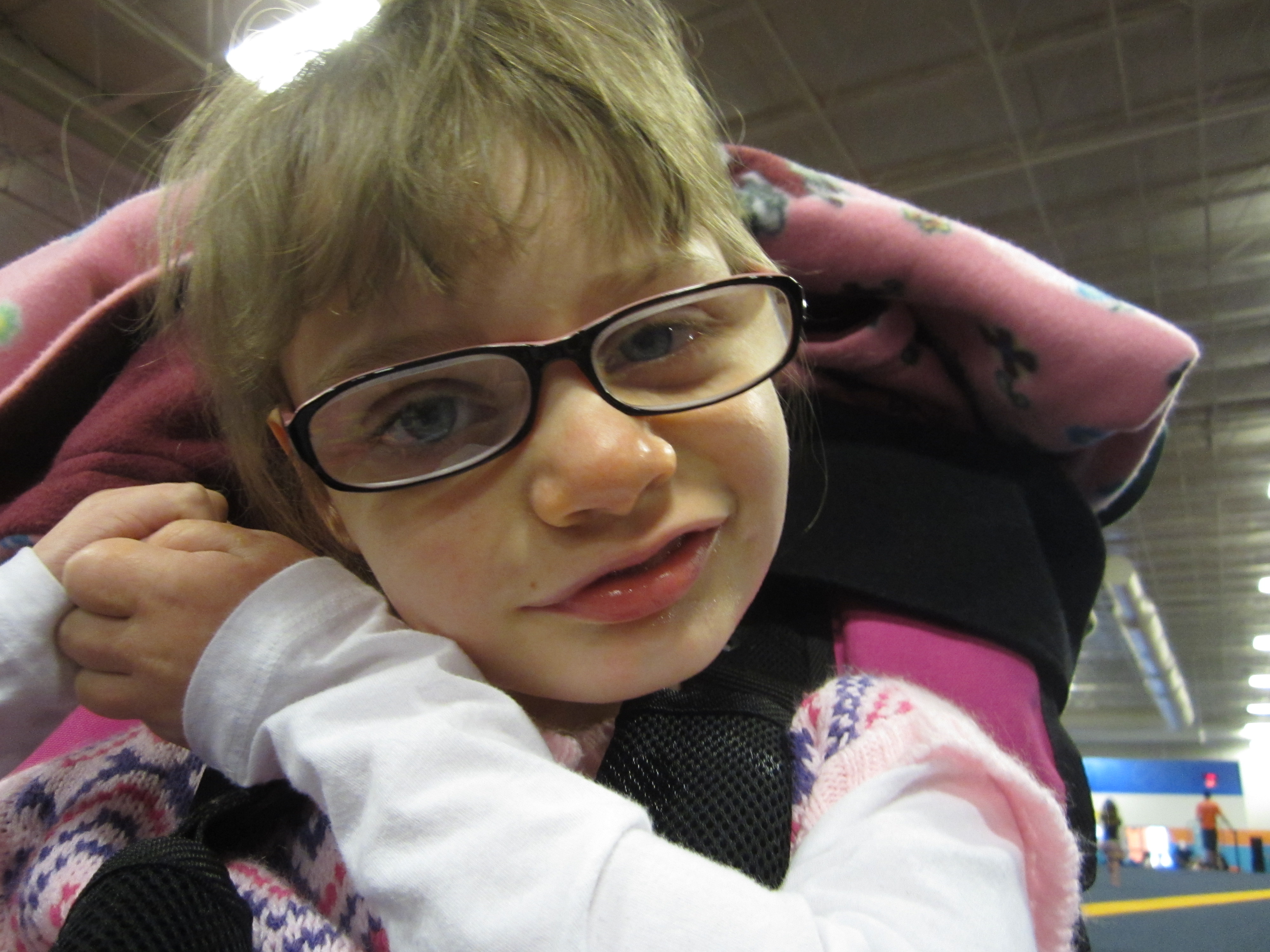
Stacia at the age of three.
By guest blogger Susan McBrine
Originally from California but retiring to Oregon
Day 1 of Blogging for TSC Awareness Month

My first child of four was born in 1971 . She lived until 2003, 32 short years. She was a joy, a beautiful baby , and I was a young 23-year-old  teacher.When she was about eight months, she started crying for no reason. Then she seemed to stop smiling and rolling over, and later she started jerking her head down in a series of movements. Frantic trips to  doctors’ offices  found nothing wrong. I was an “overly concerned mom,” and ” it was nothing” I was told. The few funny white spots I noticed at three weeks, were also “nothing,” and  the fact that she didn’t lift her chest or head up from lying on  her stomach was “weak shoulder muscles.” Every doctor I saw dismissed my concerns. I wanted to believe it was nothing, but in my gut I knew something was wrong! Moms always do!

Finally, one day, she had eight separate instances of jerking her head and body  in a series. I was alone with her and decided I was not going to take no  for an answer any more. I drove to the emergency room and, probably hysterically, told the  doctor there that I wasn’t leaving until someone told me what was wrong with my baby! Weirdly enough, the emergency room doctor  was moonlighting from local AFB and had a patient, 12 years old, with TSC. He recognized the white spots and my description of the infantile spasms she was having.

He bluntly told me she had TSC and would be handicapped… Would  not walk or talk and not live  if her seizures weren’t controlled. I cried all the way home.

 My world stopped! Life as I knew it changed forever. He turned out to be right  about one thing. It was TSC! And after finally seeing a pediatric neurologist at Loma Linda Hospital who confirmed it, (MRI was not yet developed until two years later), and hospitalizing her for invasive brain tests, we had to accept her diagnosis and the gloomy prognosis they gave us.

I was told so many things  that proved to be wrong. How rare it was, life expectancy, IQ expectancy, etc. And that there was no definitive genetic or diagnostic test available. And that really there was not one damn answer to any question. Now I know to question, to not believe predictions, to do my research, to develop a tough skin, and to be assertive. Doctors aren’t God. But she taught me all that in time. I took her home, loved her  and wondered  how I would ever survive her predicted, imminent death, as we struggled to control her seizures, first with meds, and then with ATCH shots. Welcome to the world of medication, seizures, hospitalizations, fears, tears, more tears and  special education. That was my new reality. I started to research tuberous sclerosis in many libraries, poured over medical journals, medical books, books on retardation, and epilepsy only to discover what was written about  TS was minimal (no internet). The  disease was considered very rare, and no real research or awareness had occurred  in over 100 years since it was named Bourneville’s disease. No wonder doctors didn’t know much about it. Not much was known period!

I was starting to get angry now, and when I read in the American Association of Mental Deficiency book that the life expectancy was 25 years, I knew then that no one really knew diddly squat! My pediatric neurologist was advocating institutionalization and no one had real information. I became empowered with my anger about no answers and no knowledge. I was a teacher, a reader, and yet I couldn’t find answers. Maddening! I refused to believe there was no hope! By now, she was almost two and I was expecting my second child, Tanya, after a geneticist told us Stacia was a random mutation. My older sister told me about preschool programs for special needs kids and about a magazine called Exceptional Parent. I wrote to it, asking for other parents with TS children to contact me. I thought if there were others out there, we could unite and make our voices heard. We could demand research, a genetic test, and treatments. Support could happen! I dreamed it all!

In two weeks I got 15 letters from all over the USA. Three from California. And one from  a mom of a 29 -year-old with TS ,who thought she was the only case in the world. Clearly no one had ever tried to find out how many cases there were (again, no internet yet). To make a long story shorter, I found Adrianne Cohen, Verna and Bill Morris, and Debbie Castruita in California.

And ….

We started to meet and plan, write letters, call moms, have meetings and contact doctors. We created a newsletter (run off on a school mimeo machine) and a medical research survey. Adrianne helped us get our first grant, a lawyer friend helped us incorporate as a non-profit and NTSA was born.We knew if we were determined enough we could make a difference. We talked to regional centers, hospitals, child neurologist associations, and put articles in magazines and newspapers. We also hoped for a celebrity to endorse us. We lived and worked on NTSA for years. Then slowly let go and let others take it over when it became a  successful reality. Now the Tuberous Sclerosis Alliance!

It spread and now it is international. I no longer have to write letters of hope to other moms from my kitchen.
We have a staff, TSC clinics, a medical advisory board, genetics test, research, a magazine, a bonafide celebrity (Julianne Moore), fundraising,  and chapters all over the world. Tuberous sclerosis is no longer an unheard of disease and there is hope for no mother to go through what I did. It is miraculous really. But we still have the disease  TSC…. and we still have heartache and families looking for help and hope. Now we have Facebook, the internet, this blog, and a phone call or email to the TS Alliance for immediate help and hope. My dream has come true.

Along the way I had four children, got a divorce, remarried, became a special education teacher and struggled every day to raise my TSC child, Stacia Diaz, and battle her ever growing list of symptoms. She turned out to be severely involved, mentally about three years old, brain tumors, kidney tumors, sleep , appetite problems, autism, and aggressive behaviors. She was verbal at eight and was able to say I love you (and cuss:). She was funny, happy, and taught me and my other children so much. But she also suffered, and we suffered…

And  when I look back on the day she was diagnosed and remember the stages of grief I went through to come to acceptance (to learn to love her for who she was,  not who I hoped

Stacia on her last birthday.

she’d be), I remember how it was a long and difficult journey. The grief never really ends. Yet today parents have support!

The end, for her, was the hardest. We watched her die in a hospice, after her second remaining and only kidney was so full of tumors that nothing could be done. She could not tolerate dialysis and a transplant. The heartache never really goes away, and I miss her every day,  but I’m glad she’s not suffering anymore. I know today the newer kidney drugs might have saved her. But knowing the TS Alliance is making  strides in treating TSC kids gives her life…and her death, meaning. Maybe I was her mom for a reason? No parent should bury a child, but even her death made me a better person. She and TSC taught me many life lessons.

I now have  Cll leukemia and am doing very well with my own medical battle. But I know Stacia’s courage, her smile through all of her battles with TSC, and seeing her still smiling when she died gives me courage and allows for no self pity. I just want each mom and dad and individual with TSC to know that, though it isn’t fair to have this disease,  you CAN, as one person, make a difference in the  fight to cure this disease!!!! We moms who started this organization believed that!

It is a battle we are winning. Things are better. There is hope. There is help. You aren’t alone! And every case of TSC is unique.

I’m so grateful for the work alliance members and staff do daily. I feel so fortunate to see a dream become reality. I hope my story helps someone today who reads it. And I hope Stacia is smiling down on all of us!