Category Archives: Guest Bloggers For TSC Awareness Month

It isn’t going to be easy, but nothing worth doing ever is.

Second Annual “Blogging for TSC Awareness Month” Day 3

by guest blogger Michele Stiefel  (Lancaster, Pennsylvania)

adam 5In March of 1985, our second son was born.  Adam was the baby I could relax with, knowing a bit more the second time around.  But by May, Adam was hospitalized with his first seizures and flown from our local hospital to Children’s Hospital of Philadelphia where he was diagnosed with tuberous sclerosis.  No one in our family had ever heard of this disease.  No one had ever had seizures.  Our world felt like it had blown to pieces.  His four-year-old brother, Ben, felt like he had caused the baby’s illness because he had been so jealous.  Ben began to act out and we sought out counseling to help him and us.  Slowly over that summer, we started to try to find some kind of normal – going to the local mall, taking Ben to his swim lessons and so on.  We waited anxiously for Adam’s early intervention program to have his spot available in the fall, but before we could start – Adam was back in Children’s Hospital with infantile spasms.  The next three years were nothing short of awful as there weren’t the kinds of meds back then that are around now.  We never really got control of the infantile spasms and he went from a smiling baby at 4 months to a lump that didn’t cry, didn’t coo, and didn’t roll over…just laid where ever he was placed and kept on having seizures.  That was our beginning…

Fast forward two years and Adam is five.  The infantile spasms are fading out although his “Heinz 57” varieties of seizures are still around.  But he’s no longer in the fog of IS:  he smiles, has a beautiful face and people fall in love with him easily. He’s learned to sit and crawl. He’s standing but hasn’t taken that first independent step yet.  My husband and I hire his early intervention teacher to do respite with the boys overnight so we can celebrate our 10th wedding anniversary at a nice hotel.  When we get home the next morning, Adam greets us by walking independently around the corner!  Stinker took his first steps while we were away!  It was the best present we ever received.

Early intervention those first five years helped Adam and our whole family to survive.  We learned to hope and dream of a future, not just of limitations but of having him experience as much of a normal life as his older brother with the same opportunities and experiences – adapted Adam-style.   It wasn’t going to be easy but nothing worth doing ever is.

The first big “normal like Ben” goal for Adam was to attend weekend religious school at our synagogue.  There were no other children with special needs in adambmitzvahthe building and our rabbi wasn’t so good at “getting Adam.”   Luckily I’d met another Jewish mom in town whose son was a couple of years older, also non-verbal, who used a wheelchair.  I talked her into joining and we started our own class with our boys.  About the same time I volunteered to serve on the synagogue board of directors because the best way to make things happen is to become a decision-maker with a voice and a vote.  Then the rabbi who didn’t get our kids took another job in another city and the search committee started looking for a new rabbi who would be willing to do Bar Mitzvahs for kids with special needs.  We got a great one.  Our boys started studying extra with the rabbi, listening to Bible stories, handling ritual objects, and being recognized in front of the entire religious school just like the rest of them.

At 13, Adam had his Bar Mitzvah and it was wonderful!  He loved Jewish music, so we hired a Jewish folk singer who wove music throughout the service.  Adam is non-verbal so he couldn’t lead the service like a regular Bar Mitzvah boy would.  Instead he worked for two years to be able to hold a special wine cup upright throughout an entire blessing without putting it down or spilling it.  He learned to hold and “hug” the Torah scroll on his lap without letting go.  Being non-verbal he couldn’t read from the Torah in Hebrew so his brother read for him.  This was special – no one is allowed to touch the Torah scroll where the Hebrew is written.  One uses a special pointer to follow along.  Big brother Ben held the pointer and Adam’s hand at the same time as he read so that Adam could “read with him.”  To keep Adam from fidgeting, Ben used one finger to tickle Adam’s palm because it calms him — all while they were doing the Torah reading.  The sanctuary was full and there weren’t too many dry eyes in the house.  We followed it up with a great party and Adam definitely knew he was the guest of honor!

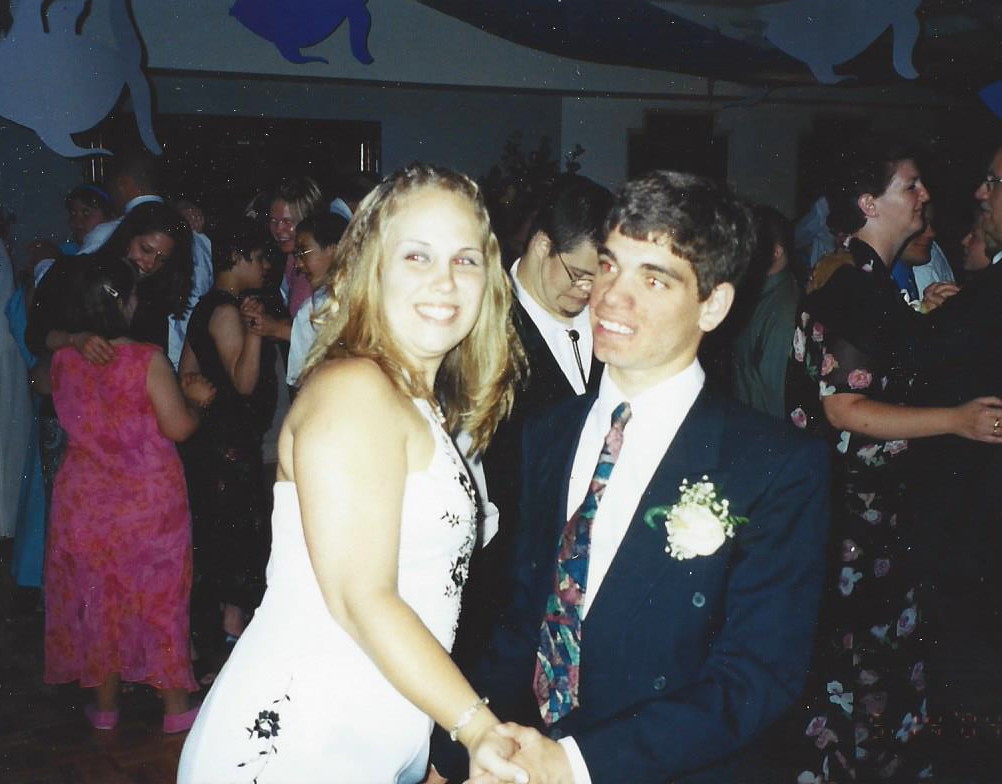
Adam went to a special needs summer day camp from the age of 8 to 21 and had lots of fun.  Swimming wasn’t his thing but music time was.  He participated in programs as a teen where he got to hang out with another teen or college student and do regular teen things.  He went to four proms and had a date for each one of them!  He discovered blondes… :)…he really likes blondes.

The summer after aging out of school at 21 was scary.  A rare malignancy was discovered in his colon.  Surgery to remove half of his colon and three weeks in the hospital with complications followed.  He was down to 85 pounds and took a good two months to recover.  Then it was time to begin his journey into the world of adult services.  We did not want Adam to be inside four walls all day in a sheltered workshop environment.  So he became one of the first participants in a new pilot program taking individuals with severe adam promdisabilities out into the community as volunteers.  He helped with Meals on Wheels – his staff would drive the car and knock on the door; Adam would hand the lunch to the senior citizen.  He made lots of elderly friends on the route.  He worked in local libraries, pushing the books onto the shelves (with hand-over-hand support by staff).  He was a busy young man and enjoyed being out and about in the community.

Through one of the programs, Adam met Matt who is also non-verbal and has autism.  Just picture two non-verbal guys making eye contact with each other and laughing and insisting on sitting together every day at lunch.  The program staff told me about how great they were together and said, “They should live together.”   I sent our contact info home in Matt’s backpack and his mom called me.  We started to get the guys together on Saturdays for pizza and we began to talk about the possibility of them living together.   News traveled through the system about these two guys and how great they were.  The head of the county intellectual disability department called us, said he’d heard about these two and were we ready for Adam to move into his own place with Matt?   Adam was 24 and we said yes because one of our dreams was that Adam would live with a friend, not just in a place where there happened to be an opening, but with someone he truly liked.  He’s lived there since 2009 and he loves it.  He’s thrived there, gaining in independence and doing things there that he’d never do for me at home!  He’s in a community he knows well, having grown up there.  We are able to keep an eye on things and be involved while we are still healthy and able because we’re in our 60’s and none of us live forever.   As parents our job is to give our kids “roots and wings”.  Big brother, Ben, went to college, started a career, got married, and bought a house.  Adam has his jobs, social life, and lives in a house set up just for him and Matt.

I mentioned that Ben got married.  Guess who was his Best Man?  Adam beamed with joy throughout the entire wedding weekend.  And boy!  Were they both handsome in their tuxes!

benadam

Finally, it’s important to know that we went through really hard times with his tuberous sclerosis, just like a lot of you.  Recently he was diagnosed with Crohn’s disease, totally unrelated to his TS, so he gets two chronic illnesses to deal with and it feels really unfair.  There have been times over the years when I fantasized about throwing my suitcase in the car and heading west and never looking back, but I never did.  Instead we used counselors, behavior therapists, doctors, teachers, compassionate friends and family to help us get through the worst.  Now after 29 years, I see what our family has accomplished and I know we more than survived, we thrived.  We are all better people because of having Adam, TS and all, in our lives.  So keep dreaming of possibilities for your kids – you never know what you can achieve!


I want new TSC parents to know that there is hope.

DSC_0080

Second Annual “Blogging for TSC Awareness Month” Day 2

by guest blogger Brittany Schwaigert  (Memphis, Tennessee)

Our story begins in the spring of 2008. My husband and I had just welcomed our very first child into the world. Greyson was born a beautiful and healthy 7 lb., 10 oz. baby boy and there were no indicators at all that anything was amiss with his health other than a slight touch of jaundice. He was, and still is, such a beautiful child. We were so thankful that he was healthy. We never took it for granted.

Then at two months of age, Greyson had his first round of vaccinations and subsequently developed what looked like sun spots on the tops of his thighs. The vaccinations had been administered in his thighs, though, and I was aware that the appearance of the spots might well be purely coincidental. I was far from panicked, but looking back on it, I do remember that point as being the first time I had misgivings concerning Greyson’s well-being.

Things took a turn when, at approximately three months of age, Greyson started to develop a strange habit. His habit looked to me like the Moro reflex – a phenomenon that occurs when some babies are placed on their backs and respond by throwing their hands out in the air. But in Greyson’s case, this behavior kept happening at strange times, and in clusters. Close family members who witnessed the behavior or were told about it tried to tell me and my husband that it must simply be an immature nervous system, or said that “babies do all kinds of weird things.”  My gut instinct, however, told me that something just wasn’t right.

Then one afternoon, Greyson was lying with me in the bed and I was watching him sleep. All of a sudden it hit me: what if this behavior was a seizure? I practically ran to the computer to find out what I could about behaviors associated with infant seizures. What I found made my stomach sink into the ground. It hit me like a Mack truck that what I was seeing in Greyson was the outward manifestation of a dangerous and aggressive type of seizure called Infantile Spasms. It felt like my world was crashing around me in one split second.

I have always felt that it was the hand of God in my life preparing me for what was to come that, before giving birth to Greyson, I had worked for a pediatric neurologist managing an event facility that he owned. I called him immediately on his cell phone and left him a message. What followed in the next few weeks would be a complete blur.

Greyson was examined by the doctor in his office, but there was nothing that he felt he could definitively diagnose without an MRI. We scheduled the MRI and when the day came, I can say without hesitation that putting a three-month-old infant into an MRI machine was one of the scariest moments of my life. I sat in that MRI room with my baby, freezing to death, trying not crumple into a heap on the floor.

After the results came back from the MRI, the doctor called me at home. He said that he saw “indications of Tuberous Sclerosis.” The doctor explained thatdownload (2) Tuberous Sclerosis (TS) can cause epilepsy, learning disabilities and sometimes even blindness if victims develop the tuberous growths caused by the disease in their eyes (incidentally, this is the reason I feel it is so important to go directly to a TS specialist when anyone is diagnosed with TS. Though I’m thankful we got a diagnosis when we did, due to the relative rarity of TS, I was given barely a shred of information about the disease that would come to change the entire scope of our lives. The only thing I knew about TS was that my husband’s step-mother’s sister had it and she had been institutionalized for years). I looked at my precious baby lying there and suddenly was filled with fear for his future.

After a myriad of other diagnostic testing, including blood work, a lung x-ray, an echocardiogram, a kidney ultrasound, and several EEGs, the neurologist we had been referred to and his group came to the conclusion that Greyson’s condition was, indeed, TS. On top of that, Greyson was also diagnosed with Polycystic Kidney Disease (PKD). Because of the proximity of the genes responsible for both TS and PKD, in many cases of genetic mutation associated with TS, both of the genes deleted at the same time. They did in Greyson’s case, and our lives have not been the same since.

We continued going to this same neurologist for months, even after he said ridiculous things like “I can tell when someone has TS just by looking at them,” or “don’t Google this disease,” or “I guess we can try Vigabatrin (the first line of defense against infantile spasms, which was only available through international mail order pharmacies at the time) but you will have to get it on your own from Canada,” or my favorite (from his associate): “Are you asking me if every spasm is like a bullet to the brain? No, I don’t think so.” Meanwhile, my child was suffering intensely. He was crying every time he had a cluster of seizures and it was heartbreaking to watch. It gives me physical pain to think of it now.

At one point at around six months of age, when my child was incredibly doped up on Phenobarbital and ACTH for his seizures, and bloated to an unrecognizable state, I broke (I am not even going to mention the horror of sticking my child with a needle twice a day). I just couldn’t take the stress anymore and I demanded that he be admitted for a 48 hour EEG. During that hospitalization, Greyson had his life saved the first time. His blood pressure was so high from the ACTH and his PKD that he had to have emergency blood pressure meds put in through an IV. He could have had a stroke at any moment.

IMG00118After that hospital stay, receiving no answers as to how we were going to stop Greyson’s seizures, I made up my mind that TS was not going to get the best of us, or him. I immediately researched the nearest TS clinic. At that time, in 2008, the closest clinics were in St. Louis and Nashville (we are in Memphis). My in-laws live in St. Louis, so that was the obvious choice. I begged the clinic appointment coordinator to get us in as soon as she could. When we met Dr. Wong, the head of the TS clinic in St. Louis, he put Greyson on Vigabatrin/Sabril immediately. For one entire year afterwards, we had seizure control with a  combination dosage of Vigabatrin/Sabril and Topamax. After going through a huge amount of different medicine combinations, we had finally found one that worked. For that year, everything seemed like it might get better.

Then, out of the blue one day in 2010 at a therapy session, the seizures started again. They didn’t stop for two years. The seizures were intense and very frequent. Sometimes, Greyson momentarily stopped breathing and often fell and hit his head. Through all this time, Grey was getting farther and farther behind his developmental milestones. He didn’t crawl until 13 months, he didn’t walk until 21 months, and he didn’t talk until he was five. At this point, I feel I can’t stress enough how important it is to get your child into Early Intervention when he or she has TS. We scoffed at the idea at first because Grey wasn’t behind until he was close to a year old. But, looking back now I would advise any parent to go ahead and start it as soon as possible, since the TS diagnosis alone is enough for your child to automatically qualify for this free service.

In any case, after failing with ACTH, Phenobarbitol, Keppra, Sabril, and Topamax, Dr. Wong was ready to pronounce Greyson’s epilepsy intractable. So, we started to think about a surgery evaluation. Around this time, I noticed that the TS Alliance had designated LeBonheur in Memphis as a TS Clinic. I was thrilled to hear this! My husband made contact with them regarding the Tennessee Step Forward to Cure TS walkathon that I have chaired for the past few years and they offered to see Greyson and give us a second opinion.

This was the beginning of something amazing. Dr. Wheless, the head of the TS clinic in Memphis, and his staff at the Memphis clinic are miracle workers. I cannot say enough wonderful things about how much this man cares for his patients. One of the best things that a doctor can be is proactive and open to listening to patients and their parents. Dr. Wheless started us on the first of several medicine changes to see what would work. We went through combinations of Clobozam, Zonegran, Topamax, Depakote, and Onfi to no avail. He did more MRIs, multiple EEGs, an MEG, and a full surgical evaluation. That unfortunately told us that Grey was not a candidate for surgery, since a cluster of tubers were located in a dangerous area of the brain over the ear, where removing them could possibly do more cognitive damage than good. But Dr. Wheless stayed vigilant.

As a last resort of sorts, when Greyson was four Dr. Wheless suggested that we try Sabril again. By this time, Greyson was having several seizure typesdownload (3) including complex partials and tonics, along with myoclonics, which were the worst offenders in his case. Dr. Wheless said that there was some research indicating that Sabril was working well for complex partial seizures once a patient gets to be a little older. But, TS had something in else in store for us.

The same week that Grey started taking Sabril again, he started to act like he was getting sick. We couldn’t figure out what was wrong with him because there were no outward symptoms except listlessness and extreme lethargy, and some bruising on his feet. I took him to his pediatrician and, bless her heart, she said “I don’t know what is wrong with him, but I know it is SOMETHING. I want you to take him to the ER right now.” That began the worst month of our lives and marked the second time that Greyson’s life was saved.

After numerous tests and several days in the hospital, the ER doctors found that his blood work had come back with severe Leukocytopenia, which means that his body was extremely low in white blood cells. So low, in fact, that he needed a plasma transfusion. Basically, if he would have fallen and hit his head (which he did frequently with seizures and hypotonia) he could have had a brain hemorrhage and died. Dr. Wheless and his team, along with the hematologist concluded that Greyson had gone toxic on his Depakote. He was on a high dose at the time and his body had lost its ability to produce white blood cells. This was after they scared us to death with the possibility of his having leukemia and talk of his potential transfer to St. Jude down the street. We had no choice but to stop Grey’s Depakote dosages cold turkey. Those of you who are epilepsy parents will understand that there is a reason that you wean off AEDs – you never quit cold turkey.

Once we got Greyson stable after the transfusion and his white blood cell count started to improve, we were able to check him out of the hospital after a week-long stay. Mysteriously, he didn’t seize one time during our stay. This was the first time in two years that he had been seizure-free that long. But the horror was really only just starting. As soon as they stopped the Depakote, Greyson began smiling and laughing again after what seemed like an eternity of being doped up and zoned out from all the medicines. Before we checked out, though, I noticed that he was hyper and not wanting to sleep.

250804_3839084948335_1350123231_n-1He didn’t sleep for five days. Greyson had an experience akin to a drug addict  going through withdrawal from heroin. He would scream and cry and want to be picked up and then want to be put down and he would try to climb you like a tree. He ate NOTHING for five solid days, he barely drank anything, and he lost so much weight. It was the absolute most difficult thing that I have ever been through, and it wasn’t even me who was going through it. It was like an alien had taken over my child. His body was literally vibrating. I have never been so scared in my life. No one could tell us what to expect or how long this detoxing process would take, so there was no light at the end of the tunnel. It is difficult to express how horrible this two-week period was on our entire family.

On the fifth or sixth day of this hell week, he finally had a popsicle. We all breathed a little sigh of relief that maybe things were getting better. And slowly, he started to want more popsicles and more drinks, acting more and more like himself. We went through three different drugs that week to get him to relax, including Valium, Klonopin, and Risperdone. The Risperdone was just as scary as the withdrawal symptoms, however, causing Grey to drool and seemingly hallucinate.

After almost two weeks of hell, his body adjusted to the change. We ended up putting him back on the Depakote at a non-therapeutic dose (less than half of what he was taking previously) just to help with behaviors. As soon as he got that first dose back in his system, he fell asleep. It was like the clouds opened up and we saw the light of heaven. He has not seized since.

That seizure-free period has now lasted for 21 months. Every day I think about the next time he will seize. I often have nightmares about it. It is a fear that will never leave your mind when you are a parent of an epileptic child. Any strange movement makes the hairs on the back of your neck stand up with alarm.

I am thankful, so thankful, that Greyson has had this respite from the continued seizures plaguing his mind, his growth, and his life. He has turned into a completely different child. He is a person who we feel we are meeting for the first time and we love every second of it. He still struggles with simple tasks like potty training, but the difference between Greyson at four and Greyson at six is 180 degrees. He began to talk at five years old, and he is now learning new words and phrases all the time.

What I want new TS parents to know is that there is hope. You should always follow your gut and keep pushing your doctors when you are not getting the answers you want and that you deserve. If your doctor will not be proactive and listen to you, then find another one.

I would also encourage TS parents to love your child today – not for what their future will bring, not for what they were before the seizures took over, not for what you imagined they would be – because none of us know what the future will bring. When Greyson was first diagnosed, my best friend said something to me that has stuck with me all this time. She said: “None of us are promised tomorrow. Tomorrow, my child might fall and hit her head on the stoop and be brain damaged.” And, however sinister a thought or remote a possibility that may be, in the end it’s true. We have to appreciate what we have right now, in this moment, because we really don’t know what tomorrow will bring.

She is not tuberous sclerosis. She is my beautiful daughter Estelle.

Second Annual “Blogging for TSC Awareness Month” Day 1

by guest blogger Jennifer Carpenter (Yellowstone National Park, Wyoming)

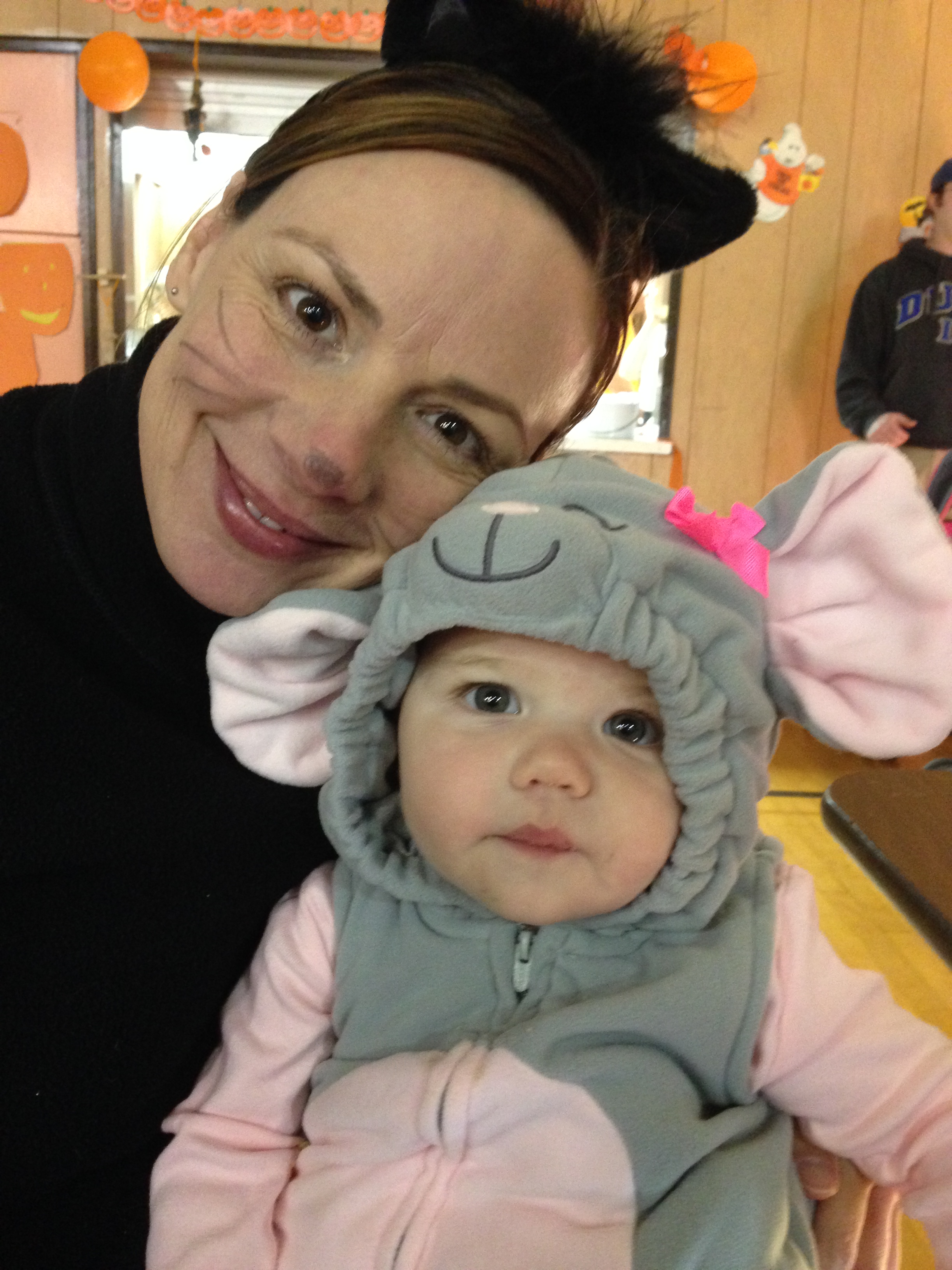
me and Estelle HalloweenI remember thinking to myself, “What are you talking about?” as I watched the radiologist point to the small white dots on the ultrasound image of my 25-week-old baby. She was saying something about cardiac rhabdo-something and her heart, and I was really just hearing words but not comprehending anything. Then, about 10 minutes later, a woman came in the room and introduced herself as a genetic counselor and handed me an information pamphlet from 1995, (and this was in 2012). I briefly glanced at it and saw the words “mental retardation” and “tumors”. I sat there dumbfounded while she told me that my unborn baby likely had a genetic disease called Tuberous Sclerosis and would have significant disabilities and may not be able to walk or talk. Again, I thought, “what are you talking about? Are you saying my baby will not be normal?”

I got into my car after the appointment and sat there in stunned silence. I picked up the pamphlet and for some reason started reading about the origins of the disease; how it was discovered and what happened to people that had tuberous sclerosis. “Fits” and “convulsions” and “retardation” were the descriptions used early on by doctors to describe these patients. Many of these poor people ended up in mental institutions. I thought, “Will my daughter have to be placed in a mental institution? How will I be able to take care of her? What will happen to her?” Then my cell phone rang. It was the genetics counselor that I had just spoken with. She told me that she was sorry and that while I could not get a late term abortion in California, that Colorado would allow medical terminations up to 27 weeks, if that was something I wanted to consider. Termination? I had been watching my daughter grow in my belly for nearly 7 months, watching her hands and feet take shape, her face and lips develop. How could I end the life of my daughter after all this time spent together? Had others terminated their babies with this diagnosis? Was that the right thing to do, if she was not going to have any quality of life and be completely mentally and physically disabled? Were the doctors certain that she had tuberous sclerosis? All of these questions were swirling around in my head as I drove the 2 hours home that day. Two weeks later, her diagnosis was confirmed through genetic testing. A spontaneous mutation had occurred during her development. This was to be our reality and I had no idea of what that would mean to my life or to hers.

In the end, I knew that I had to continue the journey with my beloved daughter growing inside of me. I became hell bent on understanding the disease and photo-178learning all that I could about what may happen to her. I threw away the 1995 pamphlet and discovered that there’s much more information and treatment options available today than there were in 1995. Our knowledge about the disease has come a long way in 20 years. (And shame on that genetic counselor that gave me such outdated information; they should be the experts on the latest information out there on genetic disorders, even the rare ones).

On the day she was born, I knew that I was going to fight for her. To be her voice and her advocate. I knew that, while I couldn’t change the fact that she has tuberous sclerosis and there is no cure, I could get her the best medical care possible and be aggressive and proactive with her treatments. I got her into a TSC clinic and I immediately enrolled her in research studies to help learn more about the disease and to help find a cure, (and selfishly, to have more doctors track her development and provide early identification of potential issues). It gave me some sense of control over an uncontrollable diagnosis and an unpredictable future. At least I could take comfort in that.

Today, my daughter is a beautiful, smiling 15 month old toddler. She isn’t yet walking or talking, but we are working on it. She may have significant developmental delays and may require special education and assistance, we just don’t know yet. She still has those cardiac rhabdomyomas, but they are not causing any issues and her eyes and kidneys are clear for now. She does have mild epilepsy, which is well controlled with medication. But these days I just try to focus on the person that she is becoming, rather than the diagnosis that she has. She is not tuberous sclerosis. She is my beautiful daughter Estelle, who laughs and hugs and smiles and just got two new teeth.

Estelle 1 year


Forgetting Yourself…and Finding Yourself

Day 23 of Guest Blogging for TSC Awareness

By guest blogger Susan McBrine

Being a mom  is the hardest job any woman ever has. No one prepares you totally for the complete neediness of a baby, or the way you suddenly know for the rest of your life you will love this baby with a love you didn’t know you even knew how to give.

You are in awe of this feeling and overcome with joy every morning when you stagger sleepily into your baby’s room and see her tiny face light up when she sees you.

No one  can prepare  you for the absolute wave of grief that hits  you, however, when a few months later, a strange doctor tells you that  baby has tuberous sclerosis .

The baby you envisioned watching graduate from school, get married, become an adult… All those dreams of normalcy seem to vanish with two words spoken from a person you now want  to slam your fist into and call a liar! You ask why, why? And you are angry, sad, and finally determined to fight this disease. You also know that nothing will change the love you feel and nothing will stop you from getting this child the medical help she needs to live a happy life.

As the years go by , perhaps you have other children, perhaps your marriage fails or gets stronger, perhaps your friends you thought you had fade away from your life because your every waking minute is consumed with caring for the child who now has brain tubers, seizures, too many medications to count, kidney tumors, behavior problems, autism  and major developmental delay. Those friends have been replaced with, perhaps, other moms of a special needs children, who are  the only ones who understand your devotion to this special child. The child, who despite driving you mad several times a week,  is so endearing when she finally can say ” I love you ” and finally can interact and play with other children .

Your heart breaks for her every day and your heart celebrates every day at her slightest progress because it is a huge long-awaited accomplishment. You  stay awake at night wondering how you will pay for her medication, whether you are being a good enough mom to your other children, a good enough wife, a good enough teacher, worker; and you worry, most of all, if your child with TSC will live, have a quality of life , a future. And what will happen to her if something happens to you?

What you don’t worry about is yourself. You’ve forgotten to worry or even think about yourself most of the time because there is no time for you. Doctors’ appointments, IEPS, hospitalizations, blood tests, therapy appointments, more doctors’ appointments, medical tests, MRIs, EEGs, sonograms, surgeries, psych evaluations, teacher conferences, trips to pharmacies …

It seems endless and every few years another body part or organ pops up with a TSC symptom and you grieve all over again for the healthy  child you  dreamed of and you cry for the suffering  one you have now and love so much. The tears are always there just below the surface.. But so is the joy  that she has defied the doomsday prognosis, the life expectancy. And she has taught your other children compassion, kindness and tolerance. You are so proud of them and grateful they are healthy and normal.

You thank God for every day she lives and beats TSC and you thank Him for making you strong enough to raise her. One day you realize she has made you a better person! But your marriage may not have survived the strain because he was never really committed or never really dealt with his grief. It’s too late to wonder why. The marriage is over. It ends when you understand he isn’t capable of  standing by your side and never was.

Or your marriage and bond grows stronger, if you have the right  man, because of this special child.

Your child is now an adult with, perhaps, a child’s mind, and  you have spent your adult years in a career working with teens and children in regular and special education while raising your own and you realize you’ve  still forgotten yourself.

You’ve spent many hours explaining to friends, relatives, doctors, teachers and strangers what tuberous sclerosis is and helping other mothers  cope. And insisting to them that you are neither a saint nor a martyr for choosing to raise this child despite the many people who say,”I don’t know how you do it.” Sometimes they say that because they are secretly wondering if they could do it if it was their child. The answer is simple . You have no choice. Your child needs you.

One day you also realize that finding yourself will be the healthiest thing you can do. You meet and fall in love with a real man, just when you thought they didn’t exist (as I did) if your  first marriage has failed. Eventually all your children, except  your TSC child, leave home to successfully live their own lives. And then your worst fear comes true. TSC has won the battle. And in my case the following happened:

Your TSC child’s second kidney is failing after endless hospitalizations and medical complications, including a year with a feeding tube. Dialysis and transplant are considered, agonized over, and then your trusted pediatric neurologist and you make the decision that she would not tolerate either successfully, only prolonging her suffering. You can no longer care for her at home and work also, which you have to do, so you reluctantly, sadly, place her in a group home  with a nursing facility where she is surprisingly happy and social for a time. Meanwhile, you continue to work and travel two hours one way to visit her on weekends when you can get there.

About a year later she is facing complete and total kidney failure and you are facing hospice care for the child you fought and battled for 30 years to keep alive. Now you realize you have to allow her to die and end the suffering…it seems impossible to bear the grief  this time.

Even though you are finding happiness in life, your world is collapsing again because your baby, your first born special child is dying and you have to let her go after a lifetime of helping her to live. How does a mother endure this pain after you were chosen to learn all the lessons raising a special child has taught you? You lie awake at night wondering and  greiving all over again and you ask why? Why?

There are no answers…but you know after burying this child that the hardest thing a woman can do ever  is to be a mother and watch your child die.

Your other children continue to bring you great joy, pride and love in your life. You are so thankful you were able to experience the joy of raising other non-affected children to adulthood. Yet  you will always grieve for your special child and miss her unconditional love, total innocence and uncanny sense of humor in spite of all her suffering.

Yet you have found yourself finally…. Because you realize you were meant to be her mother to become the person you now are. This was my TSC journey and one typical of so many other TSC moms who have made similar journeys. But their journey will be more hopeful and less lonely because of the Tuberous Sclerosis Alliance. I hope all the moms find themselves because I know we all forgot ourselves for a time.
Global awareness has increased today. And there WILL  be a cure.

photo-9

Focusing on Today

Day 22 of Guest Blogging for TSC Awareness Month

By guest blogger Cassie McClung  (Houston, Texas)

Avery1My husband and I learned that we were pregnant in the late spring of 2007. Married just two years, we were a bit surprised, but honestly thrilled beyond words. We had a ton of fun preparing for our new addition, even despite the fact that I was so horribly nauseated for the first five months that I lost 12 pounds. Her development, however, was always right on track, and every test and check-up went well. Just a month before her due date, we decided it would be fun to get the new 3-D ultrasound photos that we kept seeing at the doctor’s office. We ended up trying three different times. Every time we went, the baby had her arms up around her face, completely covering every feature. The first time was kind of cute. The second time was a little frustrating. The third time I asked the technician, “Isn’t it a little unusual to have her arms up every time?”

“Yes,” she said, flat out, “I’ve never experienced this before.” I remember my heart went into my throat. Could something be wrong? The doctor dismissed my concern later, telling me not to worry. I tried not to.

The next thing I knew my delivery date was around the corner but the baby was in breach position, so a C-section was scheduled. In late January of 2008, we were blessed with our beautiful daughter Avery. The surgical delivery went well, but within an hour of her birth, I was surrounded by a number of doctors with very serious faces.

They were concerned because it appeared that our precious newborn was having small but frequent seizures while under observation in the nursery. They bombarded me with a million questions at once. “Was she seizing in utero?” is the one that still stands out. WHAT?? What does that feel like? This was my first pregnancy. She kicked a lot, does that count? Were there other signs I should have noticed? I was stunned. Immediately, the doctors sent her away to a bigger hospital with a higher level N.I.C.U. I remember my Avery2delivery doctor turned to me and said, “I’m sorry,” before walking out the door, not to be seen again.

My husband and I were absolutely shocked and terrified.There was no holding, cuddling or bonding.  I tried to recover quickly from surgery, all the while imagining my baby girl across town under the care of who knows who, doing who knows what. Complete and utter torture. This was when I started thinking about the genetic condition that runs in my husband’s family. We were told previously by family members that we should not worry about it…that it was basically no big deal. Then I heard someone at the hospital say it for the first time. TS. Tuberous sclerosis. We hadn’t a clue.

I broke out of the hospital early and rushed to the N.I.C.U. I couldn’t believe how tiny she was, hooked up to so many tubes…all of the nurses knew her name. My Avery. They already knew so much about her. They’d spent so much more time with her than I had. It felt so strange. At first glance, she looked pretty and pink, sleeping peacefully like a typical newborn. And then I saw it. All of a sudden, she puckered her little lips, turned bright red, and her right arm extended straight out. It faded quickly, but there was no mistaking that she was seizing. Nothing could ever have prepared us for what happened next.

We were shown into a large meeting room across the hall. A doctor sat across from me and five or six med students and residents sat next to her. I’ll never understand why they were invited…why they needed to sit and watch this intrinsically personal experience unfold. They never spoke, just watched. The doctor slowly explained to us that Avery had been born with a rare genetic condition called tuberous sclerosis. Benign tumors grew willy nilly in her brain and heart. She had many of these growths in the left side of her brain, which were causing massive abnormalities and resulting in seizures. She also had a few in her heart, but they were not affecting her breathing, and we were told they would eventually disappear. Small victory. The ones in her brain, unfortunately, would not just go away.

Avery3So that’s when Avery’s brain surgeon appeared. Yep, my daughter has a brain surgeon. Surreal. And that’s when we found out that our newborn needed a radical brain surgery that was meant to end her seizures, or she would not survive: a hemispherectomy. The two sides of the brain would be disconnected from each other, and large portions of “bad brain” would be removed from the left side. Before we could even begin to digest this information, the surgeon went on to explain that he had never performed this surgery on a baby less than nine months old, and most of his colleagues had told him he was crazy. But that it was her only chance.

This is the part where I have to pause and breathe. Because more than two years after the fact, I can still feel the residual effects of this man’s words pulsating through my mind and body. I can still close my eyes and remember the breath-stealing sobs I cried as I said goodbye to my week-old daughter and heartbrokenly handed her to the nurse that would take her to the operating room. We waited hours and hours, hardly breathing, wondering if we made the right decision. It was, and Avery did beautifully. Her strength amazed us. It still does! She was in and out of brain surgery three times in her first month of life. She came home after one month and five days in the hospital, eating on her own, cooing and wiggling. The seizures had completely stopped. We had renewed hope, renewed faith. Her future appeared so much brighter.

We were told by the doctors that there was really no way to predict her future as far as cognitive and physical ability; but the upside was that the earlier the surgery, the better– i.e. giving the “normal” side of her brain time to take over tasks that the opposite side can’t handle anymore…and we couldn’t have done it any earlier!

Avery actually needed two more brain surgeries, at three months of age and at five months, before the seizures stopped returning. She continued taking Vigabatrin (Sabril) for the next four years as a back-up, in case they did try to come back. It was the only drug that had ever slowed down her seizures before.

For four years, Avery thoroughly enjoyed a total break from seizures, as did her parents. We were busy attending to her other many needs, like the fact that the surgery had resulted in the left side of her body being extremely weakened (hemiparesis). No one ever mentioned this side effect before surgery. It was then, and is now, our biggest challenge among many. When she was still not sitting up by herself at 18 months and after lots of therapy, we knew we needed a lot more help. We were lucky enough to find an amazing, private special needs preschool that had experience with children just like Avery. They taught her to sit and scoot. They taught her sign language, how to drink with a straw, and how to use a fork and spoon. And they continue to teach her now. I don’t know what we’d do without these amazing teachers that love my daughter for exactly who she is, and not what she lacks.

Sadly, this past year the seizures returned. We were devastated of course, but not surprised. We knew it was a miracle that they stopped for as long as they did. They are under Avery4control again now with new meds: Onfi and Vimpat. She seems a little more tired now, but overall a happier disposition.

Walking is still our biggest goal. The left side of her body just doesn’t want to cooperate! Although still extremely developmentally delayed, her cognitive skills continue improving. No words yet, but lots of sounds. We have three PT’s, two OT’s and two SP sessions every single week, on top of her school “work.” Avery works harder than any kid I know, and she does it with a smile. She has taught us endless lessons about love, grace, and the simple joys in life. Almost two years ago, we were blessed with another sweet girl! A healthy, TS free little sister, who dotes on her older sister.

As many special needs moms have said before me, it’s impossible to focus on the future right now. In order to get there, we have to focus on today. Today she is healthy, happy and working as hard as she possibly can to reach her potential. What that is, no one knows, but we will move heaven and earth to get her there.

Please check out Cassie’s blog at www.abubslifeblog.blogspot.com

Alee’s Advocate

Day 21 of Guest Blogging for TSC Awareness

By guest blogger Mindee Mata  (Kilgore, Texas)

photoWhen I was first asked to write about Alee I thought..sure ..no problem..I have been Alee’s advocate, her voice for 4 years. I can talk about her forever. As I prepared, I realized that on a daily basis I intentionally put all the horrible parts of her disease in the back of my mind. Her past…her future… I can not think about those things. I have to think about today and today is good! But in order for you to understand Alee I needed to revisit those things.

When Alee was born she was perfect…just like every baby should be but I was still scared to death. I had a 17-month-old and a 4-year-old. I wish I could say I enjoyed every minute of her infant stage but in reality I was on auto pilot until the day after her 6 month check up. She was falling asleep, but every time she started to doze off she would almost jump. It reminded me of the infant startle reflex. At first it just happened every now and then, but it gradually became so frequent that it happened every time she would try to sleep. It would happen all night long off and on with crying in between the clusters. I met with her pediatrician at the time but he had no answers. I called an old pediatrician I had used when we lived in Houston and even went to see her. She set us up with a neurologist but still nothing. Four months went by and she eventually stopped. I was relieved but deep in my heart I knew something was still wrong. My whole life changed one night when she was 11 months old. We were getting ready for bed and she seemed hot, so I gave her some Tylenol and thought she must be getting sick. We went to bed. A little while later I heard the awful noise…the noise I would start hearing so frequently I could hear it in a stadium of 100,000 people. Alee gasping for  breath. I looked at her and she looked like she was in a daze. She could not make eye contact and was completely limp. The only noise was her trying hard to breath. I had no clue what was going on. I had never seen a seizure before, especially one that started like this. My husband called 911. After 20 minutes of the blank stare, the all out seizing started and she stopped breathing all together. I had to do CPR on my baby girl…me…I just did it because I had no other choice. There was no time for an emotional breakdown. The EMT’s arrived, gave her an IV, and headed for the hospital. She was still seizing. At the ER we were able to stop the seizing but her breathing would not return to normal. They were forced to intubate and call for life flight to take her to the nearest pediatric ICU. My husband and I watched all of this basically in shock. I held her, sang to her, kissed her, but I held it together…until she was being loaded on the helicopter and we could not go with her. I looked at her little body all attached to wires and tubes with tears running down her face but no sound. I felt so helpless. The next 30 minutes felt like a lifetime as we drove entirely too fast to the hospital. In my mind the next part is just a haze of doctors, tests, sedation, and questions, but still no answers. We were in the hospital for five days until finally we had a diagnosis. There were eight doctors in the room when they came with her test results. I can remember watching the second hand tick by behind the doctors head because if I did not make eye contact it would not be real. She had tuberous sclerosis. WHAT!! What was that?  And there is no cure? What do we do? Do our other kids have it? We had so many questions, but we finally had a reason for why Alee was sick.

The next year was the hardest thing I have ever had to go through in my life. Alee was in the hospital 1 to 2 days every week. We could not get her seizures under control.  We were photo-18trying every medication available and we just had to wait and see if any would work. She literally ate, slept and seized. My whole life revolved around the seizures and the hardest part was it was affecting my other kids. My son was looking forward to kindergarten, so his first day of school we all got ready and headed out to walk him in and get some pictures. Our house was only three minutes from school, but it was just long enough for Alee to try to fall asleep and the seizures began. As we were walking in Alee started having a long seizure so I had to lay her on the grass in front of the school on her left side and start getting my emergency meds ready. My son was so nervous he was going to be late on the first day, so I gave him a hug and said, “I know you can remember how to get to your class so go ahead and go and I will be there in a few minutes to check on you.” He is so brave. He went and  I watched my 5-year-old have to grow up too fast because of this terrible disease. Alee’s sister went with me everywhere. I was forced to stop working because Alee need 24-hour care and I did not have any family in Waco. Alee was having to get blood work all the time because we were changing meds so frequently and we needed to know how much was in her blood. She had so many IV’s and blood draws that her little veins just collapsed. At one visit they strapped Alee to the board and started trying to get blood. No luck. By stick nine she was screaming and in and out of seizures. The tech was crying and I looked over at Isabella who was sitting like a big kid in a chair and tears were just running down her little face.  All she said was, “Mommy, please make them stop.” Well, I basically lost it then. After stick 14 there was still not blood so we called it a day and would try again tomorrow. I realized that we were all suffering. My husband and I decided to move closer to family so we could have some help with the older kids. And..well..that was God’s plan all along. We had not even started looking for a job yet when my husband received a call that there was a job opening in his home town.  So, within a few months, we moved to Kilgore.

Alee’s social worker at the time told me about a clinic for TSC kids in Houston so I got on the waiting list. After a long 4 month wait we were finally able to see the docs there. Her new neurologist wanted us to try an experimental drug, Sabril, and at this point I would have done anything. I gave it to her for the first time on a Monday and by Thursday she was down to three seizures a day. My prayers had been answered. But the downfall of this drug is it can cause permanent vision loss. Today Alee has lost a little of her peripheral  vision and once that is gone it will take it all. So, we were forced to make a decision. How much vision loss is too much? So when all of her peripheral vision is gone we will take her off the one and only drug that is keeping her from seizing out of control.  We will start the cycle all over again…this may be in six years or six months. We just have to wait and see. On top of the seizures she has tumors in her brain, heart, eyes, skin, face and kidneys. We will more than likely have brain surgery at some point. She will develop polycystic kidney disease, go into kidney failure, and be placed on a transplant list. I know the reason God made her so strong willed…it is because she is going to have to fight for the rest of her life! Her struggles are not going to get any easier, just harder as time goes on. When you think about your children in the future you picture them playing with their friends at recess at school, falling in love, going to college, getting married, having children, but that is not the life that was given to Alee. She has a different path. She is going to be an advocate for TSC. She will help find a cure for this horrible disease.

I wish I could say I was always this positive, but in reality, some days you just want to give up. The loneliest place in our house is the laundry room. That is where I go when TSC gets too big for me to handle. Many, many breakdowns have happened in there, but it is also where I pull it all back together. The emotional side of any disease is too much for most people, but that is not all that is involved when you have a sick child. We are struggling now with so many decisions because she is about to turn 5. Public or private school? What things do we fight for on her IEP? How do we handle that she does not sweat due to long-term use of topamax or her sleepiness from all her meds at school? How do you send your baby to school knowing that she cannot communicate well enough to tell you what is happening there?  I really do believe that God carefully chooses special needs parents and children. You have to be strong, patient, and sensitive at the same time. You have to be able to comfort your seizing child while fighting the ER doctors for her life. You have to be able to hold it all together when the specialty pharmacy forgets to send her meds and you know the outcome will be a life-threatening hospital stay.  Our entire family fights the TSC battle every day and we will not stop. We will give everything but up!!!

And now a word from another mother…..

I’m a guest blogger over at Captain Jacktastic today!

quilterina's avataryou don't know Jack

We are still in May
And that means

We are still in TUBEROUS SCLEROSIS AWARENESS MONTH!!

I asked my internet friend and mother of Connor– an adorable, sweet boy who also has TSC – to tell HER story.
Here she tells us about the diagnosis, and her journey…..

Please be sure to check out her son’s Facebook page here, and her blog here.


image-3image-2


I worried about so many things when I was pregnant. I researched the best prenatal vitamins (didn’t find much conclusive). I decided I would not have the occasional glass of wine until I was out of the first trimester, which turned into the second trimester, which turned into after birth. At most I had a sip or two at a wedding and indulged in an O’Douls. My doctor talked me into a flu shot, and then I spent the next two nights…

View original post 1,033 more words

Love For Lani

Day 20 of Guest Blogging for TSC Awareness

By guest blogger Kimberly Clisbee  (Los Angeles, California)

childrens hospital 020
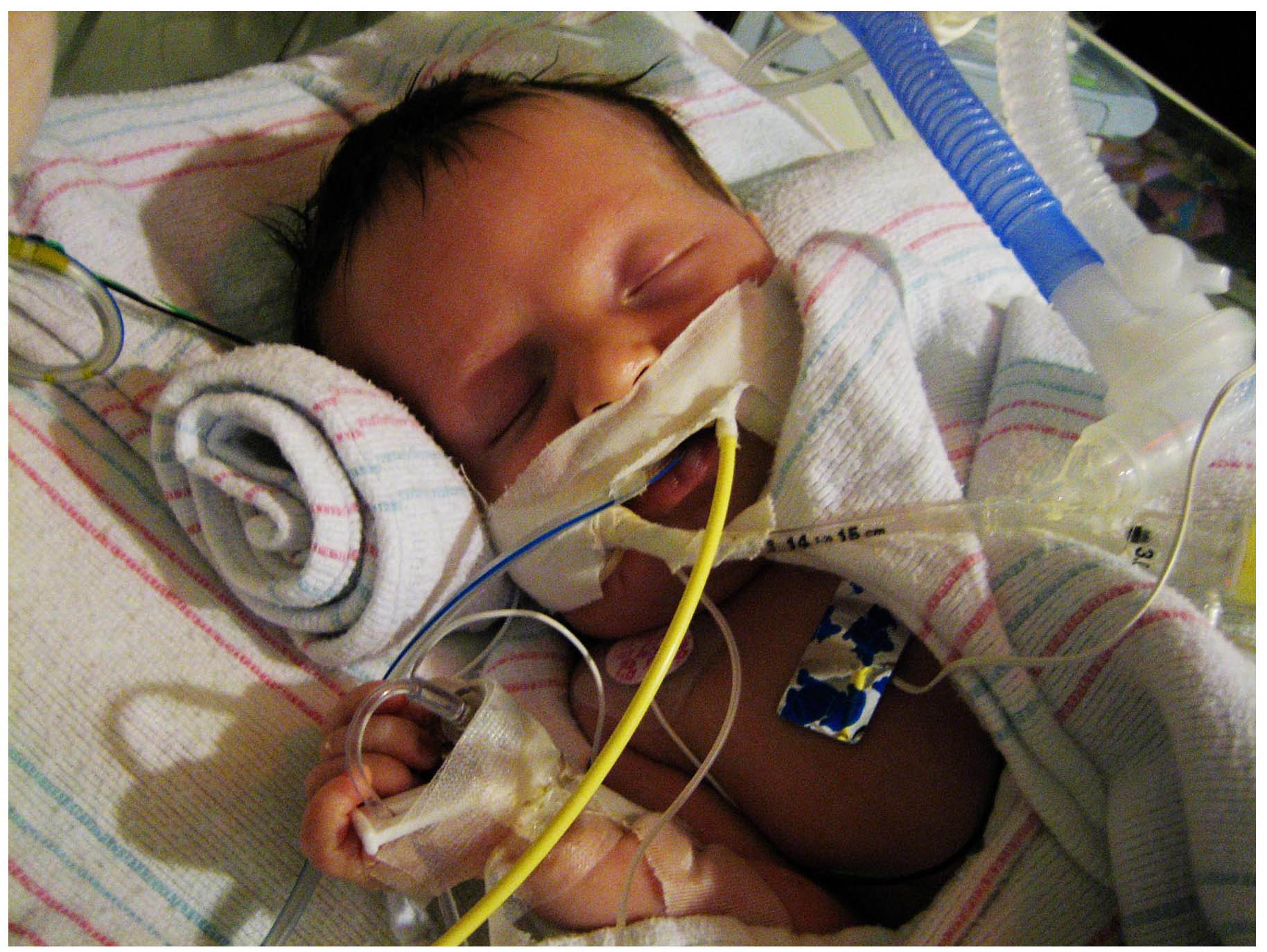
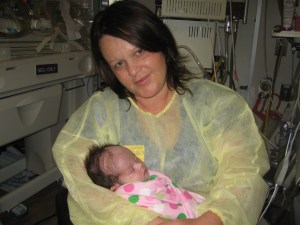
When you are expecting a child everyone has advice to give. What diapers are the best, what to do for a fever, rash, or tummy aches. But no one prepares you to hear the words “your baby has brain cancer.”  I would like to bring you on Lani’s journey and share with you her struggle and successes with this dreaded disease that we now know to be tuberous sclerosis.

I moved to California from NH in hopes for a better life. It was 2009 and we were in a deep recession. I was unemployed and could not find work to save my life, so I enrolled in college in the pursuit of a bachelor’s degree in criminal justice. I attended school for a year, but as my unemployment was coming to an end, I needed to find employment to pay the bills.

At the time I was teaching martial arts and had a great opportunity to open a school with a martial arts colleague of mine in LA. During a business meeting in September of 2009, I met Chris,  and we fell for each other almost immediately. For the next three months he would fly out to visit me while I was closing out my affairs in NH. We would drive out to California on December 27, 2009. In February of 2010 I discovered I was three months pregnant. The plan was that I would give birth, then go back to school to finish my degree and get a job to support my family. When I arrived in California, Chris revealed that he was disabled and could not work due to seizures. He was scared to tell me because he thought I would leave him. But I am not that way. If you love someone, you love them no matter what.

When Leilani was in my tummy everything was fine. I had placenta previa when I was pregnant, so I had monthly ultrasounds which never displayed any developmental childrens hospital 042problems. I was always told everything looked great. I also had an amniocentesis which came out fine. So when I had Leilani on August 26 I was expecting to have a perfectly healthy baby girl. From the first moment I held her in my arms I knew something was not right. She seemed to jump and twitch every couple of minutes. I kept asking the doctors if there was a chance these were seizures since her dad had a history of seizures, but I was told they were infant twitches, common to newborns.
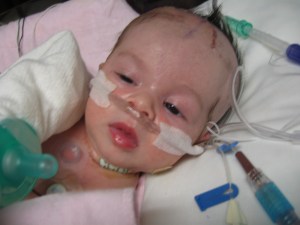
Well I have been around a lot of newborns in my life and I knew it had to be more than that. Trying to breast feed was also a big challenge for Lani. She would start off fine but then start jumping and end up stopping a couple of minutes in. The doctors again said everything was normal. Finally two days before we were to go home I called the nurse in my room because Lani’s breathing seemed labored. They brought in a respiratory specialist that said that Lani did not get all the fluid out of her lungs when she was born and needed to go to NICU until they were clear. I was relieved.

I thought that was it; she was just having problems breathing and the everything was going to be fine. That was on Saturday the 28th. The next morning at 6:00am I was woken up by the NICU doctor in charge. She had informed me that Leilani had a seizure at 3:00 am and was down having an MRI. Since Lani was delivered by caesarian they told me they were just waiting for a wheelchair and then they would bring me to her. I never hopped out of bed so fast in my life and started down the hall towards the elevators. Radiology was all the way on the other side of the building three floors down, and I think I made it there in light speed.

I don’t even remember being in pain, it just went away right at that moment. All I felt was fear. They were only a level 3 hospital, so they did not have the ability to perform contrast MRIs. All you could see was a 7 centimeter shadow taking up ¾ of Lani’s right hemisphere. She was immediately sent to CHLA. She would get the care she needed there. Unfortunately I was stuck in the hospital until the next day, so I sent Chris and my mother with Lani. That was the longest night of my life! I was alone, I was scared and I was asking every five minutes if I could leave. Finally, the next day around 2 pm, I was released.
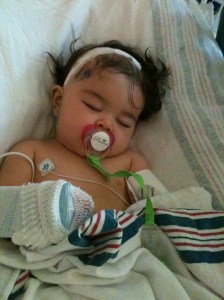
surgery 2011 022We went straight to the NICU. She was hooked up to so many machines and had so many people around her. I literally felt drunk. So many people were coming in and out, introducing themselves, telling me not to worry, as if that were possible. Finally one of the doctors came in and told me they were able to perform a contrast MRI on Lani and what they were seeing was a solid mass. They needed to do a biopsy ASAP to determined what it was. So on September 9th at 7:00 am Leilani went in for her very first brain surgery. She was only 13 days old.

Knowing that your child is going to be in the hospital long term not only holds an emotional strain but a financial one as well. We live 60 miles from the hospital, and in LA traffic that could take up to 2 hours both ways depending what time you left. For the first week we had to commute back and forth and since I couldn’t drive. My poor mother who came out for two weeks had to cart me around. This was very hard for her. Not driving me around but the whole thing. She came out to see her granddaughter come into this world and to help me and instead she got to take part in this nightmare.

She was only able to stay for a couple of weeks and in that time she had to rotate seeing the baby with Chris, hold her granddaughter in a hospital room full of sick babies, and leave without knowing what Lani’s fate would be. Thank you Ma, and I am sorry you had to go through that! We met with a counselor, Glenda. She helped us arrange everything we needed for Lani- business, personal and otherwise. She organized Lani’s baptism which was held in the hospital before my mother left, and she hooked us up with one of the greatest organizations ever! The Ronald MacDonald House.

They made things so much easier for us!!! They are right across the street from the hospital. They have a fully stocked kitchen at your disposal, your own fridge space and cabinet space so you don’t have to eat out. They have a laundry room, gym, counselors, and most nights, volunteers come in and make dinner for you. The charge $25 a night but it is based on your income, so if you can’t afford to pay they waive the fees.

We met a lot of other wonderful people there that were going through their own struggles with their children. We bonded with a few of the families, but sadly, over our 43 day stay we witnessed half of them lose their battle. That was one of the hardest parts. These people were people we had coffee with in the morning and exchanged stories with, we would take the shuttle back and forth with them, our children were in the same rooms. Until one day they weren‘t. And you see the other parents in the hall crying, and they don’t really want to talk to you because your child is still fighting and theirs lost their fight. I pray for those families every day, and I thank GOD it was not us. People don’t realize the ¼ of the children in a NICU never make it out. We were one of the lucky ones.

I decided early on that I was going to act as if this was a normal for Lani’s sake, so I was there 12 hours a day. I brought clothes, toys and bedding from home. No hospital stuff was to be used. I would be there at every feeding, bath time and doctors rounds. If I was going to do this I had to stay strong, so there was no crying allowed around Lani.

One of the first thing a child learns is emotion and they feel that through their parents emotions so I tried very hard to keep it as normal as I could. Don’t get me wrong, I lost it plenty of times!! But I would leave so she wouldn’t feel it. She was not able to feed from me so I pumped every three hours. I read her bed time stories every night and held her all the time. Singing to her and telling her all about her room, her family who loved her, and what we were going to do when she got home.

I really think that mental mindset made a big difference for everyone. It helped me cope with what was going on and gain control over my situation, as well as seal the bond between Lani and I. Mom had to leave and it was time for Lani’s biopsy. I was never so scared in my life. The surgery took three hours which felt like an eternity. We had to wait a week for the results so in that time we just tried to stay positive. Leilani was having a seizure about every 10-45 min. Her oxygen levels were always good which is what you want; no oxygen is what causes brain damage. But she was having infantile spasms which are very dangerous and usually don’t show up until 6 months of age.

I had to convince them that was what was going on. The nurses kept telling me no, she could not be having infant spasms as a newborn and moved Lani to the back of the room. They took her from having two nurses to having one nurse who was not even paying attention to her. Well that was my first run-in with the nurses, and not the last I assure you! I called the head of the department of neurology. Lani being such a rare case it was easy for me to access anyone and everyone. Everyone wanted to be part of her story.

I told him what was going on and insisted they look into her seizures so there was no more doubt or guessing. So he did. He called down to her room, reprimanded the nurses, and had them move her to the front and reassign the other nurse. They were not happy with me but I didn’t care. I was not there to make friends, I was there to save my daughters life. Most of the nurses were great I must say, but there were a few that just didn’t work for me and I let them know it. You have to. If you see something that seems wrong it probably is, and if you do not open your mouth and address it you have no one to blame for the outcome.

They performed an EEG and it confirmed they were infantile spasms, which in itself was extremely rare. The hardest part for the staff, as well as us, was that they have never seen a case like Lani’s before and they had no idea what to do for her. Finally the pathology came back and we were called into the conference room. When we got there we saw ten people sitting around the table, some we knew and some we never seen before. We were told that Leilani had a rare form of brain cancer called “Congenital Gemistocytic Astrocytoma” and that there were only three other known cases in medical history. The other cases were successful but Lani’s case was a little more complicated. She had one big tumor and two small tumors on the right. But she also had one small tumor on the left.

They could only operate on one side and it had to be the right, so they told us it didn’t look good. They said if I never had the respiratory nurse check Lani’s breathing and she went home she would have died in a few weeks. Then they went on to say that her chances of surviving such a big surgery for such a small baby were slim, and if she did make it, the left side would eventually grow, and if that happened than there would be nothing they could do. They suggested the unthinkable. Just take her home and let whatever happens happen. I told them that was not an option! If she dies in surgery then that is what happens, but I was not going to sit by and do nothing! I don’t care if you have never done this surgery on a 3-week-old! But either you take her to UCLA or I will, but she is going to have this surgery! At first they told us they were going to take the whole right side, but they only took the frontal lobe and part of the center portion.

The surgery was a success! Her seizures were gone. Her pituitary gland went into shock as a result of the surgery, so she developed diabetes incipitus (water diabetes) and renal disorder. She had to go home having two shots a day of DDAVP (a really dangerous drug that controlled her sodium levels) along with phenobarbital and topamax to control her seizures and hydrocortisone to control her adrenalin. All this adult medication for this 7 pound baby, but if it was going to help, who am I to question. I am not a doctor. Boy has that attitude changed! I was just so happy to take her home! She didn’t sleep the first few days because of the dark and quiet. She was so used to all the lights and noise of the hospital. We were so hopeful that this would be it.

Lani was released from the hospital on October 14. We were so hopeful that this was going to be it. That she would come home and recover and never have to have another surgery again. The first week home was great, she progressed so much! She was smiling and playing, doing all the things a two-month-old baby should do. A week later, mother came to visit. Everything went well, my mother got to see Lani out of the hospital, and Lani got to spend time with her Grandma. It was the night before my mother was to fly back to Boston and I was getting Lani ready for bed. She was lying on my bed while I was puttering getting things ready, when I looked down at her and noticed she was kind of breathing funny and her eyes looked red and a little watery. She almost looked as if she was scared. We didn’t make much of it and went on with our night hoping it was nothing.

Two days later I noticed it happen again. It was really hard to tell because it lasted seconds and she didn’t have any typical seizure signs. But I knew. My heart dropped. We called her doctor the next day and told her what we were seeing. She said it didn’t sound like a seizure but she wanted her to have an EEG anyway. So we went in for an EEG and it was confirmed that she was having seizures again. Her doctor told me that her visual signs and EEG results were so slight, it was hard to tell what was going on. She asked me, “What, do you do stare at her all day?” And I said, “Why yes, I do.” She laughed and called me the “seizure dog mom.” She said that they had to look at the video over and over again to see what I was seeing. I replied, “Well, I am a mom and moms just know.”

The performed an MRI just to be sure that it was a tumor causing the problem and they found one on her temporal lobe. They scheduled to have a temporal lobe resectioning on November 30. In the mean time Lani was still receiving two shots a day for diabetes insipidus, which I insisted she no longer had. But I would fight that battle after Lani’s surgery. This surgery was a bit of a nightmare. Before surgery (as most of you know) you can not eat for 12 hours, so when it is a baby they try to get them in ASAP. Well, the scrubber in the operating room was not working and since Lani’s doctor did not want to use another room, we had to wait three hours. She was seizing every hour, and she was hungry and scared. It took them five times just to get an IV line. Complete nightmare! They finally took her in and then the waiting game began. This time it was nine hours! I was so scared. I kept having them call to make sure everything was ok. Finally the doctor came up and told us he got it all out and she was on her way to the PICU.

The first person we met the PICU was Lani’s nurse whose name I can’t remember. She was a good nurse for the most part- nice enough. But the thing that I remember the most was when I walked in and she was ordering insulin along with Lani’s other meds. When I explained to her that she didn’t have sugar diabetes, that she had diabetes insipidus and needed DDAVP she said to me, “What’s that?” Scary right!? But then that was followed by, “Thank you for telling me! It gets so busy in here that I don’t always get time to read the charts.” Well needless to say, I didn’t leave that night! Thankfully we were only in there for one night. We were transferred to the main floor the next day and released two days later. This was a relatively easy surgery for Lani and she was back to herself in a couple of days. They used the same incisions, so there was no new scaring and most importantly, no seizures for three weeks…

So after three brain surgeries we are right back where we started. But this time she is having infantile spasms again, along with her regular partial onsets. They were not sure if Lani could have more surgery being so young so they wanted to go the medication route. What does this mean for Leilani? More medication. The upside is that her seizures would eventually be under control. The downside is that you are filling your baby with poison that could give her all kinds of other problems.

These medications have serious side effects and as a mother I had to research each and every one so I would know what I was willing to try and what was too risky. I do recommend you for the most part listen to your doctors, they didn’t spend hundreds of thousands of dollars and 8+ years in school to not know what they are doing. But the reality is, hospitals like anything else, are businesses and everyone wants to get paid including the pharmaceutical companies. So don’t be afraid to say no if you are informed about what it is you are protesting.

I was finally able to convince them that Leilani’s pituitary gland was functioning on it’s own so her endocrinologist took her off of the DDAVP and Hydrocortisone J. So now she is only on four types of anticonvulsants at adult doses, and she is still having up to 18-22 seizures a day that last almost 5-10 minutes each. She has been going like this for three months, which is how long I told her doctors I would give all this medication to work. Add some subtract some, it made no difference. So I told them I want to do something else because I was not willing to let these medications ravage her internal organs, they were not helping.

They recommended two alternatives: Sabril, a drug that could damage her peripheral vision, and carried no guarantee to stop the seizures. Or a high powered steroid called Actar. We went with the steroid after doing much research. This medication cost $25,000 for a two week supply! Thank GOD I didn’t have to pay for it. But it had to be administered intramuscularly twice a day which was the hardest thing I ever had to do. My heart broke every time.. She immediately started having side effects. She was inconsolable all the time!!!! And this is a baby who is always happy. She was swollen, hungry all the time, and just flat out miserable.

Her seizures did not stop or slowed down, so after two weeks of this I wanted to stop. We went to her pediatrician for a check-up and her blood pressure was 170 over 95. We immediately took her to CHLA. Her neurologist did not want to admit her. She said the when her blood pressure got under control she could leave, but I knew there was more going wrong. I kept telling them she was having problems peeing and that she had a history of DI. This was not true of course but I knew it would force internal scan, given the fact that ACTAR can shut down your kidneys and liver.

After doing some tests they discovered her liver was ¼ larger than it should be and had a gritty texture on it. She was admitted immediately. Because the medication was not appropriate for her seizures, all the bad side effects took place. This is why it is dangerous to take medication your body does not need. After four days in the hospital I went to see her surgeon to demand he rethink Lani’s surgery. I was not taking anymore chances with medications, nor would I let her keep having seizures that could cause permanent brain damage or, even worse, kill her.

He said that it would be too dangerous and the seizures would not cause as much damage as the surgery could. It is hard to know what to think or what to believe sometimes. He has performed three surgeries on her already. I thought he truly cared; he is an accredited brain surgeon. I said I would try one more thing but on my own conditions. I would try a ketogenic diet. It was medicating, but with food; it was been proven to reduce and stop seizures. I wanted her taken off all but one of her anticonvulsants, and if this did not work I was going to do what I had to do. With much fighting over trying Sabril, which was off the table for me, considering this last fiasco they agreed.

We were getting ready to go to Boston for a visit so I asked Leilani’s doctor for all of her medical records, tests, MRI results etc. The plan was to have a doctor at Children’s in Boston take a look at her case and get a second opinion. She gave me a consolidated report of Leilani’s case. She also gave us a referral for a doctor in Orange County and stated that she has been pushing for the surgery.

We made an appointment in OC before we left for Boston and that is where we met her new doctor. If you have ever had to deal with a surgeon you know that for the most part they are not very warm and fuzzy. Especially brain surgeons! I don’t know if it is the whole GOD complex thing, or they have been numbed from seeing so much. Our new doctor was the exception to this rule. He insisted we call him Devin and hugged and kissed Leilani as if she was his own child. This gave us great comfort. To Dr. Binder Lani is a person not just006 a patient. Every time we go to his office he is introducing us to the staff that does not know us. He even keeps a picture of her in his shirt pocket.
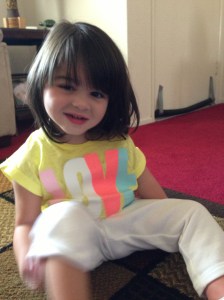
Chris and I did not come to our decision easily, this was a big surgery. For the most part, small children recover from it nicely. But Lani was only one year old and this would be her fourth surgery in a year, something that in itself is unheard of. The other issue is Leilani had a tumor on the edge of the left hemisphere. And there was a dispute on whether it was on the basal ganglia or the third ventricle.

The basal ganglia are associated with a variety of functions, including voluntary motor control, procedural learning, relating to routine behaviors or “habits” such as eye movements, and cognitive, emotional functions. And the other was the third ventricle, which is mainly responsible for storing cerebral fluids, and not as dangerous to operate on. But our doctor was sure it was the third ventricle and that it would be ok. So with that we put our trust in him and consented to operating on both sides. The decision was the toughest decision we have ever had to make. This could have stopped her seizures or left her paralyzed, but we wouldn’t know until it was all done. Sometimes you just have to trust in your gut and in GOD to that everything will be ok. And it was.

Leilani’s surgery took three hours and she was screaming “Mamma” in the recovery room. Music to my ears! She was on her way to a speedy recovery, eating and showing that she recognized us. Her surgery was a success! When they wheeled her to PICU I noticed she did not have a drain. I asked why and the doctor told me that neither he nor the hydrocephalus surgeon who assisted him thought she would have any problem draining the fluid naturally. Wrong! Within a few hours her head swelled up like a balloon. She was throwing up and screaming from the pain. I was so mad because I asked them right out of surgery if she needed it and they said no. This is something that can be done at bedside, so if they did it when I asked then she would not be going through this.

One mistake does not reduce him as a doctor to us. Yes we are still dealing with the effects because she has a little droop to her eye, lots of nerve damage, and is still on a feeding tube. But in the grand scheme of things she is alive and seizure free. So we still stand by our decision to have him as a surgeon and would recommend him to anyone. He has since told me no matter how small the surgery, because of Leilani, he will always drain, so lesson learned I guess.

She would spend the next month in the hospital recovering from this. I slept in the hospital every night. The only time I left was two hours at night to shower and eat, but other than that I was a permanent fixture in the hospital. For the most part the hospital was top notch and the staff was great. There were moments where I was glad I didn’t leave, like the time the nurse forgot to stop the drain and her CSF was all over her bed! Or the time I did leave and came back to find my baby sitting in her own throw up! Of course these instances were few and far between. We were there for a month and it was a very busy PICU. More so than any other I have ever been in. So on a scale from 1-10 I give them an 11. They were truly amazing.

We had a genealogist who was trying to uncover what caused all of this. She took one look at Chris and could see he had TSC. She asked us to talk to his doctor since he has had brain surgery in the past and was under the care of a neurologist, but his doctor said no, he had Sterg Weber disorder, so we all let the idea go. Lani’s heart was fine, and after all, she was born with cancer. As time went on, I did a lot of research online about TSC, and a week before we were to be discharged, I noticed the smallest white spot on the side of her leg.

I called the doctor in and asked if she could do a DNA test on her to rule it out. I need to know how to go forward with Lani’s treatment and what to expect. Her test results came back positive. This weighed heavy on our hearts, but it was better to know than not know. We later had Chris tested and he also tested positive for TS1.

Going forward, Lani sees every week: two physical therapists, one occupational therapist, an early interventions therapist, an eye function therapist, chiropractor, acupuncturist, a feeding therapist and a speech therapist. And this is just to be able to do all the things that all of us take for granted, like walk and talk and feed ourselves. We work with her every day all day! And that is what it will take. But she will be able to function on her own if I can help it! She is the strongest little girl I know and if anyone can do it she can. With all of this we still and always will feel blessed to have Leilani as our daughter. She has given us so much love and hope and we would not change a thing. GOD has a purpose for Leilani. I truly believe that.

Please check out Kimberly’s Facebook page: Love 4 Lani

Spilled Milk, the “R” Word, and Trees

Day 19 of Guest Blogging for TSC Awareness

By guest blogger Josh Krischel  (Dwight, Illinois)

Josh and his parents.

Life is full of lessons, as well as people who teach us these lessons, instructors if you will. When reading that first sentence you might have thought of an elder who has given you some words of wisdom, or maybe a code of life your parents always told you to live by. However, when I think of the most important lessons in my life, I don’t think of my grandparents, or my dad teaching me how to mow the lawn. Nor do I think of a single thing I’ve ever learned in school. What I do think of is the much more important things I’ve learned and continue to learn from my two absolutely amazing brothers who have TSC, Adin (13) and Mason (17). Adin and Mason are continuously reminding me to be patient, tolerant, and above all things to just enjoy the many little gifts I receive from God each day. Every morning before school, when I begin freaking out because of my intense issues with being late to events, I just slow down and take a look at one of my brothers and it just calms me down and puts a big smile on my face. Every time a situation such as that arises it always reminds me that I would never, ever, under any circumstances wish for my brothers to be any different from the way they are.

I’ll start off with a quick intro into the life of Josh Krischel. I went to Dwight Grade School for 8 years, and am currently enrolled as a freshman at good old Dwight Township High School(DTHS).  I try to, and am fairly successful at, keeping a 4.0 GPA. I play football and am part of the scholastic bowl and mathletes teams, and I also throw shot and disc for the track team. As well as trying to balance my life between all these activities and school work, just like any other teenager, I also get a bit of chaos thrown into the mix. However a bit hectic at times, I suppose chaos is a bit of a strong word. Considering I don’t know what I would do with my life if it wasn’t how it is today.

Adin and Mason both have very distinct characteristics that make them both a joy to be around. Adin, who is the higher functioning of the two, loves nature, our puppy Keegan, the weather, and always carries around a watch that has little penguins on it that he constantly looks at about every five minutes just to give us the time. Then there’s Mason who is the most joyful person to be around and always seems to have a huge smile on his face.

Now, earlier I threw out a few things I have learned from my brothers and I’d like to talk about those and how they relate to our everyday life, the first of those being patience. I’ve 553615_3801382325047_2054365817_nlearned over these past 14 years that it really isn’t worth it to get mad over all the little aggravating things in life. Just like the old saying, “there’s no use in crying over spilled milk,” which in our house quite honestly happens more than it probably does in the average household. For the simple reason that Mason, who likes to fill his glass of milk to the very brim, doesn’t have the best reflexes, so he spills quite often. So, every time this happens he just goes to the drawer in our kitchen that we keep the rags in, grabs one, and just cleans up his mess without even a single peep. After watching this happen I often sit there and just think, if my autistic brother, who is very easily upset, can be patient like that then why can’t I? The answer to that question is because I can!! Often I mess something up and begin to get frustrated, and then I just think about Mason, and his ability to keep his eyes dry over spilled milk.

Then there is tolerance, which is something I’ve learned from both my brothers. Often when we go out to eat or just have to go to store shopping, my brothers somehow find some way to make me embarrassed or to cause a scene. Well at least that’s how I used to see it. Now, whenever we are out and about and one of the two begins to say some phrase they’ve heard from a movie or something over and over, I just often let them keep on doing it and continue whatever it is I’m doing. However, in the past year or so, I occasionally even find myself chuckling at them, or even joining in quoting Finding Nemo, Cars, or The Wiggles. As far as that topic goes, having the two of them in my life has allowed me to be very tolerant for all sorts of people, whether it is race, religion, or even just personality. I constantly, day after day, am hearing people in the hallways of DTHS, using the “R” word to call someone stupid. I understand when in the moment of using this word these people don’t realize how offensive it is to some people, that or they just don’t care, but regardless, 99% of the time I will stop whatever I’m doing to call the person out on it for the simple reason that it isn’t ok. Just like how it isn’t ok to call someone a “homo” or a “faggot,” it is just as offensive to anyone who cares for someone with special needs to hear the “R” word.

294883_10200707258115803_180476492_nLastly, the most important lesson my brothers have taught me is to enjoy the little things in life. In our dining room we have a big bay window overlooking a section of our backyard, and every morning Adin will just sit there and look out at the trees and the flowers. However, one morning he seemed very spacey looking out the window. At first I thought he might be having a seizure, so I went over and sat down and asked if he was ok. He responded with just a simple yes.  I then asked him what he was looking at and he said, “I’m just looking at that tree that God made.” Then without a single ounce of hesitation I smiled and looked out the window and sat there for a good five minutes just looking at a plain old tree. This, later in the day, made me realize that I take a lot of little things for granted, and that I need to just slow down sometimes and just take a big whiff of some roses.

If I haven’t made it clear enough already, I love both of my wonderful TSC brothers more than words can describe, and I wouldn’t trade them for anything in the whole entire world. However there is one extremely wonderful, amazing, caring, and loving woman I know that has TSC, and that would be my beautiful mother. She has also helped the cause by molding me into the, not to brag, wonderful young man that I am today (never said I was modest). She has taught me how to be a loving and compassionate person. She also easily undergoes more stress than the CEO of a multimillion dollar company, but somehow she manages to keep us boys in line, and babysit her two-year-old nephew. She is probably the strongest woman anyone could ever have the pleasure of meeting and is probably the biggest inspiration in my life.

So, if there is one positive to look for out of all the troubles of TSC, it would be that TSC carriers are by far the best teachers a person could possibly ever have.

See Josh’s mom’s post here.

It Affects Us All

Day 18 of Guest Blogging for TSC Awareness Month

By guest blogger Tina Carver   (Eureka, California)

Please check out Tina’s blog at http://captainjacktastic.wordpress.com

Jackson and Tina.
Jackson and Tina.

Prior to April 2009, all that I knew about Tuberous Sclerosis Complex would fit on the head of an angel dancing on the head of a pin.
In other words:
NOTHING.
Never heard of it. AT ALL.

Once I met Jack, all of that changed.
I became Jack’s stepmom in September of 2010, and shortly thereafter, his birth mother left the area, leaving us with sole custody.

Now, I have to be honest.  The hardest part of Jack’s TSC  had already happened.  The in vitro diagnosis.  The debilitating and never ending febrile seizures.  The rounds and rounds of various seizure meds.  The brain surgery.

That all happened BEFORE.

In the TSC community I feel a bit adrift — I get asked questions about the specifics of his disease — the types of tumors, etc– and I cannot answer them.

My life with TSC is all about moving forward and making Jack’s life the best it can be in the here and now.  It is also about dealing with how the disease affects US: myself, my husband, my daughter.

Our life revolves around “what if’s”.  Every plan that we have has a back up- “just in case”.  We have emergency seizure meds in each of our cars, Jack’s backpack, the home.  We plan and plot ANY trip to make sure we are near hospitals.  My husband and I get THREE WHOLE hours a week to be adults outside the house.  My daughter knows that any school function most likely means only ONE OF US will be there (respite is a harsh mistress). Tuberous Sclerosis may have had its way with Jack, but it also has the rest of us in its grip EVERY. SINGLE. DAY.

Jackson and Dad.
Jackson and Dad.

But there are days……lovely days like last Sunday when all of us were in the backyard.  My daughter running fully clothed through the sprinklers, much to the delight of Jack who had his favorite spot on what he calls the bouncepoline.  The sky was clear and sunny.  There was laughter from all.  And it’s for these moments that we continue on.  THAT is what makes it worth it all.  We forge ahead because these moments make life worthwhile.  These moments balance those tense moments in the ER, the sedation for MRIs, and the uncertainty of the future.

Now, to be honest, how Tuberous Sclerosis has had its way with Jack has NOT been kind-

Febrile seizures have left permanent damage.
There is a thick scar that crosses his scalp from brain surgery.
There are developmental delays.  There are physical issues.
There are over 30 tumors in his brain.

But over the past few years we have seen progress.
We have speech and communication.
We have staid the growth of the tumors.
We have found the right cocktail of meds to keep away the seizures.
And Jackson the boy is blossoming……

SO what else can I say about this disease that I have come to know and loathe?
That it took away one boy and left us another.
One that I love just the same.

Jackson hanging out in Darrah's room.
Jackson hanging out in Darrah’s room.

JACKSON The Poem

In my dreams

I constantly see

You

Your smile so bright

and beautiful

A mischievous grin

to match the

glint in  those

bright blue

Eyes

You run

Untroubled

Carefree

with an easy

and natural

gait.

Laughter unfettered

Musical

And there are

no tumors

no damage

Or delays.

There is only a boy

who is

Not You.

Jack loves the number 9.