By guest blogger Paula Krischel (Dwight, Illinois)
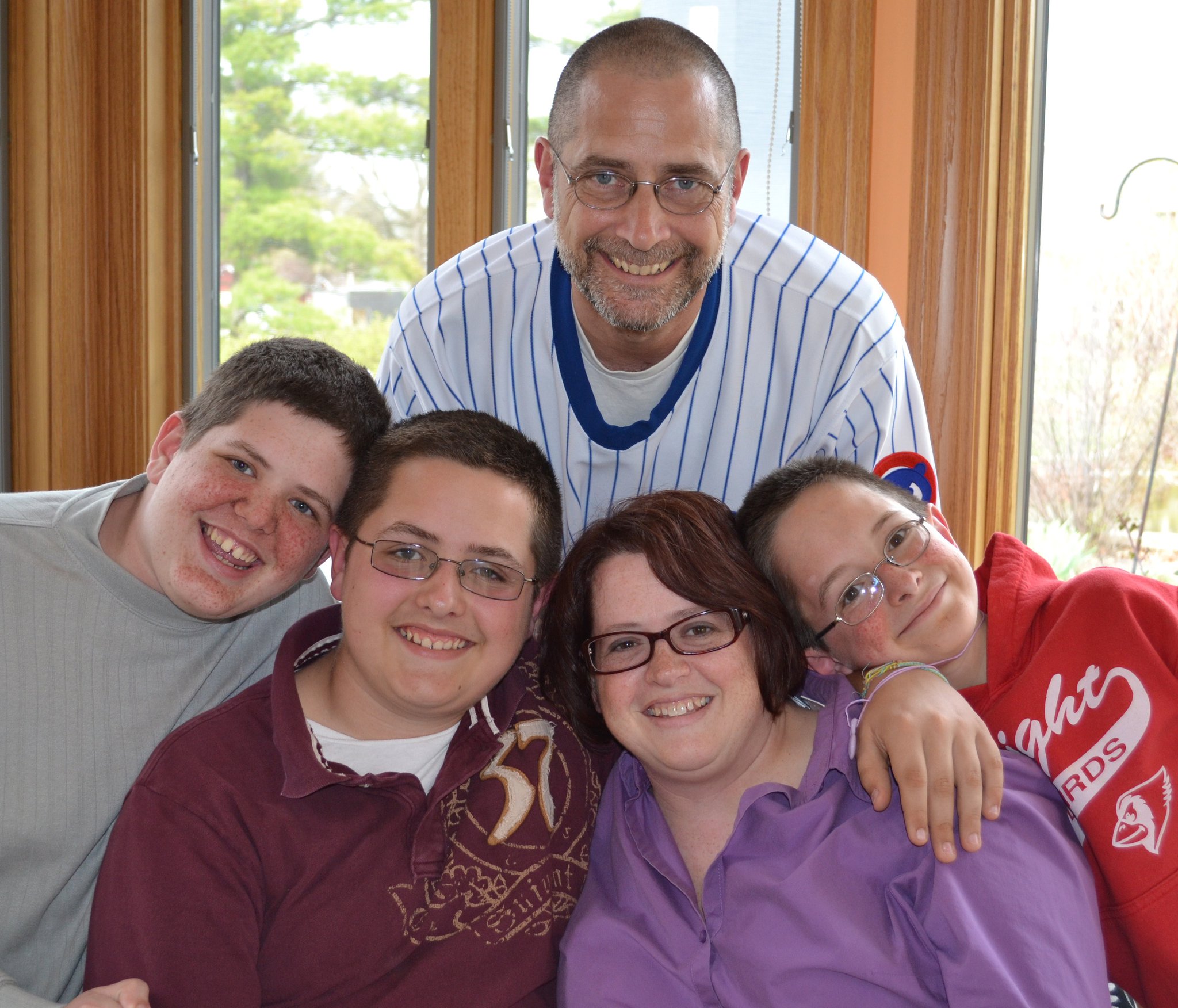
Paula with her husband and three sons, Mason, Joshua and Adin.
My story started when I noticed my infant son, who was 11 months old, puking and seizing. We went to our local hospital, and his pediatrician knew it was more than he could help with, so he sent us to Chicago. That was the first time we met Dr. Huttenlocher and started our long journey with TSC. Never in my wildest dreams could I imagine that I had this disorder for 26 years, and was completely unaware.
My world was falling apart. I became depressed, and my son was having uncontrollable status epileptic seizures. I not only had to learn all I could about this disease, and the fact we had to live day by day to see how it would affect our boy, I had to learn to accept that I do have this disease and cope with the guilt I felt about giving him this terrible thing! Mason, who is now 17, ended up having global delays; he is severely affected by this disorder, severely autistic, and will never have the ability to live an independent life. We started with therapy at a young age, but did not see much progress for many years.
We were feeling compelled to have another child, feeling Mason needed a sibling to help him learn. We prayed a lot and had Joshua. Joshua is now 14, board scholar, and wants to one day be a geneticist and work in gene therapy. As of now, he shows no signs of having tuberous sclerosis, and he wants to one day find the cure for it. We have advised him to get genetic testing done when he decides to have a family.
When my Joshua was 10 months old, I found out I was pregnant again. Eight months later I had Adin. I was not as comfortable about this pregnancy because we were planning on stopping at two. We found out through ultrasound, at seven months along in the pregnancy, that he too would have that terrible disease called tuberous sclerosis. We did a lot of praying, and even though he is autistic and has global delays, he is a ray of sunshine who can brighten anyone’s day. He is considered mild/moderately affected by this disease. He is able to communicate with us, but his older brother is very limited in his speech. Even though he started out with infantile spasms at three months, we have been able to keep his seizures under control fairly well for 13 years. He did have a breakthrough grand mal once, when going through a growth spurt. He has been under control again since 2009.
We have spent countless minutes with doctors, tests, speech therapy, occupational therapy, music therapy, physical therapy, behavioral planning, making safety plans for at school and home, and the list goes on.
Now our latest scare is me. Recently I found out my tuberous sclerosis is wreaking havoc in both of my kidneys. I get to start the new medicine Afinitor to see if we can save my cyst-filled kidneys from getting any worse. Both of my boys are on it as well for SEGA brain tumors. This is the first time I have been seriously concerned about my own health. I am the main caregiver of my boys because my husband is a very hard-working plumber, who works diligently so we can pay for all the expenses this disorder accrues. There never seems to be a very long break of good health in our family, but because of this disorder, we are stronger, more loving, and cherish all milestones that we conquer! For that I am thankful to TSC. Even though our life is crazy, and the stress seems to pile up constantly, I would not change my life for one second…and continue to look forward to the future!!!
My first child of four was born in 1971 . She lived until 2003, 32 short years. She was a joy, a beautiful baby , and I was a young 23-year-old teacher.When she was about eight months, she started crying for no reason. Then she seemed to stop smiling and rolling over, and later she started jerking her head down in a series of movements. Frantic trips to doctors’ offices found nothing wrong. I was an “overly concerned mom,” and ” it was nothing” I was told. The few funny white spots I noticed at three weeks, were also “nothing,” and the fact that she didn’t lift her chest or head up from lying on her stomach was “weak shoulder muscles.” Every doctor I saw dismissed my concerns. I wanted to believe it was nothing, but in my gut I knew something was wrong! Moms always do!
Finally, one day, she had eight separate instances of jerking her head and body in a series. I was alone with her and decided I was not going to take no for an answer any more. I drove to the emergency room and, probably hysterically, told the doctor there that I wasn’t leaving until someone told me what was wrong with my baby! Weirdly enough, the emergency room doctor was moonlighting from local AFB and had a patient, 12 years old, with TSC. He recognized the white spots and my description of the infantile spasms she was having.
He bluntly told me she had TSC and would be handicapped… Would not walk or talk and not live if her seizures weren’t controlled. I cried all the way home.
My world stopped! Life as I knew it changed forever. He turned out to be right about one thing. It was TSC! And after finally seeing a pediatric neurologist at Loma Linda Hospital who confirmed it, (MRI was not yet developed until two years later), and hospitalizing her for invasive brain tests, we had to accept her diagnosis and the gloomy prognosis they gave us.
I was told so many things that proved to be wrong. How rare it was, life expectancy, IQ expectancy, etc. And that there was no definitive genetic or diagnostic test available. And that really there was not one damn answer to any question. Now I know to question, to not believe predictions, to do my research, to develop a tough skin, and to be assertive. Doctors aren’t God. But she taught me all that in time. I took her home, loved her and wondered how I would ever survive her predicted, imminent death, as we struggled to control her seizures, first with meds, and then with ATCH shots. Welcome to the world of medication, seizures, hospitalizations, fears, tears, more tears and special education. That was my new reality. I started to research tuberous sclerosis in many libraries, poured over medical journals, medical books, books on retardation, and epilepsy only to discover what was written about TS was minimal (no internet). The disease was considered very rare, and no real research or awareness had occurred in over 100 years since it was named Bourneville’s disease. No wonder doctors didn’t know much about it. Not much was known period!
I was starting to get angry now, and when I read in the American Association of Mental Deficiency book that the life expectancy was 25 years, I knew then that no one really knew diddly squat! My pediatric neurologist was advocating institutionalization and no one had real information. I became empowered with my anger about no answers and no knowledge. I was a teacher, a reader, and yet I couldn’t find answers. Maddening! I refused to believe there was no hope! By now, she was almost two and I was expecting my second child, Tanya, after a geneticist told us Stacia was a random mutation. My older sister told me about preschool programs for special needs kids and about a magazine called Exceptional Parent. I wrote to it, asking for other parents with TS children to contact me. I thought if there were others out there, we could unite and make our voices heard. We could demand research, a genetic test, and treatments. Support could happen! I dreamed it all!
In two weeks I got 15 letters from all over the USA. Three from California. And one from a mom of a 29 -year-old with TS ,who thought she was the only case in the world. Clearly no one had ever tried to find out how many cases there were (again, no internet yet). To make a long story shorter, I found Adrianne Cohen, Verna and Bill Morris, and Debbie Castruita in California.
And ….
We started to meet and plan, write letters, call moms, have meetings and contact doctors. We created a newsletter (run off on a school mimeo machine) and a medical research survey. Adrianne helped us get our first grant, a lawyer friend helped us incorporate as a non-profit and NTSA was born.We knew if we were determined enough we could make a difference. We talked to regional centers, hospitals, child neurologist associations, and put articles in magazines and newspapers. We also hoped for a celebrity to endorse us. We lived and worked on NTSA for years. Then slowly let go and let others take it over when it became a successful reality. Now the Tuberous Sclerosis Alliance!
It spread and now it is international. I no longer have to write letters of hope to other moms from my kitchen.
We have a staff, TSC clinics, a medical advisory board, genetics test, research, a magazine, a bonafide celebrity (Julianne Moore), fundraising, and chapters all over the world. Tuberous sclerosis is no longer an unheard of disease and there is hope for no mother to go through what I did. It is miraculous really. But we still have the disease TSC…. and we still have heartache and families looking for help and hope. Now we have Facebook, the internet, this blog, and a phone call or email to the TS Alliance for immediate help and hope. My dream has come true.
Along the way I had four children, got a divorce, remarried, became a special education teacher and struggled every day to raise my TSC child, Stacia Diaz, and battle her ever growing list of symptoms. She turned out to be severely involved, mentally about three years old, brain tumors, kidney tumors, sleep , appetite problems, autism, and aggressive behaviors. She was verbal at eight and was able to say I love you (and cuss:). She was funny, happy, and taught me and my other children so much. But she also suffered, and we suffered…
And when I look back on the day she was diagnosed and remember the stages of grief I went through to come to acceptance (to learn to love her for who she was, not who I hoped
Stacia on her last birthday.
she’d be), I remember how it was a long and difficult journey. The grief never really ends. Yet today parents have support!
The end, for her, was the hardest. We watched her die in a hospice, after her second remaining and only kidney was so full of tumors that nothing could be done. She could not tolerate dialysis and a transplant. The heartache never really goes away, and I miss her every day, but I’m glad she’s not suffering anymore. I know today the newer kidney drugs might have saved her. But knowing the TS Alliance is making strides in treating TSC kids gives her life…and her death, meaning. Maybe I was her mom for a reason? No parent should bury a child, but even her death made me a better person. She and TSC taught me many life lessons.
I now have Cll leukemia and am doing very well with my own medical battle. But I know Stacia’s courage, her smile through all of her battles with TSC, and seeing her still smiling when she died gives me courage and allows for no self pity. I just want each mom and dad and individual with TSC to know that, though it isn’t fair to have this disease, you CAN, as one person, make a difference in the fight to cure this disease!!!! We moms who started this organization believed that!
It is a battle we are winning. Things are better. There is hope. There is help. You aren’t alone! And every case of TSC is unique.
I’m so grateful for the work alliance members and staff do daily. I feel so fortunate to see a dream become reality. I hope my story helps someone today who reads it. And I hope Stacia is smiling down on all of us!
When Connor was first diagnosed with TSC, it felt like my life very quickly split into two parts: BTSC and ATSC. Before TSC and After TSC. Although the extreme emotions surrounding that feeling have faded, I still find that when I think about stuff I did in the past, I calculate how long until he would be born when I did it. Moving into the dorm with Gio-13.5 years until Connor will be born. Teaching English in Korea-less than nine years. Taking language classes in Spain-eight years. Starting to teach elementary school-less than seven. Closing down our favorite bar every weekend with Lili-less than five. Meeting Chris-three and a half. Traveling to Italy-11 months. It feels so foreign to think I was just walking around at one time, thinking something like this could never happen to me or someone I knew.
Now I wonder who the people are walking around, like I did, never even hearing of this disease, not knowing that it will enter their lives someday. There are other versions of me that are getting ready to take final exams at college, lying on a beach, starting a new job, looking for their first apartment, at the mall, house hunting, planning a big summer backyard bash, training for a 5k, and just going about their lives, with no idea that one day a doctor will say the words tuberous sclerosis complex to them.
I have a number of guest bloggers that will be sharing their personal TSC stories over the next month. Some have family members with TSC. Some have TSC themselves. Some have both situations. I hope sharing their unique stories will help spread awareness and help us find a cure someday.
Ten days. It has been ten days since we last recorded one of Connor’s eye rolling seizures with our SeizureTracker app. Yes, there’s an app for that. Just like that, after five months of this weird seizure activity and a 3-day in-patient EEG–nothing. It is awesome, and we just try to enjoy it without projecting ahead because there are no promises in TSC land. He’s so much more alert and engaged in the meantime. Even more giggly, more aware of his surroundings, and increasingly open to people he doesn’t know as well. He had his best swim class ever last week. I’ve been swearing to his instructor that my kid really does smile–I have pictures to prove it. But week after week, though he didn’t fuss or cry, he openly regarded us as dumbasses for requiring him to take an extended bath in an oversized tub to off key singing. But finally, he not just cracked a smile, but laughed and did all his own kicking without me prompting him to move his legs.
The class he has been enjoying immensely is music. He is very interested in the other babies, which is great because I want him to be inspired to crawl and move like them. First he seemed to have a man crush on Ben, but this morning a new love crawled into his life and knocked his socks off. Well, actually she crawled over and just yanked one of them off, but he was so instantly smitten by Priyanka’s bold gesture, that he grabbed both her shoulders and went in for the forehead kiss…or lick. He has made a wise choice. Mom is an ER doc. I feel good about having a doctor in the family. And if Priyanka ever seems distracted by any of the other boys, I’ve observed that I can win her back for him with my car keys.
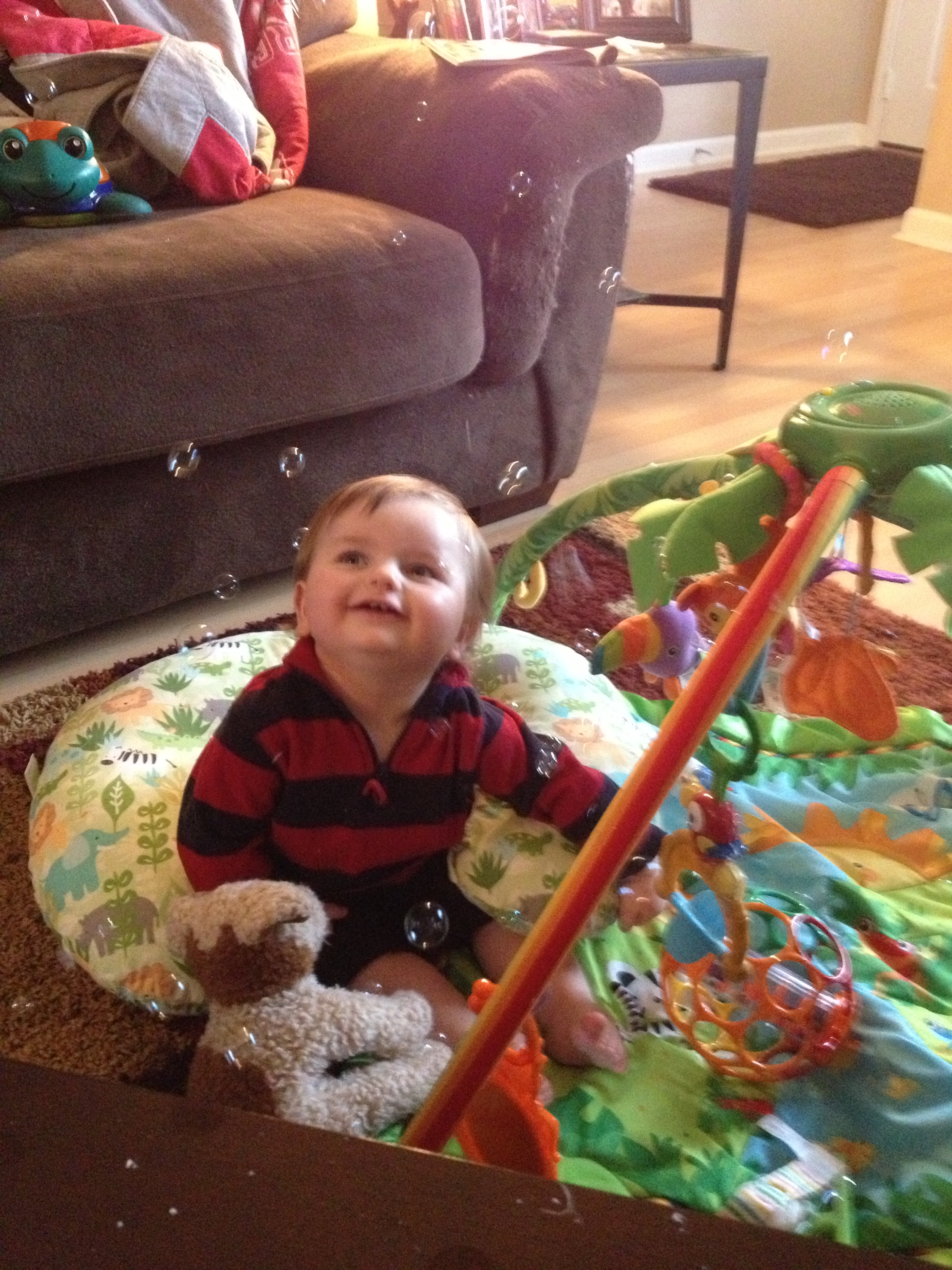
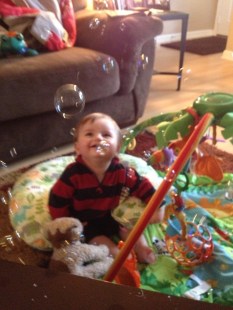
Connor can now stand when bracing himself against the couch, which is nice. He is also firmly into the “it’s fun to throw everything on the floor” phase, which is less nice. He started speech therapy last week, and I sense some of his grumbling will eventually form into four-letter words. His speech therapist brought him some awesome bubbles that are unlike your standard Target bubbles. These don’t pop as easily, allowing him to catch them, stack them, and for me to scrape them off furniture for days afterward. But look how much fun he’s having.
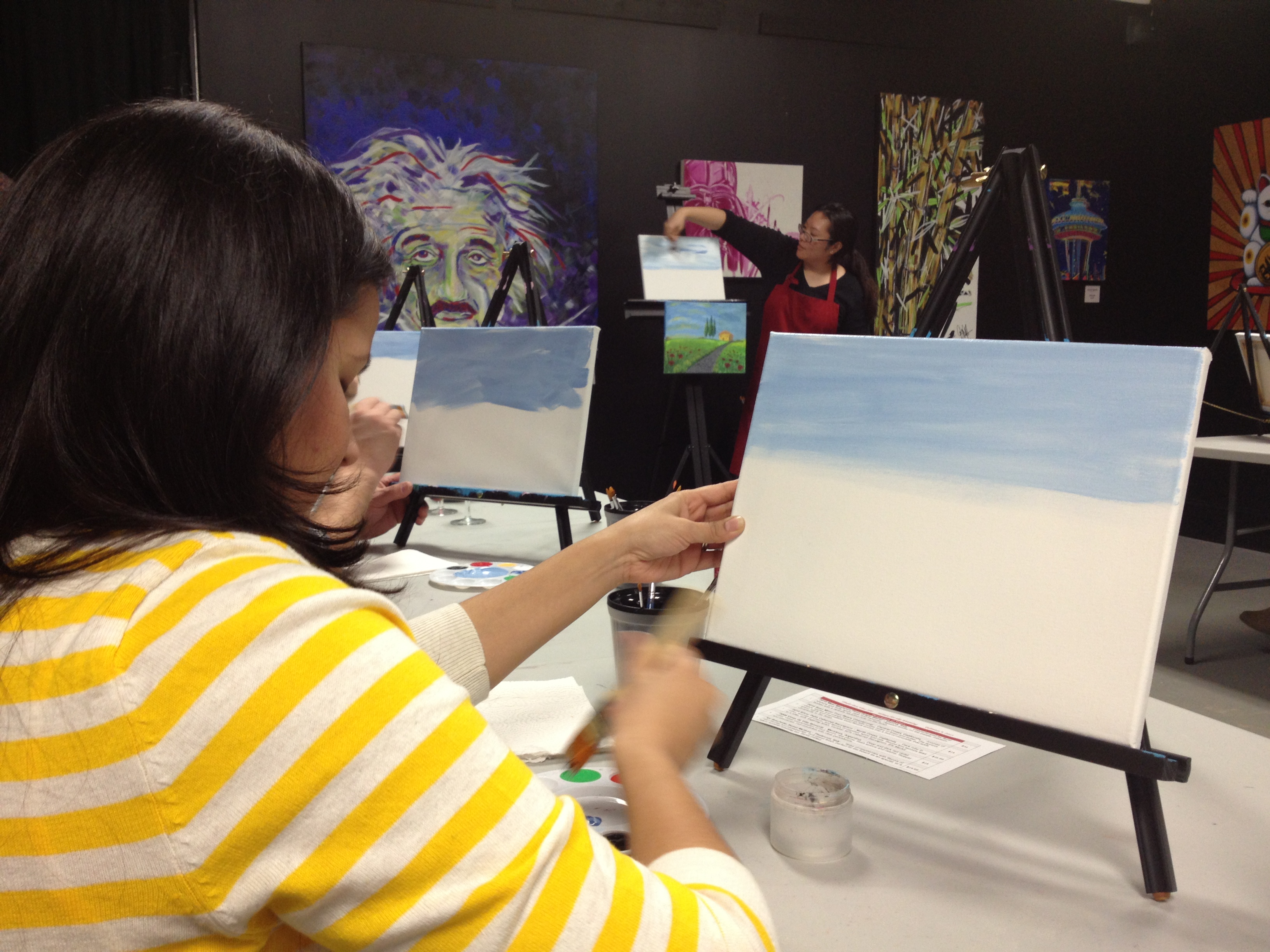
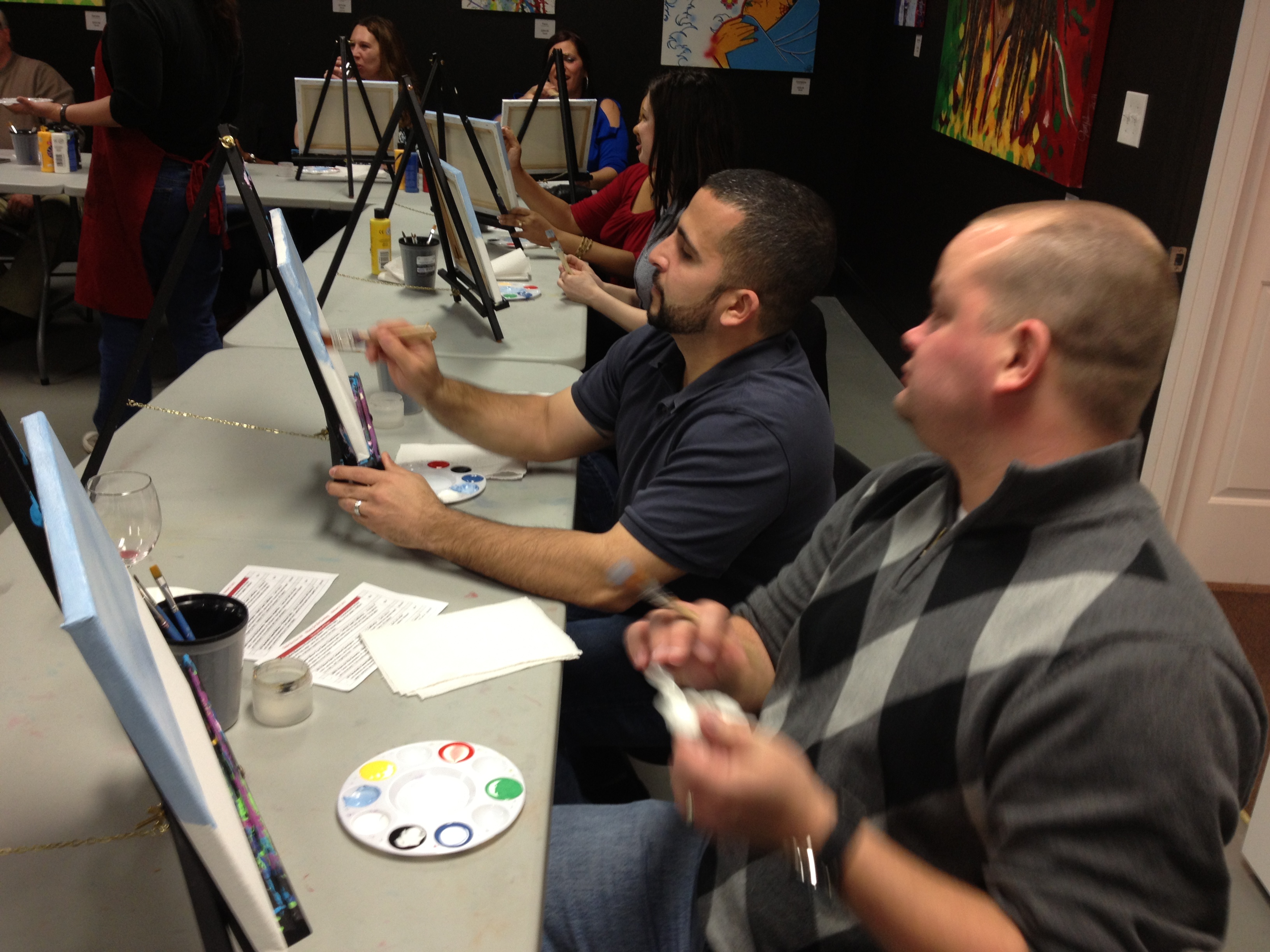
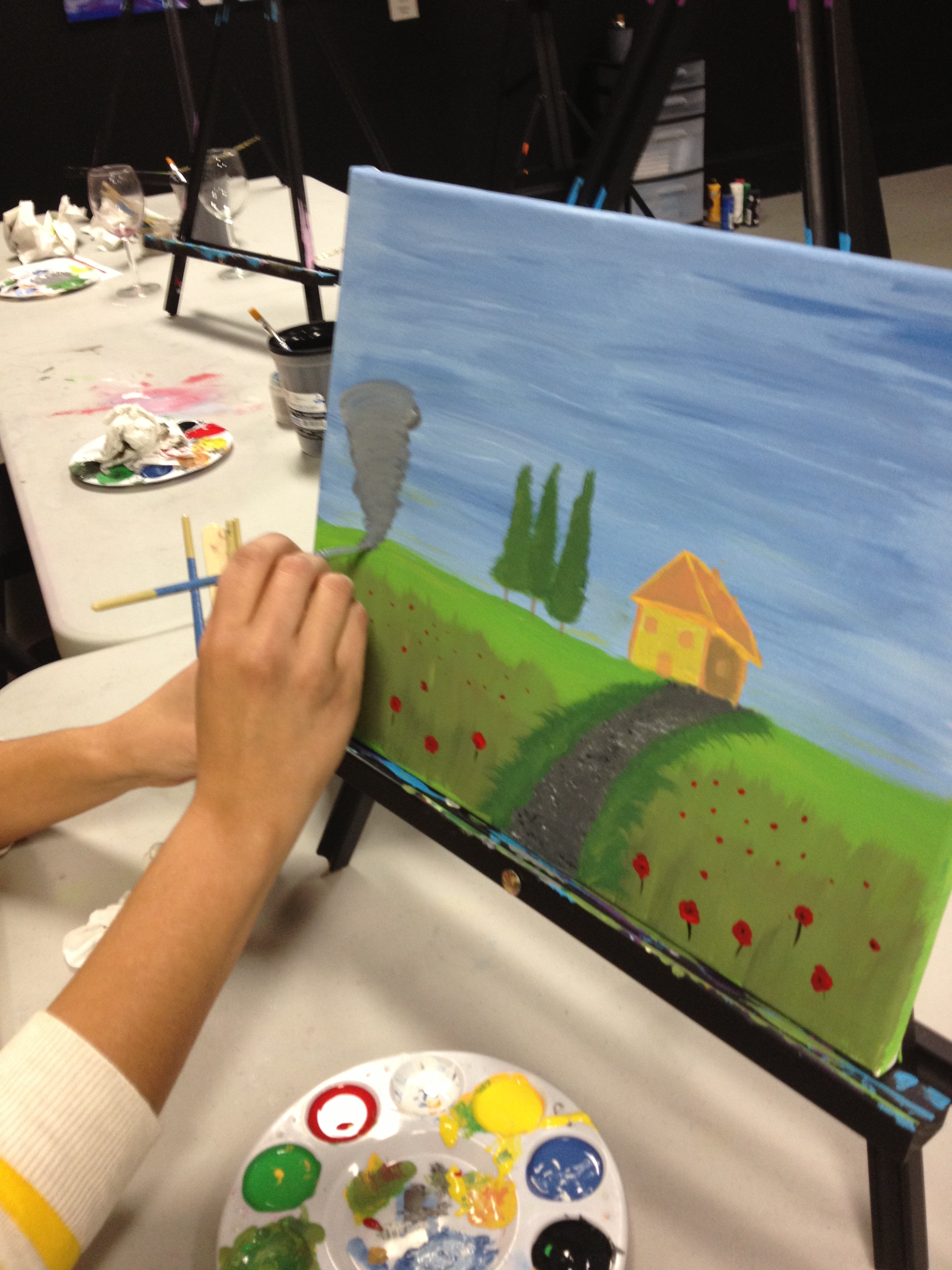
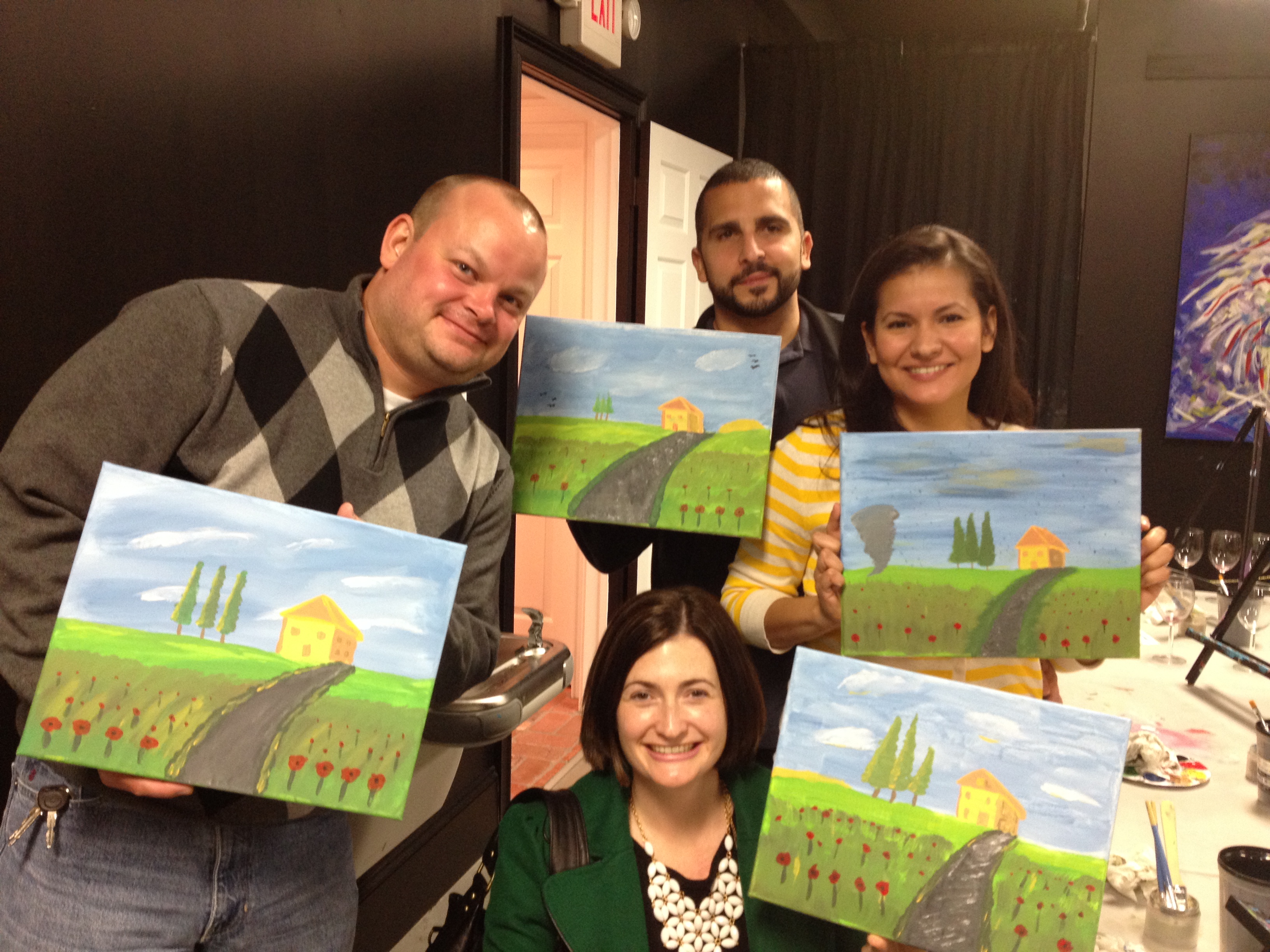
Meanwhile, in adult world, I’ve been trying to motivate myself to go out more. It’s so easy to be lazy and do nothing when it’s cold AND you have a kid. I actually had two social engagements in one weekend. I felt like I was 27 again! Chris and I attended a paint and wine tasting function at a local gallery with our friends Giovana and Damien, taught by our friend Yuri Strom (insert reference to Yuri so that when she’s famous I can prove I know her). I love the way each of our paintings shows our personality. My “I need to please by doing it right, but I’m trying to emulate a carefree lifestyle” painting, Chris’s “OCD everything must be symmetrical” painting, Damien’s “I’m just here for the wine, so my sun’s gonna set in the east if I feel like it” painting, and Gio’s “I’ll show you, happy Tuscan countryside, exactly what pain is” painting.
The next “morning” I went to Barcelona Wine Bar for brunch…at noon. We live in the Bible-thumping state of Georgia, and only just got Sunday alcohol sales. Of course the government still feels the need to regulate the hours that is permissible, so they can’t serve until 12:30, thereby destroying the essence (mimosas) of the brunch. So, I guess it was really breakfast for lunch. Oh well. I showed the gov’ment by ordering an entire bottle of wine.
One 45 minute test equals 4.5 hours in the hospital.
Ah, the electroretinography (ERG). a routine test you are supposed to have done every three months while taking Sabril (vigabatrin). You are also required to have an eye exam every three months because this particular drug carries a risk of loss of peripheral vision. Sabril has only been approved by the FDA for a few years. Before that you had to order it from Canada. But then it received approval here, the cost skyrocketed, it became heavily regulated, and it’s only available through specialty mail-order pharmacies. Many people resent being treated as if we’re too stupid to understand and take on the risks.
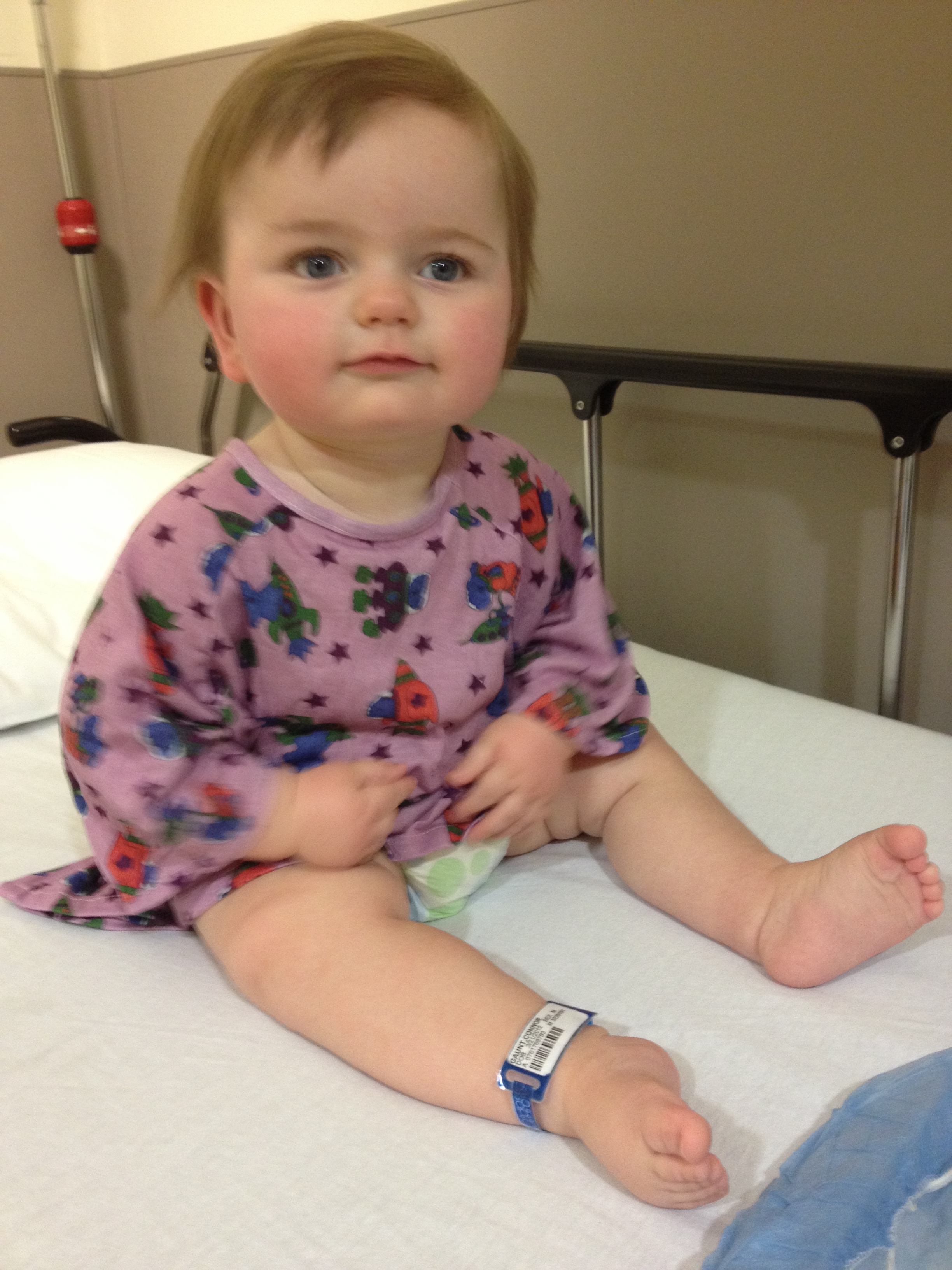
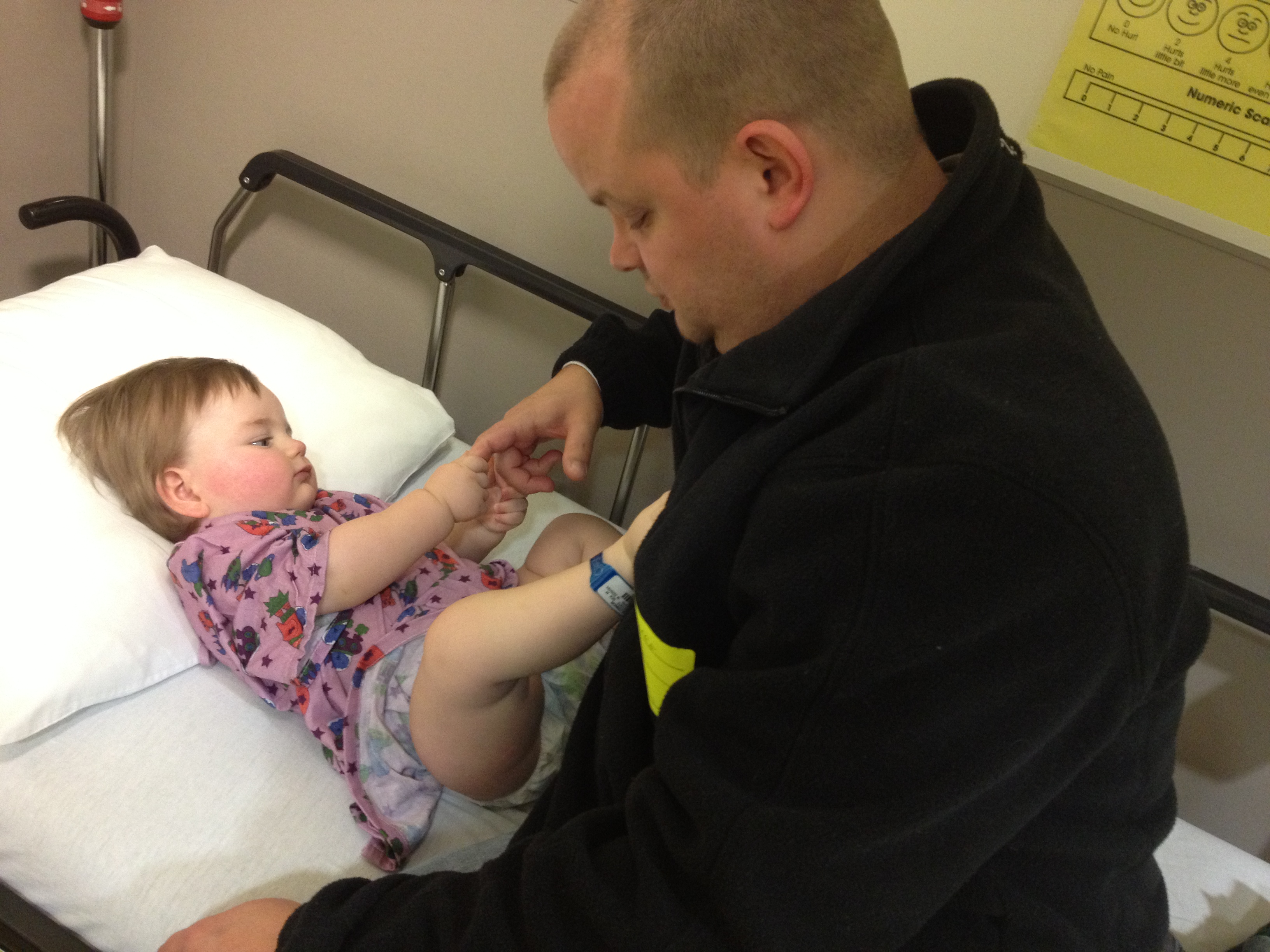
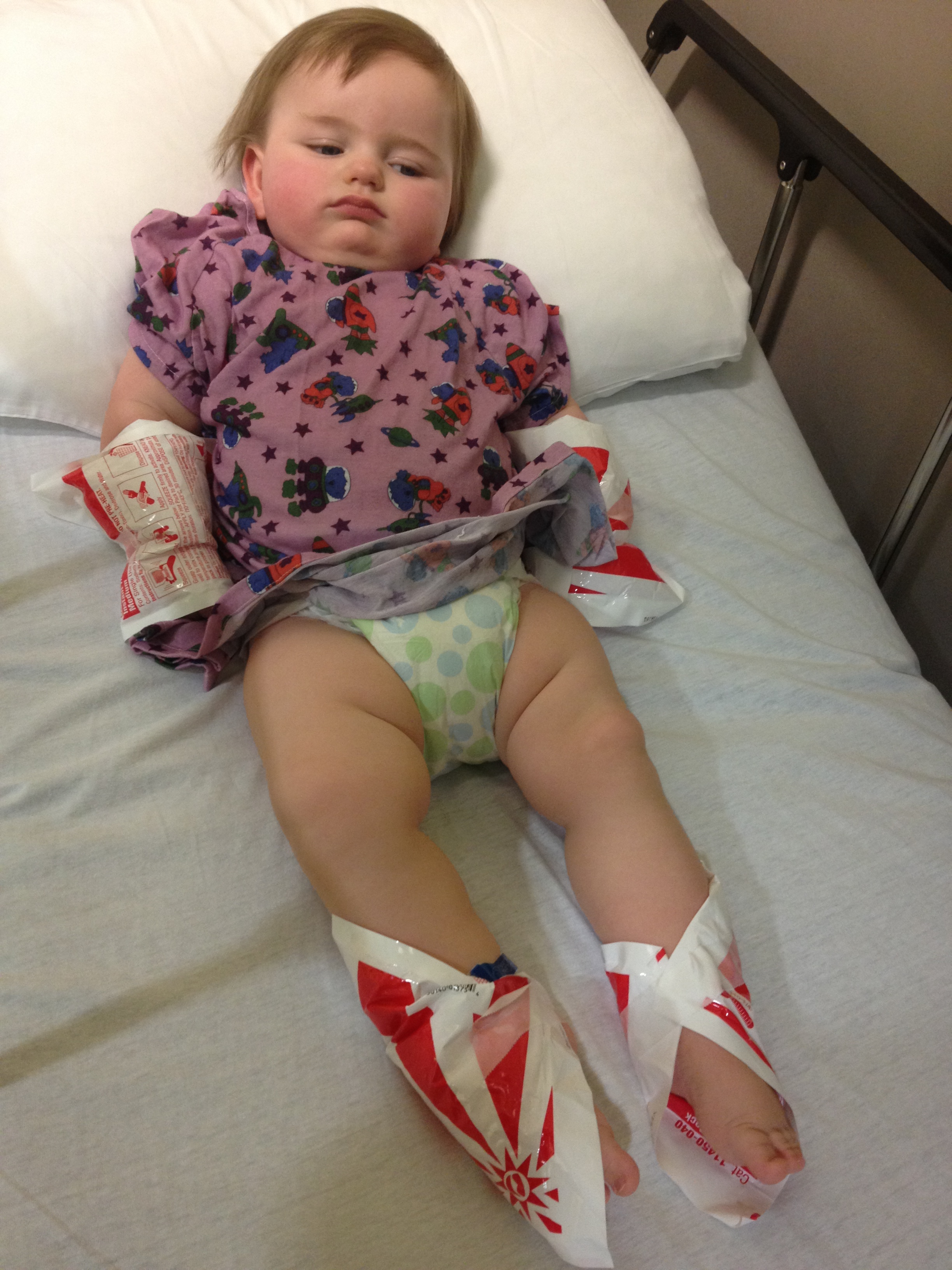
Given the risks, should we keep a close eye on the vision of our children? Certainly. But the intrusive nature of the ERG makes many families angry. It’s no simple test. We took Connor in for his second one yesterday (mmm hmmm, we’re behind schedule). We had to be at the hospital by 9 and get admitted through day surgery for a test that won’t start until 11. Yup, I told you it’s not a simple test. Then there is lots of information gathering, weighing, measuring, and finding a vein for the IV. Connor likes to make things difficult by hiding his veins. He always requires the IV team, rather than a regular nurse. Then we take him down to the room where they will place contacts in his eyes that test his reactions to stimuli. But he won’t be awake. He must be sedated with propofol (yup, Michael Jackson propofol). Once it’s over, we must wait for him to wake up and drink before they will pull out the IV and we are allowed to leave.
These tests and the frequency with which we are expected to undergo them frustrate a lot of people. We know there are risks to the peripheral vision. But we didn’t put our kids on this drug just for the heck of it. If someone is taking it, it’s for pretty dire reasons. The primary reasons I know of for its use are infantile spasms (why Connor is taking it) and frequent compex partial seizures that have not responded to other medications. Most people (based on my interactions on message boards) wouldn’t take their kids off this drug, even if they were told vision was being affected. Infantile spasms, left untreated, can cause major brain damage. What good is fantastic vision if your brain is fried? And the people taking it for other seizures have likely tried every cocktail in the book and are having so many seizures that their lives are being adversely affected to the extreme. So is being sedated every three months a bit much? You decide.
I’m not really freaked out by Connor being sedated, I guess because I’ve seen so much in his 10 months. I also know he’s being closely monitored. It’s not like Michael Jackson, who was abusing it with the help of a shady doctor. I just think the overregulation is an American agency assuming we are idiots. Should we keep an eye on vision? Yes. Every three months? Some people are on this drug for years. What hell. Especially if you are getting it through Accredo Pharmacy, specialty pharmacy of Medco. If so, you are probably already going through the monthly hell of securing your refill from this incompetent place.
Modeling high hospital fashion.
Heat packs to bring out the veins.Headed home with giant pupils.
We recently increased Connor’s dose of vigabatrin again in hopes of putting a dent in these eye rolling seizures. We are seeing some improvement. We actually had a day recently where we didn’t see any, which hadn’t happened in a while. We are also having more days in which we only see 1-2 clusters of eye rolling. But other days we see up to 4 or 5. Then again, for a while we were frequently seeing 4-6, so it’s definitely an improvement. His other seizure med is keppra. His neurologist is considering adding Onfi, and if it seems to help, we will wean him off the keppra.
Any TSC families reading this, I will be going to DC at the end of the month with volunteers from all over the country to meet with members of Congress regarding TSC research funding. I’m in need of personal stories and letters to your congress people. If you can help, e-mail me at pin.the.map@gmail.com. I can give you more details.
Thanks to everyone who has been voting for me to the right by clicking on the Top Mommy Blogs button.
You never know when or if something might spring up with TSC. We came so close after surgery to having some normalcy, but it wasn’t to be just yet. About a month after surgery, on Wednesday August 22, Connor had a follow up EEG. We hadn’t seen any seizures since surgery, and now we would see how he was doing as far as the subclinical seizures that can’t be seen to the naked eye. The neurologist would read the EEG and call us with the results within a week. But on Friday morning, August 24, the moment that had lost me countless hours of sleep and stress happened. We saw his first infantile spasms. I don’t even know how much desperate begging and praying I had done that he wouldn’t develop this complication. Infantile spasms are extremely rare in the general population, but kids with TSC are at a higher risk of developing them. I had watched countless YouTube videos other parents had loaded to help others with identification, so that I would be sure if the moment came. But why so much more concern over this seizure type than what he had before? IS can cause brain damage, prevent children from reaching milestones, and even cause regression. Some people had reported their babies had regressed to a newborn state after developing these, losing any milestones they had achieved.
I had obsessed and obsessed over how things would go when these started. How long would it take to get treatment rolling? How many would he have before treatment started to work? What damage would be done between the moment we first saw them and the moment treatment became effective? One thing I didn’t worry about was whether the drug I knew he would get if this happened, Sabril (vigabatrin). would work. I’d heard amazing things about its effectiveness. I’d even obsessed over whether they would start on a Friday after the neurologist’s office closed further complicating getting treatment started. If these had come out of nowhere, meaning we knew nothing of his TSC, these would warrant going to the ER to get treatment started. But since we already had a plan in place and a neurology team, we were told just to call the office and we’d get the ball rolling. So naturally, they started on a Friday. And the office closes early on Fridays. Did I mention I had a full blown anxiety attack on top of everything else? Because people were right. They said you’d know the spasms when you saw them. And I did.
It actually worked out well that the office was closed. Instead of going through medical assistants, I was able to directly page the doctor on call. I described what I saw and I could tell my description concerned him. They hadn’t yet reviewed his EEG, so he said he would look at that and call us back shortly. Confirmed. His EEG showed hipsarrhythmia, the scrambled pattern of brainwaves that often (but not always) accompany IS. They called in a prescription for Klonipin (clonazepam) for the weekend to help calm them, and we had the first appointment Monday morning to get him on Sabril. On the bright side, the surgery had been a success. No complex partial seizure activity. We should have been able to celebrate, but I try not to be bitter. Try.
It was a long weekend in which we saw 3-4 clusters a day (his worst day having 8). A cluster is a series of spasms. Monday morning we signed our life away on paperwork due to the fact that a possible side effect of Sabril is damage to or loss of peripheral vision. But as Wendi (the fellow TSC mom who has been there to help us and answer our questions through all this) said, “What good is 20/20 vision if their brain is mush?” I haven’t come across any stories yet about children experiencing this so hopefully he won’t either. Because of the risk, he has to undergo eye exams every three months as a precaution, including an ERG (electroretinography) at Scottish Rite. He has to be sedated and electrodes are used to check his vision. Can nothing be simple? You can’t even get Sabril at a regular pharmacy. It has to be Fedexed to your house.
After about a week and a half we seemed to be in the clear. We went three days with no spasms. Then the eye rolling started. It is now mid October and we are still trying to get a handle on the eye rolling. Presumably, they are milder spasms that are breaking through on the Sabril, but he’s doing well and continues to progress. While the full spasms were going on, he was quieter and it was harder to get a laugh, but he’s back to his giggly self. He underwent an 8-hour EEG to try and determine what was going on. Naturally, he didn’t have a single incident for the entirety of the test. Nope, not until we were in the car on the way home. I was so frustrated I might have driven my car into a tree had Connor not been in the car. But the EEG came back otherwise greatly improved, the hipsarrythmia having cleared up. So this Wednesday it’s back to the neurologist for an hour EEG (yeah right, like we’ll get lucky enough for something to happen in that small window) and an appointment to discuss his progress. I’ve been a little bit crushed that Sabril wasn’t the 100 percent miracle cure it has been for many others. I truly thought it would knock them out completely within a few days, so that we’re still seeing anything has been a bit crushing. That being said, it has immensely improved the situation and allowed him to continue on his developmental path.
Since Connor was diagnosed at birth as having a seizure disorder, he automatically qualified for the State of Georgia program Babies Can’t Wait. This program is great because it provides physical therapy in your home at a Medicare rate. There is a common misconception in the hospitals that it is free. It’s not, but it is typically covered by insurance. I’m guessing that misconception exists because most people’s insurance covers it. Since they charge the far more reasonable Medicare rates, I would think most insurance companies don’t make an issue of it. If we went for private therapy, we’d have to pay a co-pay, drive him there, and they would charge several hundred dollars an hour. We haven’t had to pay anything out of pocket. And if for some reason, insurance doesn’t cover it, they charge you a fraction of the Medicare rate based on your income.
Physical therapy session
Seizures can impede development because you can’t take in input during one, plus they make you sleepy, so this adds up to less alert time to learn. Connor also has somewhat low muscle tone due to his neurological condition so it takes him a little longer to master a new physical activity than the average baby. (His pediatrician says his tone has improved vastly since she first saw him and it’s not expected to have a major effect on him when he’s older). At his initial assessment, which was shortly after he turned two months, he was placed in the 0-1 month category due to head lag. This means that when pulled to a sitting position from lying down, his head fell back rather than staying even with the body. I already knew he wasn’t lifting his head on par with other babies his age, so I was very nervous. He also spent the first five weeks of life in a hospital bed which didn’t help. So the first goal we tackled in therapy were exercises that would help him strengthen neck and back muscles that would help him hold his head up. He owned a pilates ball already and I had never even tried pilates.
Besides the head, the biggest difference I noticed was how wobbly he was when holding him to my side. He didn’t hold himself as erectly as other babies, so we also worked on strengthening his core. I was pretty unnerved this whole time though. Even though nobody said this would be his case, I had come across situations in which people had such low muscle tone that they were in wheelchairs or had exceptional difficulty with physical activity.
Fortunately, we went forward with brain surgery on July 27. It was performed at Scottish Rite by Dr. Joshua Chern. Oh, we love Dr. Chern. I did not expect a neurosurgeon to have a bedside manner, but he had really blown us away when we met him in the NICU in April. Very approachable and interested in making sure we understood what would be done, as well as the risks. When he tried to show us the MRI, he was unable to retrieve it in the computer system, but instead of just giving us a quick run through so he could go on with his day, he said he’d be back in an hour because he wanted us to see exactly what needed to be done.
Before going off to surgery
Surgeon marking side of head for operation
He was back in about 40 minutes, and not only had he retrieved the MRI, but during that time he had spoken with Connor’s neurologist, as well as called a colleague for consult in another part of the country. Considering I feel like I have to call various medical offices eight times any time I need something medically related done, this kind of proactive go-getting was awesome. The tuber in the right frontal lobe was plain as day and according to the EEG, responsible for 80-90 percent of the seizures. And perhaps removing it would help lessen the few that were coming from the rear left occiptal lobe. It wasn’t too deep and he was confident it wouldn’t have any long term effects on him. It’s location was in a not very vital area, it was on the surface, plus at this age the brain can compensate by using other parts of the brain instead.
A little after his four month birthday we checked in for surgery at 6 am on a Friday morning. He went back at 8 am for another MRI in the operating room and the surgery was underway by 10. My parents and Chris’s sister came to the hospital for support and as we sat at the lobby Starbucks it became apparent that Chris wasn’t talking. His nervousness was palpable. I can’t really explain why I was as calm as I was (other than that I had started back on my anxiety pills a few weeks prior :). I was the mess during the NICU and Chris kept it together. Now the roles were reversed. Although his version of being a mess is much more pleasant than mine. I was just looking forward to having some sort of resolution finally. Although I will say the backpack full of thank you notes to be written and magazines to be read didn’t get touched. I wasn’t THAT good, despite hourly calls from the OR to let us know everything was going fine.
Being wheeled out of surgery
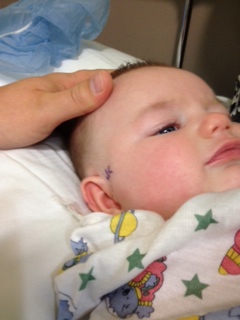
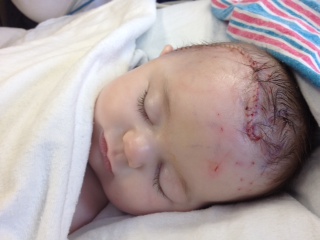
The day after surgery
Dr. Chern came to speak with us shortly after one o’clock when they finished. Everything had gone smoothly and the plan was to keep him in ICU that night and on the seizure floor until Monday. And then Connor became a rock star.
If you couldn’t see it, you wouldn’t know he’d had brain surgery. I’m a bigger baby over a headache. Surgery? I’d probably be ringing a bell and demanding to be waited on for six months. The only time he fussed was the next day when the swelling started and you could see his face getting tight. Once we told the nurse to give him the meds regularly, he was fine (side note: we actually had to tell them to give pain meds to him. We assumed that would be automatic after drilling into his head, but apparently not). Even then, all he had was tylenol and motrin. Man, even I got percocet automatically for pushing him out.
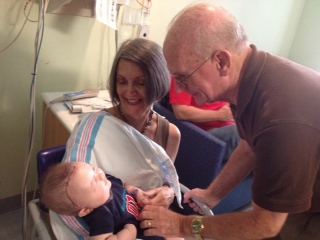
My parents with Connor after surgery
So I spent the weekend sleeping in his room, further mastering my craft of reattaching leads to his chest that would come loose and wake me up every couple hours with their incessant beeping. I relearned what the various alarms meant and which ones I could silence myself as they received no response from anyone on duty. I also enjoyed pretending to be asleep during shift change when the two nurses would peek in and talk about how cute my baby is. And finally, on Monday he went home. We haven’t seen another complex partial since, and his motor skills picked up immediately. His head was up, his core was steadier, he began to laugh more and an already awesome personality became even more incredible. He’s currently six months, getting close to seven months, and he’s well on his way to sitting independently.
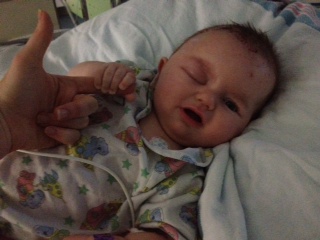
Back home three days after surgery
By the way, I was nursing a headache as I wrote this, but pushed on because my kid has made it clear I’m a big wimp.
Has someone ever pointed out a new car model to you that you’d never seen before and suddenly you saw it everywhere you went? That’s kind of how I feel about sick children. Now that we have to contend with Connor’s health issues, I feel like everywhere I look I see people with sick kids. It’s a cruel, messed up world if the countless prayer pages for children on Facebook are any indication. Not to mention the time I’ve spent in hospitals seeing other people’s children wheeled around with tubes sticking out of them or minus their hair. Sometimes I think if I’d had this awareness before I got pregnant, I never would have had a kid at all. But now that he’s here, I wouldn’t give him up for anything. I just hope there really is something better waiting for us all in the end, or I’m going to be really ticked.
So what is TSC? Tuberous sclerosis complex is a rare multi-system disease that can cause benign tumors to grow in various organs including the brain, heart, lungs, kidneys, eyes, and skin. It CAN cause retardation or learning disabilities, autism, seizures, behavior issues, OCD, ADHD, kidney issues, lung problems and skin lesions. But every individual’s course with TSC is different. There is a full range of the severely afflicted that need constant care to those who are so mildly affected they may not even know they have it until they have a child who presents more severely.
I’ve heard many describe it as walking through a minefield. It’s a pretty apt description. We basically have a long list of things that MIGHT happen. Or they might not. Seizures. Check. Been there, done that. He started having complex partials the day he was born. Although I’m thrilled to say we haven’t seen any since surgery and none were on his most recent EEG. We are currently contending with infantile spasms, a very rare form of epilepsy seen in children, although more frequent in TSC. He’s been on Sabril for about a month now which has helped considerably, but he still has 1-2 breakthrough clusters a day which are much, much milder than what he was having. These are scary though because even though he will eventually outgrow them, they have potential to be extremely damaging and cause regression. Fortunately we’ve seen none of that and he continues to progress. We’re still working with the neurologist to get these under control. I’ll go into these more in a separate entry.
But that TSC minefield I mentioned? It means that even though the spasms will eventually go away, and even though the surgery was successful, there is no guarantee for the future. Some people’s seizures go away for good, some go 2, 10, 20 years before it happens again.
Currently we’re lucky (lucky in the most screwed up sense of the word) because we’re only dealing with brain involvement. His cardiac rhabdomyoma we saw on the ultrasound cleared up by three months old. They told us it would happen by the time he was in his early teens, so we like to think that it happened so quickly is a good sign. I just wish all the organs worked that way.
His kidney and eye scans at birth came back clear. Both have been checked again in the last month and remain clear. Lung involvement is rarer in males (thank God for small favors), but can be very problematic for females (Google LAM). He also doesn’t show any signs on his skin. The eyes may show signs of TSC, but rarely affect vision (the boy will have glasses anyway thanks to his parents). But for the rest of his life he will require annual MRIs of the brain and kidney scans so that if there are any life threatening growths, they can be treated immediately with some of the amazing new medications that have come about in the last decade for TSC or by surgical intervention.
But what is causing this? Two genes have been identified so far as being involved in tuberous sclerosis. Mutation of chromosome 9, which regulates the protein hamartin, results in a diagnosis of TSC1. Mutation of chromosome 16, which regulates the growth of tuberin, results in a diagnosis of TSC2. These proteins are growth supressors in cells, and the chromosomal damage results in the growth of the tumors seen in TSC. Connor has TSC2.
Why does he have it? After meeting with a genetic counselor after his birth, the thought was that he is most likely a case of spontaneous mutation, as are the majority of cases. There was nothing in our family histories to indicate that it has been passed down. That being said, unless Chris and I undergo genetic testing, we can’t be 100 percent sure neither of us has a mild case of it. Indeed, one of us COULD be a spontaneous mutation and passed it on to him. It is a dominant gene, so if you have it, your children have a 50 percent chance of inheriting it. The degree to which the parent is affected doesn’t foreshadow the degree to which a child will be. We don’t currently plan to have any more children, so we probably won’t be tested. Chris has no desire to know, and although I’m curious, I don’t know how I would handle that information. It sure makes you analyze yourself, though. Is TSC why I’ve had anxiety since elementary school? It this why Chris makes the bed military style and is constantly angling everything in the house just so? At any rate, I’m probably forever cursed to wonder if I could have done something different. I know I didn’t DO something wrong, but the questions are there. What if I had spent the last few years eating organic? Did I expose myself to something environmental somewhere along the way?
We simply don’t know what lies ahead, so I focus on this sentence from the Mayo Clinic website: “With appropriate treatment, however, many people who have tuberous sclerosis lead full, productive lives.”






 Mixed Up Mommy